
You aren’t just struggling with debt; you’re fighting a system designed to keep your bank account empty through relentless ACH withdrawals and interest rates that can soar as high as 400 percent. It’s exhausting to wake up every morning wondering if a lender will drain your remaining balance before you can even buy groceries. Understanding the critical differences between payday loan consolidation vs settlement is the first step toward reclaiming your financial agency and escaping this trap.
We understand the pressure of aggressive collection tactics and the confusion that comes with choosing the right exit strategy. You deserve a clear path out of this cycle. In this guide, we’ll compare these two paths so you can stop the high-interest rollovers, secure your bank account from predatory withdrawals, and transition into a single, affordable monthly payment plan that fits your life in 2026. By the end of this article, you’ll have the knowledge necessary to protect your income and choose the most effective strategy for your specific situation.
Key Takeaways
- Understand the fundamental choice between payday loan consolidation vs settlement, distinguishing between merging payments for stability and negotiating balances for a hard reset.
- Learn how to stop the cycle of predatory withdrawals by revoking ACH authorizations and regaining control over your bank account immediately.
- Discover a clear decision framework that helps you choose the right path based on your monthly budget, desired timeline, and the long-term impact on your credit score.
- Explore the mechanics of how an intermediary can simplify multiple high-interest due dates into one manageable monthly installment.
- Identify how to integrate credit card debt into your plan for a unified exit strategy that secures your financial freedom in 2026.
Defining the Terms: Payday Loan Consolidation vs. Settlement
The predatory nature of short-term lending hasn’t changed, but the stakes in 2026 are higher than ever. With average APRs still hovering around 400 percent in many states, “doing nothing” is the most expensive financial decision you can make. Every day you wait, the interest compounds, often doubling your balance in just a few months. Choosing between payday loan consolidation vs settlement is about deciding whether you need a bridge to stability or a total hard reset. One manages the debt, while the other attempts to delete a portion of it.
Understanding Debt consolidation basics is your first step toward clarity. Consolidation targets the interest rate and the frequency of payments. It aims to stop the cycle of daily bank withdrawals that leave you with nothing for essentials. Settlement, on the other hand, targets the principal balance itself. It’s a negotiation where the lender agrees to accept less than what is owed to close the account forever. Each path has distinct mechanics and consequences for your financial future.
What is Payday Loan Consolidation?
A payday loan consolidation service acts as a protective shield between you and your lenders. Instead of juggling five or six different due dates, your debts are merged into a single, manageable monthly plan. You aren’t necessarily taking out a new loan; rather, you’re restructuring the existing ones to eliminate “rollover” fees and predatory interest rates. This approach focuses on consistent, managed payments. It’s designed for those who have some steady income but are currently being suffocated by the sheer frequency of high-interest withdrawals.
What is Payday Loan Debt Settlement?
Settlement is frequently categorized as a payday loan relief “last resort.” It involves a strategic process where you stop making regular payments to force the lender to the negotiating table. Because you’re no longer paying the full amount, the lender may eventually agree to a lump-sum settlement or a pro-rata payment plan for a fraction of the original debt. This path is often reserved for individuals facing a total cash-flow collapse. While it can result in significant principal forgiveness, it requires a willingness to default on the original terms to prove financial hardship.
The Mechanics of Payday Loan Consolidation
Imagine waking up without the dread of five different lenders hitting your bank account on five different days. A payday loan consolidation service makes this possible by acting as a professional intermediary. Instead of you fighting the lenders alone, the service takes over the communication, merging your various high-interest obligations into one structured plan. This transition provides immediate psychological relief. You move from a state of constant financial defense to a single, predictable monthly payment. When weighing payday loan consolidation vs settlement, remember that consolidation focuses on restructuring your current debt rather than defaulting on it. It’s a proactive way to manage the typical features of these high-cost products, as detailed by the CFPB on payday loans.
The “Consolidation Advantage” is about more than just convenience. It’s about preserving your financial reputation. By avoiding charge-offs, you keep your credit report clean of the most damaging indicators. Many lenders view a successfully managed consolidation plan as a sign of financial responsibility. To see the math for yourself, using a payday loan consolidation calculator allows you to visualize exactly when you’ll be debt-free. It turns a vague hope into a concrete timeline.
How the Consolidation Process Works Step-by-Step
The journey begins with a thorough assessment of your active payday and credit card accounts. Your advocate reviews every balance and interest rate to build a comprehensive map of your debt. Next, they negotiate directly with lenders to secure lower interest rates and waive predatory fees. Finally, you set up a single-payment management account. Instead of multiple withdrawals, you make one payment to the service, which then distributes the funds to your creditors according to the negotiated terms. You can calculate your potential savings today to see how much breathing room you can gain.
Who Should Choose Consolidation?
This path is ideal for borrowers with a steady income who can afford a reduced, single monthly payment. It’s particularly beneficial if you want to protect your credit score for future goals like buying a home or a car. Because you continue to pay the principal, you avoid the “settled” or “default” marks on your credit report. It’s the right choice for those who want to stop lender harassment and regain control without the long-term scar of a settlement mark. If you’re unsure which path fits your budget, comparing payday loan consolidation vs settlement through a lens of long-term credit health is essential.
The Reality of Payday Loan Debt Settlement
Debt settlement is a heavy-duty financial tool. It’s often positioned as a payday loan relief “last resort” for those who are one step away from considering bankruptcy. While consolidation focuses on making payments manageable, settlement seeks to reduce the total amount you owe. This creates what professionals call the “Savings Gap.” You’re essentially asking the lender to accept a portion of the principal balance and forgive the rest. However, this forgiveness comes with strings attached. The IRS considers any forgiven debt over $600 as taxable income, meaning you might trade a payday loan balance for a tax bill at the end of the year.
The risk of litigation is another factor that sets this path apart. When you stop paying to force a negotiation, some lenders may choose to sue rather than settle. This is a high-stakes environment that requires professional guidance. While Forbes on debt consolidation notes that restructuring is often safer for your credit, settlement is for those whose cash flow has completely collapsed. Deciding between payday loan consolidation vs settlement requires you to be honest about your tolerance for aggressive collection calls and potential legal threats during the negotiation phase.
The Settlement Timeline and Credit Impact
Lenders rarely negotiate when you’re current on payments. Most accounts must be at least 90 days past due before a lender considers a settlement offer. This “waiting period” is when your credit score takes the hardest hit. Once a deal is reached, your credit report won’t say “Paid in Full.” Instead, it will show as “Settled for less than full balance.” This mark remains on your report for seven years. It’s a temporary score drop that many accept as a necessary trade-off for becoming debt-free, but it’s a significant difference from the credit-preserving nature of consolidation.
Negotiation Strategies for Settlement
Success in settlement depends on leverage. Having professional representation is critical when dealing with aggressive “cycle” lenders who use automated collection systems. Lump-sum offers are almost always more effective than asking for an extended settlement payment plan. Lenders want the certainty of immediate cash. You must also ensure every agreement is received in writing before you send a single dollar. Verbal promises from collection agents are worthless. Once you have a written contract, the account is legally closed, protecting you from future collection efforts on that specific debt.
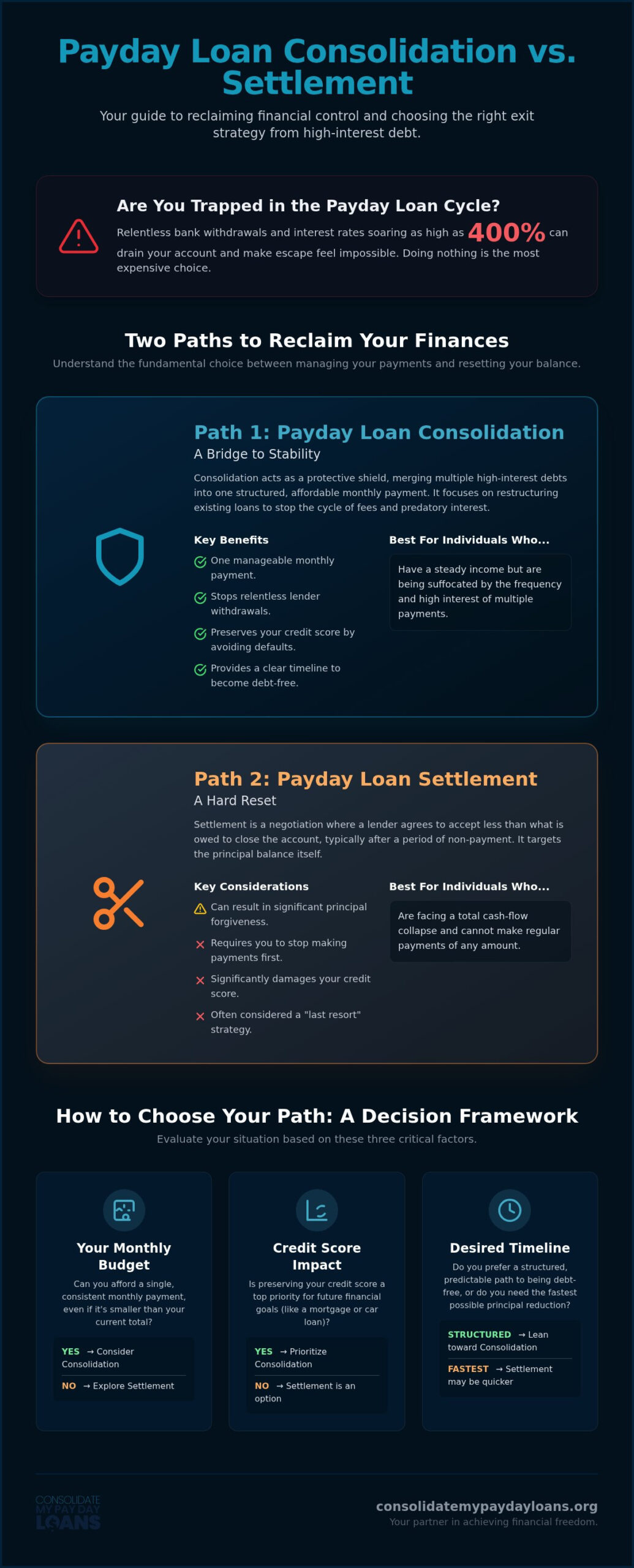
Choosing Your Path: A Decision Framework
Choosing between payday loan consolidation vs settlement isn’t just a mathematical exercise; it’s a decision about your life’s trajectory over the next twenty-four months. To find the right path, you must be honest about your current cash flow and your future goals. If you have a steady income and want to pay back what you borrowed at a fair rate, consolidation is your bridge to stability. However, if your bank account is already in the red every month, settlement might be the emergency brake you need to stop the descent toward bankruptcy.
Your timeline also dictates your strategy. Consolidation typically takes twelve to twenty-four months of consistent payments to reach zero. In contrast, settlement can sometimes be completed in six months if you have access to a lump sum of cash. You must also consider your upcoming credit needs. If you’re planning to apply for a mortgage or a car loan in the next two years, the credit-preserving nature of consolidation is a significant advantage. For many, a unified exit strategy that combines credit cards and payday loans offers the most comprehensive relief by maximizing your daily cash flow. You can begin your path to recovery by evaluating which of these variables matters most to your family.
Consolidation vs. Settlement: Side-by-Side Comparison
- Monthly Payment Affordability: Consolidation requires a medium-sized payment that covers the full principal over time. Settlement payments are often lower because you’re only paying back a fraction of the original debt.
- Total Cost of Debt: Consolidation involves paying the full principal plus a reduced interest rate, often between 6% and 36%. Settlement costs less in total dollars but carries a much higher price in terms of credit damage.
- Stress Level: Consolidation is a managed, quiet process. Settlement involves a high-stress negotiation phase where you must endure collection calls while your accounts are in default.
Common Pitfalls to Avoid in Both Paths
Don’t fall back into the “rollover” trap while you’re enrolled in a relief program. Taking out a new payday loan to cover your program payment will only reset the predatory cycle. You should also be wary of any company demanding large upfront fees before they provide help; legitimate services only charge for results. Finally, don’t ignore the payday loan hardship program options that some lenders offer directly. While these are often limited, they can sometimes provide a temporary reprieve while you finalize your long-term strategy for payday loan consolidation vs settlement.
Regaining Control: How to Start Your Exit Strategy
Taking the first step toward financial recovery requires more than just a decision; it requires a tactical shift in how you handle your income. The predatory cycle depends on your passivity. By organizing your debt and understanding the nuances of payday loan consolidation vs settlement, you begin to act as the primary authority over your own finances. Start by listing every lender, current balance, and interest rate. Seeing the numbers in black and white often reduces the psychological weight of the debt and allows you to choose a partner that understands the specific pressures of unsecured, high-interest obligations.
Adopting a payday loan consolidation instead of bankruptcy mindset is a strategic move for your long-term stability. It’s about finding a path that resolves the crisis without the decade-long shadow of a bankruptcy filing. This proactive approach ensures you’re moving toward a unified solution that can also incorporate credit card debt, simplifying your recovery into one manageable stream.
How to Stop the Bleeding Immediately
The most critical move you can make today is revoking your ACH authorization. This stops lenders from automatically draining your bank account the moment your paycheck arrives. You must draft a formal ACH revocation letter and send it to both the lender and your bank. While many banks allow you to stop payments online, a formal written notice provides a legal paper trail that protects you if the lender attempts to bypass your request. If a lender continues to attempt unauthorized drafts despite your revocation, opening a “clean” bank account at a different institution is often the most effective way to secure your income. Revoking ACH does not cancel the debt but does give you control over when you pay.
Taking the First Step with Consolidate My Payday Loans
Our experts specialize in evaluating the specific mix of predatory debt that keeps families trapped. We don’t offer “new” loans that simply move the problem around. Instead, we provide transparent consolidation plans that focus on reduction and management. We look at your total financial picture to ensure your new monthly payment is actually affordable. There are no hidden fees or predatory surprises; our goal is to serve as your advocate and guide toward a debt-free life. Your recovery doesn’t have to be a solo struggle. You can get your free payday loan debt assessment today and begin the process of choosing the right path in the payday loan consolidation vs settlement debate.
Your Path to a Debt-Free Future Starts Now
Financial freedom in 2026 isn’t a distant dream; it’s a series of deliberate choices you make today. Whether you prioritize preserving your credit through consolidation or need the hard reset of a settlement, the key is to act before predatory interest rates drain your remaining resources. Navigating the choice of payday loan consolidation vs settlement requires a clear understanding of your monthly cash flow and long-term objectives. By revoking ACH authorizations and organizing your debts, you’ve already begun the process of reclaiming your personal agency.
You don’t have to face aggressive lenders alone. Since 2004, our expert negotiators have provided A+ rated debt management support to help families escape the high-interest trap. We offer a no-obligation debt savings estimate to show you exactly how much breathing room you can gain. It’s time to stop the daily stress and start building a stable, predictable future. Stop the Payday Loan Cycle Today and take the first step toward lasting peace. You have the tools and the knowledge; now, let’s secure your financial ground together.
Frequently Asked Questions
Is payday loan consolidation better for my credit than settlement?
Consolidation is generally better for your credit health because it involves paying back the full principal balance over time. Settlement requires you to default on your original agreements, which results in a significant score drop and a “settled for less” mark on your report for seven years. Consolidation allows you to merge your debts into a single plan while avoiding the damaging charge-offs that often follow a settlement strategy.
Can I consolidate my payday loans if I have bad credit?
Yes, you can absolutely consolidate your payday loans even if your credit score is low. Our programs don’t rely on traditional credit checks for approval because they aren’t new high-interest loans. Instead, we focus on your current income and your ability to manage a single, reduced monthly payment. This approach allows individuals with poor credit to stop the predatory cycle and begin rebuilding their financial standing immediately.
What happens if I stop paying my payday loans to start a settlement?
If you stop making payments to force a negotiation, your accounts will fall into default and your credit score will decline rapidly. You should expect an increase in aggressive collection tactics, including frequent phone calls and letters from lenders. Most creditors won’t even consider a settlement offer until the debt is at least 90 days past due. This period can be stressful and requires professional guidance to manage the pressure.
How much can I save with payday loan consolidation vs. settlement?
The math of payday loan consolidation vs settlement reveals different types of savings. Consolidation saves you thousands of dollars by eliminating rollover fees and reducing interest rates to manageable levels while you pay the principal. Settlement can reduce your actual principal balance by a significant percentage, but you must account for potential tax liabilities on forgiven debt over $600 and the long-term cost of a damaged credit score.
Will payday loan consolidation stop lenders from calling me?
Professional consolidation programs act as a protective intermediary between you and your lenders, which typically stops the harassment. Once you’re enrolled, your advocates handle the communication and negotiation with your creditors directly. This shift moves your accounts into a structured management plan, giving lenders the assurance of a payment schedule. This usually ends the daily cycle of aggressive collection calls and provides you with immediate psychological peace.
Can I consolidate credit card debt and payday loans together?
Yes, merging these two types of unsecured debt is a highly effective way to maximize your monthly cash flow. Our unified exit strategy allows you to combine high-interest credit card balances with your payday loans into one manageable stream. This comprehensive approach simplifies your financial life and ensures that your single monthly payment is distributed strategically across all your accounts to eliminate your total debt as quickly as possible.
How long does it take to become debt-free through settlement?
The timeline for settlement typically ranges from six to thirty-six months depending on how quickly you can save funds for lump-sum offers. The process involves a strategic “waiting period” where you accumulate cash while your accounts are in default. Once you have enough saved, negotiations begin for each individual loan. While this can be faster than some consolidation plans, it involves navigating a high-stakes environment where lenders may choose litigation.
Is there a way to get out of payday loans without taking another loan?
You don’t need to take on new debt to escape the predatory cycle. Our payday loan relief programs focus on restructuring your existing balances through expert negotiation and budget management. We help you revoke ACH authorizations to secure your bank account and then establish a payment plan that fits your actual income. This method allows you to resolve your original obligations without the risk of a new high-interest loan.