
What if the legal “fresh start” of bankruptcy is actually a ten-year anchor that keeps you from ever owning a home or a reliable car? It’s a question more Americans are asking as bankruptcy filings rose nearly 12% in early 2026. You’re likely exhausted by the relentless cycle of 400% interest rates and the anxiety of watching your bank account empty every payday through aggressive ACH withdrawals. It feels like there’s no way out but the nuclear option of a court filing. However, choosing payday loan consolidation instead of bankruptcy offers a more surgical way to reclaim your agency without destroying your credit for a decade.
You can break the predatory cycle and protect your financial future by moving toward a single, manageable monthly payment. In this article, you’ll discover how to stop the drain on your bank account, negotiate with lenders, and preserve your credit for future needs like housing or a new vehicle. We’ll explore a strategic exit plan designed to help you regain control and find lasting relief from high-interest debt without the long-term damage of a legal filing.
Key Takeaways
- Understand why the “10-year shadow” of bankruptcy is often unnecessary when you can use a strategic exit plan to resolve debt in a fraction of the time.
- Learn how choosing payday loan consolidation instead of bankruptcy allows you to protect your credit score for future housing and vehicle needs.
- Discover the immediate first step to “stop the bleeding” by revoking ACH authorizations and ending aggressive bank account withdrawals.
- Gain clarity on your financial situation by using a specialized calculator to turn overwhelming multiple debts into one affordable monthly payment.
- Leverage the power of expert negotiation to break the predatory interest cycle and finally regain personal agency over your financial life.
The Payday Loan Debt Trap vs. the Decision to File Bankruptcy
The anatomy of the debt trap is simple but devastating. When you take out a payday loan, the interest rate often exceeds 400% APR. This means that after just two weeks, you owe the original amount plus a fee that often forces you to roll the loan over into a new one. This cycle repeats until you’re paying hundreds of dollars every month just to keep the debt from growing, without ever touching the actual balance. Many people feel backed into a corner where they believe legal action is the only way out. However, exploring Debt consolidation offers a pathway to resolve these obligations without the long-lasting stigma of a court filing.
Why Payday Loans Feel Like a Financial Dead End
Triple-digit interest rates ensure that your payments barely cover the interest. When you have multiple lenders, they create a financial cross-fire in your bank account, each trying to pull funds via ACH withdrawals before the others. This leads to cascading overdraft fees and a sense of total loss of control over your own income. The payday cycle is a systemic trap designed to keep you borrowing, not a personal failure of character or budgeting.
The Reality of Filing for Bankruptcy
Bankruptcy is often called the nuclear option because it stays on your credit report for up to ten years. While it might stop the immediate collection calls, it comes with heavy upfront costs. In 2026, attorney fees and court filing charges represent a significant hurdle for someone already in financial distress. You also have to choose between Chapter 7, which may involve liquidating assets, or Chapter 13, which requires a multi-year repayment plan overseen by the court. Total bankruptcy filings rose by 11.9% in the 12-month period ending March 2026, showing that more Americans are reaching their breaking point.
Choosing payday loan consolidation instead of bankruptcy allows you to tackle the debt while keeping your financial privacy intact. Bankruptcy is a public record that can affect future employment and housing applications for years. Consolidation focuses on negotiating with your current creditors to create a manageable path forward that fits your actual budget. It’s a surgical recovery tool rather than a legal sledgehammer. By consolidating, you address the root cause of the interest trap without the decade-long shadow of a bankruptcy filing.
How Consolidation Works as a Strategic Bankruptcy Alternative
Consolidation is often misunderstood as simply taking out a new loan to pay off old ones. While that is one method, a strategic exit plan for payday debt is frequently about a new management structure rather than new debt. For many individuals trapped in the high-interest cycle, a professional relief program acts as a mediator. This process combines your various high-interest obligations into one manageable monthly payment. Instead of juggling five different lenders with five different due dates, you follow a single, organized path toward zero balance. This approach satisfies your financial obligations while preserving your legal rights, offering a dignified way to move forward without the oversight of a court trustee.
Relief Programs vs. Traditional Consolidation Loans
Many traditional lenders require a fair credit score to approve a consolidation loan. This creates a barrier for payday borrowers whose scores have already been impacted by the debt cycle. Professional relief programs, such as those offered through Solid Ground Financial, don’t rely on high credit scores. Instead, they focus on negotiating directly with your lenders to stop the accumulation of fees and reduce the total amount owed. By aligning your payment schedule with your actual pay dates, these programs stop the predatory cycle of re-borrowing. You can use a payday loan consolidation calculator to see how these negotiated payments compare to your current monthly drain.
Comparing the Two: Side-by-Side Analysis
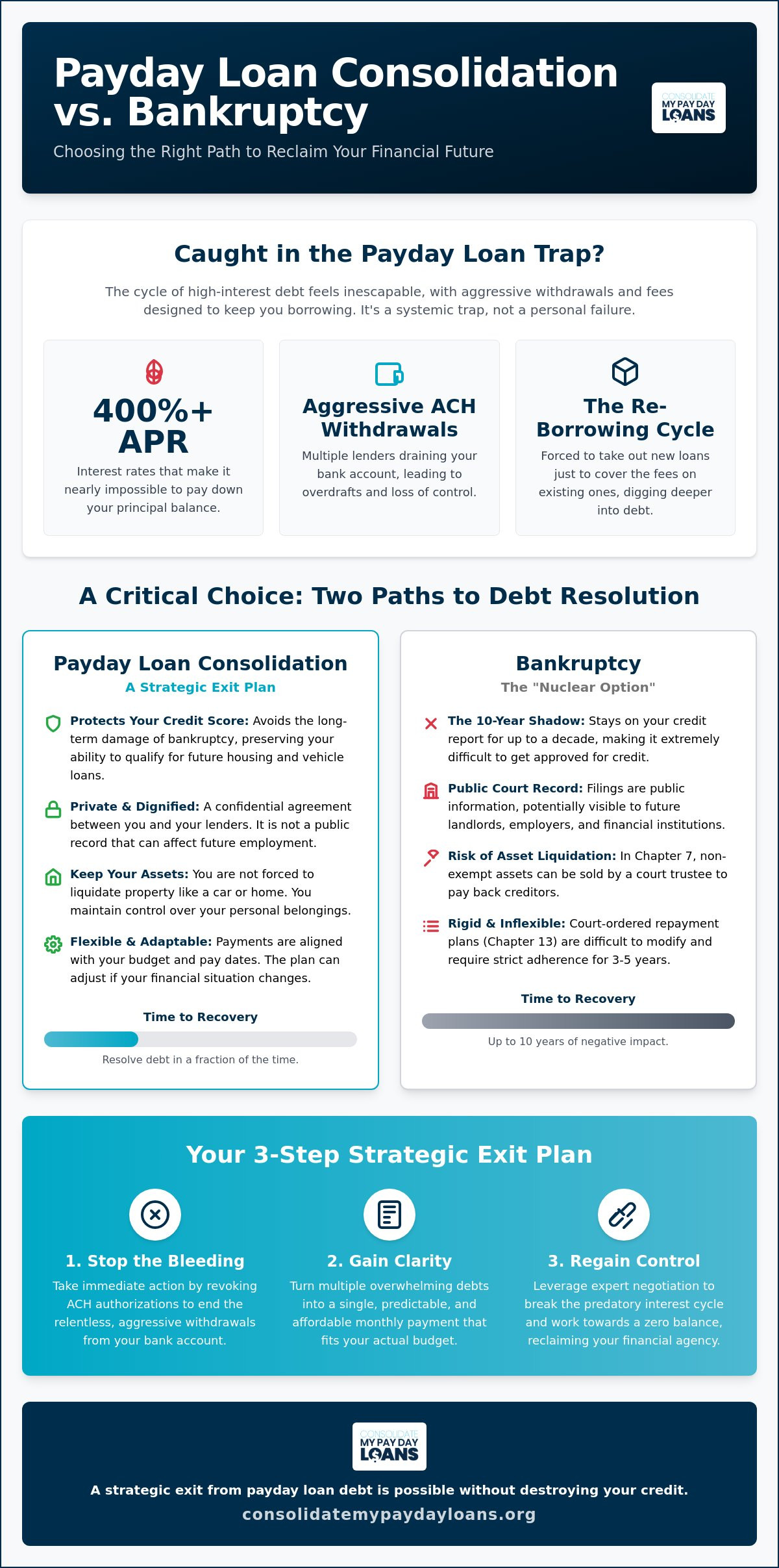
Choosing payday loan consolidation instead of bankruptcy allows you to maintain control over your personal assets. While bankruptcy involves a rigid legal framework described in the Bankruptcy Basics from the U.S. Courts, consolidation is a private agreement. It offers the flexibility to adjust if your income changes, whereas bankruptcy court orders are much harder to modify. Below is a comparison of how these two paths typically impact your life in 2026.
| Feature | Payday Loan Consolidation | Bankruptcy (Chapter 7/13) |
|---|---|---|
| Privacy | Private agreement; no public record. | Public record; visible to employers. |
| Credit Impact | Score can recover as debt decreases. | Negative mark for 7 to 10 years. |
| Asset Protection | You keep your car and home equity. | Assets may be liquidated or seized. |
| Upfront Cost | Minimal or no upfront fees. | High legal and court filing fees. |
Professional negotiation can often lower your total balance more effectively than a court order because it removes the adversarial nature of legal proceedings. Lenders are often willing to accept a structured settlement through an established advocate because it guarantees them a recovery without the cost of litigation. This allows you to settle your accounts for a fraction of the original interest-laden balance while keeping your financial life out of the public eye.
Financial Future: The Long-Term Impact on Your Credit Score
The morning after a bankruptcy filing, the immediate relief from collection calls is often replaced by a sober reality. A Chapter 7 bankruptcy casts a ten-year shadow over your credit report, acting as a permanent red flag for future lenders. In contrast, choosing payday loan consolidation instead of bankruptcy allows your credit score to begin its recovery in months rather than a decade. While bankruptcy is a public record that anyone can find, consolidation is a private financial decision that leaves no such legal footprint. Privacy is a major win. By opting for payday loan consolidation instead of bankruptcy, you avoid the “public record” status that can derail employment opportunities in sensitive industries or government roles.
According to the Consumer Financial Protection Bureau, the high costs and rapid repayment cycles of payday loans are designed to keep you in debt. Breaking this cycle through consolidation shows future creditors that you took proactive steps to manage your obligations. When you eventually apply for a mortgage or a car loan, lenders look at your history to judge your reliability. A former bankruptcy filer often faces the highest possible interest rates or outright denials for years. A person who consolidated their debt, however, demonstrates a successful recovery and a commitment to repayment that traditional banks find far more appealing. Lenders value that commitment.
Rebuilding Credit After the Debt Cycle
Consistent, on-time payments within a consolidation plan provide the steady data points your FICO score needs to climb. Bankruptcy often acts as a scarlet letter during rental applications, as many landlords view it as a sign of high risk. Consolidating your debt immediately improves your debt-to-income ratio by replacing multiple high-interest obligations with a single, lower-cost commitment. This shift makes you look much more attractive to financial institutions when you need to borrow for life’s major milestones. It’s about showing progress, not just survival.
The Cost of Credit: Interest Rates Post-Recovery
The long-term cost of bankruptcy isn’t just the filing fee; it’s the thousands of dollars in extra interest you’ll pay on future loans. Lenders view proactive consolidation as a sign of financial responsibility and maturity. They see someone who encountered a problem and found a structured solution. There is also a profound psychological peace that comes with paying back what you owe rather than wiping it out through a court order. This sense of agency helps you build a healthier relationship with money as you move toward a stable, debt-free 2026. You’re building a foundation that lasts.
Steps to Take Instead of Filing for Bankruptcy
You don’t have to wait for a court date to stop the financial bleeding. Taking immediate action can prevent the aggressive withdrawals that drain your account before you can pay for essentials like food or rent. By choosing payday loan consolidation instead of bankruptcy, you’re following a structured path that prioritizes your stability over lender profits. Follow these specific steps to move from chaos to a controlled recovery. It starts with regaining control of your own bank account.
Revoking ACH Access Legally
The Electronic Fund Transfer Act (EFTA) gives you the legal right to stop automatic payments at any time. Lenders often imply that these authorizations are permanent, but that’s a myth designed to keep them in control of your income. To stop the cycle, you must notify the lender in writing that you’re revoking their authorization. Simultaneously, inform your bank in writing or through their official stop payment process. This simple act stops the financial cross-fire and gives you the breathing room to organize your next move. You can learn more about how to stop payday loan automatic withdrawals to protect your remaining balance.
Once you’ve stopped the unauthorized drain, you need to see the full picture. Document every lender, current balance, and interest rate. It’s often helpful to use a payday loan consolidation calculator to estimate your path to debt relief and understand the true cost of your debt. Seeing the numbers clearly helps remove the emotional weight and allows you to treat the situation as a manageable math problem rather than an insurmountable crisis. Knowledge is your first line of defense.
Assessing Your Debt-to-Income Ratio
Determining if your debt is manageable starts with a simple formula. Divide your total monthly debt payments by your gross monthly income. If your payday loans consume a large portion of your take-home pay, you’re a prime candidate for relief. Payday loans are often prioritized in consolidation because their interest rates are the most predatory. Look for terms like “origination fees” or “rollover charges” that make the principal impossible to pay down. These are the specific points a professional negotiator will target to lower your total burden. Identifying these predatory terms is essential for building a strong case during negotiation.
Consulting a relief specialist should always happen before you call a bankruptcy attorney. A specialist understands the specific tactics used by online and storefront lenders and can often secure a settlement that fits your budget. If you’re currently watching your bank account get drained by automatic withdrawals or fielding constant collection calls, exploring a payday loan hardship program can help you freeze the interest and reclaim control over your income before taking any legal steps. This proactive approach keeps your financial life private and avoids the heavy legal fees associated with court filings. If you’re ready to see how a single-payment strategy can work for you, calculate your new monthly payment today and start your journey toward financial agency.
Why Consolidate My Payday Loans is Your Best Exit Ramp
Choosing payday loan consolidation instead of bankruptcy is about more than just numbers. It’s about partnering with an expert ally who understands the specific tactics used by both online and storefront lenders. Since 2007, Solid Ground Financial has served as a stable anchor for individuals facing financial turbulence. We leverage our established relationships with creditors to negotiate terms that work for your real-life budget. Our approach is non-judgmental because we know the payday cycle is a systemic trap, not a personal failure. We prioritize your mental health by providing a clear, structured path toward recovery.
We also recognize that financial distress rarely happens in a vacuum. Many of our clients carry a mix of high-interest obligations. Our customized plans allow you to consolidate both credit cards and payday loans together. If you’re also struggling with revolving balances, exploring credit card consolidation for bad credit can help you understand how to merge those high-interest burdens into a single, manageable payment alongside your payday debt. This creates a unified strategy that simplifies your life and moves you toward zero balance faster than you thought possible. By addressing all your unsecured debt at once, we help you regain personal agency over your income and your future.
The Relief Program Experience
In your first 30 days, you’ll feel the immediate benefit of having a professional advocate on your side. We handle aggressive collector calls on your behalf, giving you the psychological peace needed to focus on your recovery. Our philosophy is rooted in a “no new loan” approach. We don’t believe in adding more debt to fix an existing problem. Instead, we focus on the reduction and management of your current balances. Our fee structure is completely transparent, ensuring you know exactly how every dollar is working to clear your name.
Your Path to Financial Peace Starts Here
Waiting only makes the payday cycle more expensive. Every rollover and fee adds to the burden, making it harder to break free. The enrollment process is methodical and simple, designed to build your confidence without overwhelming you with technicalities. You’ve already learned how payday loan consolidation instead of bankruptcy can protect your credit score and your privacy for the next decade. Now is the time to act. Estimate your savings with our payday loan consolidation calculator and take back your financial agency today.
Your Path to a Debt-Free Future
You’ve seen how the high-interest cycle of payday lending is designed to be a systemic trap rather than a personal failure. While bankruptcy might offer a legal exit, it leaves a public record that can hinder your housing and employment opportunities for a decade. Choosing payday loan consolidation instead of bankruptcy is a surgical approach to debt relief that protects your privacy and preserves your credit score. You can stop the aggressive bank withdrawals and replace overwhelming multiple payments with one affordable monthly amount.
Solid Ground Financial brings over 18 years of industry experience and A+ rated debt management support to your recovery. Our specialized payday loan relief programs are specifically built to lead you toward psychological peace and tangible financial improvement. Take Control of Your Debt Without Bankruptcy—Apply for Relief Today. You don’t have to carry this burden alone any longer. Your journey toward lasting financial agency begins with a single step forward.
Frequently Asked Questions
Is payday loan consolidation better for my credit than bankruptcy?
Yes, consolidation is typically much better for your long-term credit health because it avoids the public record status of a court filing. Bankruptcy stays on your report for up to ten years and acts as a major red flag for lenders. Choosing payday loan consolidation instead of bankruptcy allows your score to recover as you pay down balances. It demonstrates financial responsibility to future creditors rather than total liquidation.
How much does it cost to consolidate payday loans vs. filing bankruptcy?
Filing for bankruptcy involves significant upfront attorney fees and court charges that often represent a major hurdle for someone in financial distress. Consolidation generally doesn’t require the large lump-sum payments that legal professionals demand. Instead of paying for a complex court process, your funds go directly toward satisfying your debt obligations. This approach keeps more of your income working for your recovery rather than paying for legal paperwork.
Can I consolidate payday loans if I have bad credit?
You can absolutely consolidate these loans even if your credit score has already suffered from the debt cycle. Many relief programs focus on your current ability to make a single monthly payment rather than your past credit history. Since these programs negotiate with your existing lenders to stop predatory interest, they’re designed specifically for individuals in financial turbulence. You don’t need a high score to start breaking the cycle. If you’re also carrying credit card balances, learning about credit card consolidation for bad credit can show you how a low score doesn’t have to be a barrier to combining all your high-interest debt into one manageable payment.
Will consolidation stop payday lenders from calling me at work?
Professional consolidation programs include dedicated advocacy that helps manage and reduce aggressive collector contact. Once you’re enrolled, your specialist handles the communication with lenders on your behalf. This intervention helps stop the harassment at your workplace and home, providing the psychological peace you need to focus on your recovery. It restores your personal privacy and removes the daily stress of constant collection attempts.
Can I include credit card debt in my payday loan consolidation plan?
Yes, most comprehensive relief plans allow you to combine both credit card debt and payday loans into one unified strategy. This approach is often the most effective way to address multiple high-interest obligations at once. By consolidating everything into a single payment, you simplify your financial life and ensure all your creditors are being managed through one organized system. It’s a total solution for your unsecured debt.
What happens if I stop paying my payday loans and don’t consolidate?
If you stop paying without a plan, lenders will likely ramp up aggressive ACH withdrawals and collection efforts. This often leads to cascading bank fees, closed accounts, and eventually legal action or wage garnishment. Understanding what happens if you don’t pay back a payday loan can help you see why choosing payday loan consolidation instead of bankruptcy provides a structured middle ground. It stops the predatory cycle while ensuring you aren’t simply ignoring the problem, which only leads to more severe legal and financial consequences.
How long does the consolidation process take to start working?
The process begins working almost immediately after you enroll and authorize your specialist to act on your behalf. Within the first 30 days, you should see a significant reduction in collection calls and the implementation of your new payment schedule. While the total time to reach a zero balance depends on your specific debt load, the relief from aggressive lender tactics starts as soon as the negotiation phase begins.
Pingback: Help with Multiple Payday Loans: 2026 Recovery Guide
Pingback: Payday Loan Debt Reduction Programs: The Complete 2026 Guide to Breaking the Cycle
Pingback: Best Payday Loan Debt Consolidation Services: 2026 Comprehensive Buying Guide
Pingback: How to Consolidate Payday Loans into One Monthly Payment: A 2026 Guide
Pingback: The Real Cost of Payday Loan Rollovers: A 2026 Guide to Breaking the Cycle
Pingback: Top Credit Card Consolidation Companies: How to Choose a Legitimate Partner in 2026