
Trying to manage multiple payday loans is often a mathematical impossibility. When interest rates exceed 400% APR and automatic bank withdrawals leave your balance at zero before you can even pay rent, you aren’t managing debt; you’re just surviving a systemic trap. It’s exhausting to face a barrage of harassing phone calls while feeling forced to re-borrow every two weeks just to cover basic necessities. You likely feel like you’re drowning in a cycle that was designed to keep you under.
We understand the heavy burden of financial turbulence and the need for a stable anchor. This guide explains exactly how to manage multiple payday loans by shifting your focus from temporary fixes to a permanent exit strategy. You’ll discover how to protect your bank account from unauthorized access, stop predatory withdrawals, and consolidate multiple high-interest obligations into one manageable path toward freedom. We will break down the mechanics of debt relief and the specific steps you can take in 2026 to regain your personal agency and finally achieve lasting psychological peace.
Key Takeaways
- Learn how to exercise your legal right to revoke ACH authorization, immediately stopping lenders from draining your bank account on payday.
- Discover why learning how to manage multiple payday loans requires moving beyond the “rollover” cycle and into a structured consolidation plan.
- Master the negotiation process for Extended Payment Plans (EPPs) to break your debt into smaller installments without additional fees.
- Understand the mechanics of a payday loan relief program that combines all your high-interest obligations into one affordable monthly payment.
- Gain a clear roadmap for rebuilding your credit and establishing an emergency fund so you can break the cycle of predatory borrowing for good.
Emergency Triage: Immediate Steps to Protect Your Bank Account
Your bank account is a battlefield. When you’re struggling with how to manage multiple payday loans, the most immediate threat isn’t just the high interest; it’s the automatic withdrawal. Lenders use Automated Clearing House (ACH) transfers to pull funds directly from your balance the moment your paycheck hits. This often happens before you can buy groceries or pay rent. To regain control, you must stop the bleeding immediately. Stopping these withdrawals is your first priority because it allows you to decide where your money goes, rather than letting a computer algorithm decide for you.
You have the legal right to stop these transfers. Federal law, specifically the Electronic Fund Transfer Act, protects your right to revoke authorization for preauthorized transfers at any time. Understanding what payday loans are helps you realize they are designed to be paid back in one lump sum, which is why they rely so heavily on direct access to your checking account. By revoking this access, you break the cycle of immediate depletion and give yourself the breathing room needed to build a real exit strategy.
How to Revoke ACH Authorization Legally
To stop the cycle, you must notify both the lender and your bank. Start by sending a formal revocation letter to the lender via email and certified mail. You don’t need a complex legal argument. A single, clear sentence is sufficient: “I am writing to formally revoke my authorization for any and all automatic withdrawals from my bank account, effective immediately.” Once this is sent, notify your bank in writing that you have revoked the lender’s access. If a lender attempts to withdraw funds after you’ve revoked permission, it’s a violation of federal law. Some banks may suggest a “stop payment” order, but a full revocation is a more permanent shield for your assets. For a complete walkthrough of this process, including the required three-day notice rules and your 2026 protections, see our detailed guide on how to stop automatic payments on payday loan accounts legally.
Managing Your Basic Needs First
It’s time to shift your perspective on debt priority. In a financial crisis, you must fund “The Four Walls” before anything else: food, utilities, shelter, and transportation. Payday loans are unsecured debts. While the harassing phone calls are stressful, they cannot take precedence over your survival. If lenders begin calling your workplace, stay calm. Inform your employer that you’re working through a financial dispute and ask them to block the numbers. Protecting your income and your home provides the stability you need to eventually learn how to manage multiple payday loans through professional consolidation or relief programs.
If your bank refuses to cooperate or if lenders find ways to bypass your revocation, the “New Account” strategy may be necessary. This involves opening a checking account at an entirely different financial institution and moving your direct deposit there. It’s a drastic step, but it provides a clean slate. It ensures your hard-earned money stays where it belongs: in your hands, ready to be used for your recovery rather than disappearing into a void of interest and fees.
Why Managing Multiple Payday Loans is a Mathematical Trap
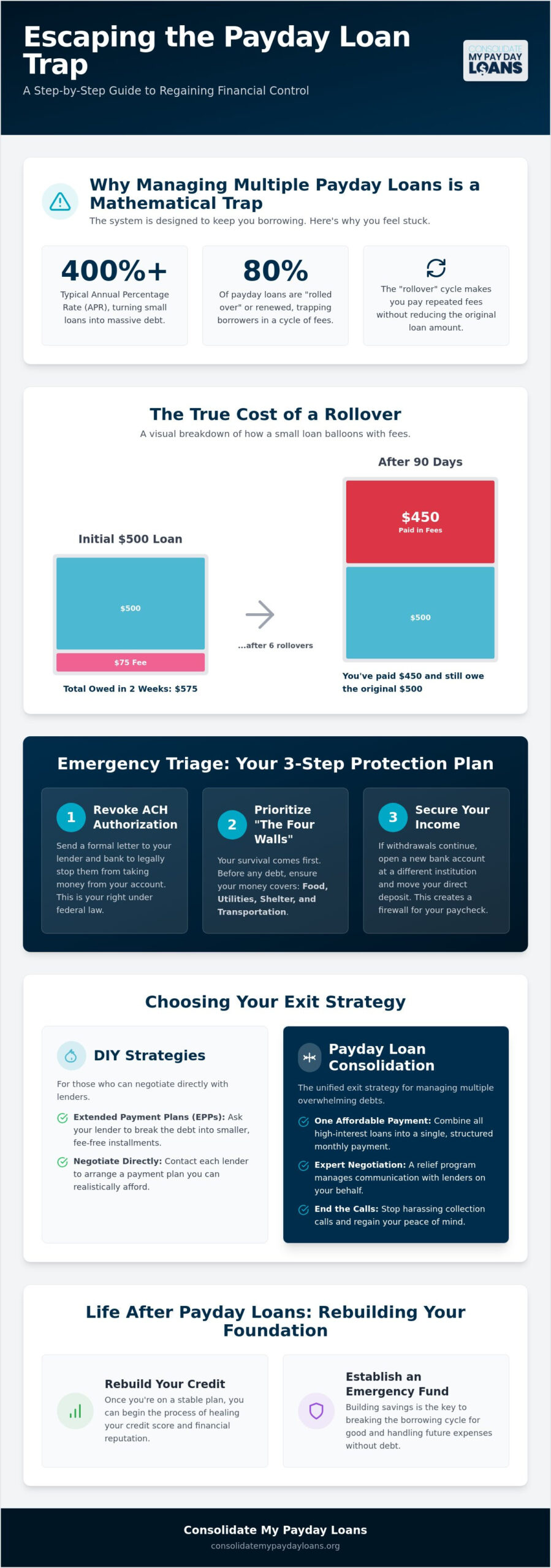
Trying to figure out how to manage multiple payday loans often feels like running on a treadmill that keeps speeding up. When you hold three or more of these high-interest obligations, you’ve likely entered what we call the “Payday Loan Hole.” This isn’t just a period of tight finances; it’s a specific mathematical point where your total interest and fee payments exceed the original amount you borrowed. It’s a calculated trap designed by the lending industry to ensure you never quite reach a zero balance.
Lenders frequently present rollovers or renewal fees as a helpful way to “manage” your debt when you can’t pay in full. In reality, these are profit centers that provide no benefit to the borrower. Research shows that approximately 80% of payday loans are rolled over or followed by another loan within 14 days. This creates a compounding effect that drains your income before you can even cover your basic needs. It turns your paycheck into a pass-through account for lenders, leaving you with nothing for yourself.
The Truth About APR and Rollover Fees
The math behind these loans is staggering. A typical payday loan costs and fees of $15 per $100 borrowed. On a $500 loan, that’s a $75 fee for just two weeks. If you roll that loan over for 90 days, you’ll pay roughly $450 in fees alone, yet you’ll still owe the original $500. This equates to a 400% APR. Taking out a new loan to pay off an old one is a guaranteed path to failure because you’re simply adding more high-cost interest to a debt you already couldn’t afford. A true relief plan must stop these fees rather than just extending them.
Identifying Predatory Lending Patterns
Some lenders actively encourage “stacking,” which is the practice of taking out multiple loans from different companies simultaneously. This is a major red flag of predatory behavior. While the Truth in Lending Act requires lenders to disclose the APR and total cost of credit, these details are often buried in complex contracts that are hard to read under stress. If you’re currently juggling five different due dates and varying interest rates, you need predatory loan help to break the cycle. The psychological toll of tracking these payments creates a state of constant “financial fight or flight” that makes it hard to see a way out. You can use a payday loan consolidation calculator to see exactly how much you’re losing to interest and begin visualizing a path to freedom.
DIY Strategies: Negotiation and Extended Payment Plans (EPPs)
You don’t have to wait for a miracle to start reclaiming your income. If you’re currently overwhelmed by how to manage multiple payday loans, you have tools at your disposal that lenders rarely advertise. One of the most effective is the Extended Payment Plan (EPP). Lenders won’t tell you this. They prefer you to keep rolling over the debt to maximize their fees, but the law often provides a way to pay back what you actually owe over a longer period without extra interest.
Many people search for how to get out of payday loans and find complex financial advice, but the simplest path often starts with your legal rights. Before you pick up the phone, you must prepare a financial hardship statement. This is a clear, factual explanation of why you cannot pay, focusing on essential costs like food and housing. Never negotiate over the phone without a written follow-up. Collectors are trained to get a verbal commitment, but a verbal agreement is hard to prove if they suddenly withdraw funds anyway. Always demand that any agreement be sent to you via email or physical mail before you make a payment.
The EPP: Your Statutory Right to Relief
In many states, lenders are legally obligated to offer you an EPP if you cannot pay. This plan breaks your debt into smaller installments over several weeks or months. It’s an interest-free extension. However, you must act quickly. Most lenders require you to request this plan no later than the business day before your loan is due. If a lender claims they don’t offer payment plans, don’t take “no” for an answer. Check your state’s specific statutes; 37 states have specific laws governing payday lending, and many mandate these relief options. If you’re struggling with how to manage multiple payday loans across different states, knowing these local rules is your best defense.
Effective Negotiation Scripts for Borrowers
When you call a collector, stay firm and use a script to keep the conversation on your terms. Start with a clear statement: “I am experiencing a severe financial hardship and cannot pay this loan in full; I am requesting an interest-free Extended Payment Plan immediately.” If they push for a rollover, be firm. Tell them: “I will not pay a rollover fee; I am only interested in a settlement or a payment plan that reduces my principal balance.” Use the “Inability to Pay” script when they demand more than you have: “My budget only allows for a payment of $X per month after my essential living expenses are met.” Staying firm on your budget prevents you from making promises that will lead to another default later.
Settling old debt is also an option. If a loan has already gone to collections, you can often settle for 50% or less of the original balance. Aim for a specific “settlement” goal. Tell the collector: “I have a one-time lump sum of $X to close this account permanently.” Once you reach an agreement, ensure you receive a “settlement in full” letter before sending a single cent. This prevents the lender from selling the remaining balance to another collection agency later.
Payday Loan Consolidation: The Unified Exit Strategy
Managing the logistics of five or six different lenders is a full-time job you didn’t ask for. The psychological weight of tracking varied due dates, interest rates, and login portals creates a state of constant anxiety that makes it nearly impossible to focus on your long-term goals. When you’re looking for how to manage multiple payday loans, the answer isn’t better organization; it’s unification. Payday loan consolidation streamlines this chaos by merging every outstanding balance into a single, predictable payment that aligns with your pay cycle. This shift allows you to stop reacting to emergencies and start following a methodical plan for recovery.
Unlike traditional personal loans from a bank, specialized relief programs don’t rely on a perfect credit score. Most banks turn away payday borrowers because their debt-to-income ratio is skewed or their credit history is thin. A legitimate consolidation partner understands the systemic nature of the payday trap. They focus on your current ability to make one sustainable payment rather than your past financial turbulence. You can use a payday loan consolidation calculator to see exactly how this transition changes your monthly outlook and reduces the total amount you pay over time.
Relief Programs vs. Traditional Debt Consolidation
Traditional consolidation involves taking out a new loan to pay off old ones. For many, this is a dead end because the new loan often carries its own high interest. Specialized relief programs operate differently. They negotiate directly with your lenders to stop the cycle of rollovers and renewal fees. This results in significantly lower payday loan payments without the need for a new high-interest installment loan. You aren’t just moving the debt around; you’re actively reducing the cost of the obligation and ensuring every dollar goes toward your principal balance.
Choosing a Legitimate Consolidation Partner
The industry is unfortunately full of “debt settlement” companies that promise the world but deliver defaults. These companies often tell you to stop paying your lenders entirely, which can lead to lawsuits or aggressive collection tactics. A legitimate partner will offer transparency and a clear path toward resolution without hidden fees. Look for companies with a long history of successful negotiations. They should offer “No Credit Check” options because they prioritize your future agency over your past mistakes. Avoid any company that encourages you to hide from your debt; choose an advocate who helps you face it with a structured plan.
If you’re tired of the endless cycle of re-borrowing every two weeks, the first step is visualizing a way out. You can calculate your savings and start your consolidation plan today to finally restore your peace of mind.
Life After Payday Loans: Rebuilding Your Financial Foundation
Reaching the end of a debt cycle is a profound moment of relief. Once the immediate crisis of how to manage multiple payday loans is resolved, you face a new challenge: restoration. Moving from a state of financial turbulence to one of lasting stability requires more than just paying off a balance. It demands a total shift in how you view and access emergency funds. While the predatory lending industry relies on your return, your goal now is to build a fortress that keeps them out for good. You’ve regained your personal agency; now it’s time to protect it.
Breaking the habit of emergency borrowing is the most critical step in this journey. For months or years, your survival instinct was tied to high-interest credit. To break this link, you must prioritize a “starter” emergency fund. Even a small cushion of $1,000 can be the difference between handling a car repair with cash or falling back into a high-interest trap. The money you previously lost to 400% APR fees is now yours to keep. Redirecting those former “fee payments” into a liquid savings account is the most powerful way to secure your future.
Creating a “Payday-Free” Budget
A functional budget is your primary defense against future debt. Many successful graduates of relief programs use the 50/30/20 rule: 50% of income for needs, 30% for wants, and 20% for savings or debt repayment. During your first year of recovery, consider tilting that 20% heavily toward your emergency fund. If a financial gap occurs, look to local credit unions instead of online lenders. Many credit unions offer Payday Alternative Loans (PALs) with interest rates capped at 28%, providing a much safer bridge than the predatory options you’ve left behind.
Monitoring Your Credit and Consumer Reports
Your path back to traditional banking involves cleaning up your record. Most people check their standard FICO scores, but payday lenders often report to specialized bureaus like Teletrack and Clarity Services. These reports track your history with high-risk lending and are often used by banks to determine your reliability. Once you have settled your obligations, you must ensure every account is marked “Paid in Full” or “Settled in Full.” If you find inaccurate entries or “zombie” debts that were already resolved through your consolidation plan, dispute them immediately with the bureau. Closing these loops ensures that your history of learning how to manage multiple payday loans doesn’t haunt your future credit applications.
Long-term debt freedom is a marathon, not a sprint. If you feel the urge to borrow again, consider speaking with a non-profit credit counselor. They can offer a stable, non-judgmental environment to review your progress and help you stay focused on your goals. You’ve already done the hardest part by breaking the cycle; now, every step you take builds a foundation of peace and agency that no predatory lender can take away.
Take Back Control of Your Financial Future
The journey from drowning in high-interest debt to achieving true financial agency begins with a single, decisive step. Throughout this guide, we’ve identified how to protect your bank account from predatory withdrawals and how to use your legal rights to demand interest-free payment plans. Understanding how to manage multiple payday loans isn’t about finding more money; it’s about implementing a structured exit strategy that stops the cycle of rollovers for good.
Since 2007, we’ve been a stable anchor for individuals facing financial turbulence, offering A+ rated debt management strategies that prioritize your recovery. You don’t need a perfect credit history to qualify, as no credit check is required for consolidation eligibility. By merging your varied obligations into one predictable path, you can finally reclaim your income and achieve lasting psychological peace.
Ready to visualize your path to freedom? See how much you can save with our Payday Loan Consolidation Calculator and start your recovery today. You have the power to break this trap, and we’re here to lead the way.
Frequently Asked Questions
Can I go to jail for not paying multiple payday loans?
No, you cannot go to jail for failing to pay back a payday loan. Debtors’ prisons do not exist in the United States, and defaulting on a loan is a civil matter rather than a criminal one. While some predatory collectors may use the threat of arrest to intimidate you, such threats are illegal under the Fair Debt Collection Practices Act. You should never let the fear of criminal prosecution prevent you from seeking a stable exit strategy.
How many payday loans can I have at once in the US?
The number of loans you can hold simultaneously depends entirely on your state’s specific regulations. Currently, 37 states have statutes governing these lenders, with some jurisdictions limiting borrowers to just one or two active loans at a time. Other states have no such caps, which unfortunately allows lenders to “stack” multiple high-interest obligations. Learning how to manage multiple payday loans becomes significantly more difficult in states without these protective limits.
Will consolidating my payday loans hurt my credit score?
Consolidation typically has a much milder impact on your credit than the alternative of repeated defaults or filing for bankruptcy. While settling a debt for less than the full amount may cause a temporary dip in your score, it stops the cycle of late fees and “charge-offs” that cause long-term damage. A structured relief program provides a methodical path toward rebuilding your credit profile once the high-interest debt is finally resolved.
What happens if I simply stop paying all my payday loans at once?
If you stop paying without a plan, lenders will likely initiate aggressive collection efforts, including constant phone calls and potential lawsuits. They may also attempt to drain your bank account through repeated ACH withdrawal attempts, which can trigger hundreds of dollars in bank overdraft fees. It is much safer to revoke your bank authorizations and enter a formal consolidation program rather than simply walking away without any legal protection. Understanding exactly how to stop automatic payments on payday loan accounts before you cease payments gives you a critical legal shield against unauthorized withdrawals.
Can a payday loan consolidation program stop harassing phone calls?
Yes, a professional relief program is designed to act as a barrier between you and the lenders. Once you are enrolled, your consolidation partner typically notifies the lenders that they are representing you. Under federal law, collectors must generally stop contacting you directly once they know you have professional representation. This shift provides the psychological peace needed to focus on your recovery rather than answering the phone in a state of constant stress.
Is it better to consolidate payday loans or file for bankruptcy?
Consolidation is often preferred because it avoids the severe, ten-year credit damage associated with a bankruptcy filing. Bankruptcy is a drastic legal step that can affect your ability to get a job, rent an apartment, or buy a car for a decade. Consolidation allows you to resolve your specific payday debt through negotiation and a single monthly payment, providing a specialized solution without the broad and lasting consequences of a federal court proceeding.
How do I know if a payday loan relief company is legitimate?
A legitimate company will have a transparent history and will not demand upfront fees before they provide debt settlement services. Look for organizations that have been in business for decades, such as those operating since 2007, and check for a physical presence and clear, written contracts. Avoid any company that promises to “erase” your debt instantly or suggests you should ignore all legal communications without a structured plan in place.
What is the difference between payday loan consolidation and a debt management plan?
Debt management plans (DMPs) are typically designed for credit card debt and involve a nonprofit agency distributing payments to creditors over several years. Payday loan consolidation is a more specialized strategy built specifically to handle the unique “mathematical trap” of 400% APR loans. Because payday loans have much shorter terms and higher interest rates than credit cards, they require a more aggressive negotiation approach to stop rollovers and protect your bank account immediately.