
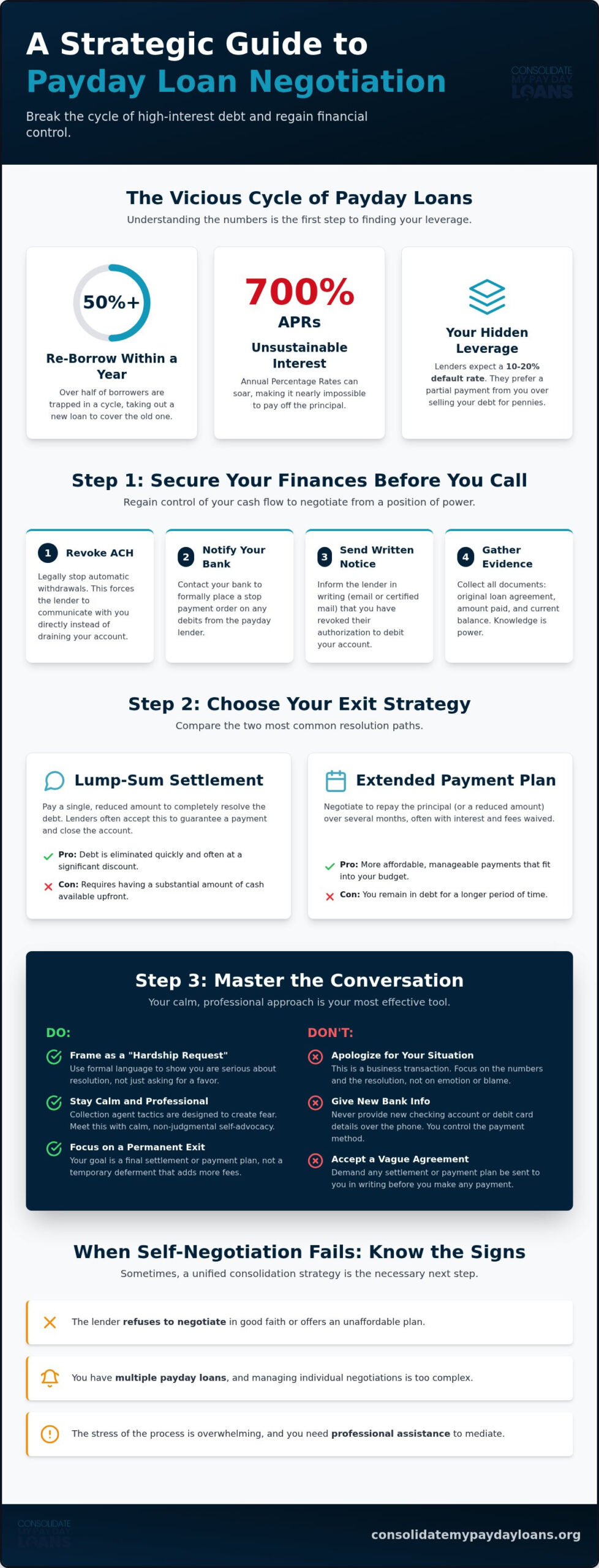
Over 50 percent of payday loan borrowers take out another loan within a year, often trapped by APRs that can reach 700 percent. When your bank account is being drained by automatic withdrawals and collection calls never seem to stop, it’s easy to feel powerless. However, successful payday loan lender negotiation is a tactical hunt for agency; it requires protecting your cash flow before you ever dial the phone. You aren’t just a number in a database, and you don’t have to accept a cycle of debt as your permanent reality.
We know how overwhelming it is to face these costs while trying to cover basic living expenses like rent or groceries. This guide provides the specific tools you need to break free. You’ll learn how to navigate current 2026 regulations, such as the CFPB “Two-Strikes” rule, and gain access to proven scripts designed to lower your payments. We’ll walk you through a structured exit plan to waive late fees, stop the drain on your bank account, and finally secure the psychological peace you deserve.
Key Takeaways
- Learn how to frame your financial struggle as a formal hardship request to encourage lenders to choose partial payment over a total default.
- Discover the critical steps to protect your assets, including how to revoke ACH authorization and regain control of your bank account.
- Master the art of payday loan lender negotiation by comparing the long-term benefits of lump-sum settlements versus interest-free extended payment plans.
- Access a professional, phase-by-phase script designed to help you communicate clearly and confidently with collection agents.
- Identify the specific warning signs that signal when self-negotiation has failed and it’s time to transition to a unified consolidation strategy.
Why Payday Loan Lender Negotiation is Your First Step to Freedom
When you are caught in a cycle of high-interest debt, it’s easy to feel like the lender holds all the cards. However, the reality of the industry in 2026 tells a different story. To regain your financial agency, you must view negotiation not as a plea for mercy, but as a formal request for a hardship arrangement or a structured settlement. Understanding what are payday loans and how they function as high-risk assets for the lender is your first step toward total debt relief. By initiating a payday loan lender negotiation, you shift the dynamic from being a passive victim of automatic withdrawals to a proactive negotiator who is taking control of their cash flow.
Lenders are businesses driven by recovery metrics. They face a simple economic choice: accept a partial payment from you now or sell your account to a third-party debt buyer for pennies on the dollar. Most lenders would much rather secure a guaranteed, albeit smaller, payment directly from you than risk getting nothing at all through a total default or bankruptcy. This “insider knowledge” is your greatest leverage. When you approach them with a clear plan, you are signaling that you are a “recovery-ready” borrower who is willing to pay if the terms become manageable.
Understanding the Lender’s Perspective in 2026
In the current lending climate, payday lenders typically anticipate a default rate of 10-20 percent across their portfolio. They know that a significant portion of their borrowers will eventually stop paying due to the unsustainable nature of 700 percent APRs. Because selling debt to a collection agency involves high administrative costs and a massive haircut on the principal, your persistence is an asset. If you remain firm and professional, you prove that you are more likely to complete a settlement than the average borrower who simply disappears. They want to close your file with some profit intact; your goal is to make sure that profit doesn’t come at the expense of your survival.
The Emotional Anchor: Staying Calm Under Pressure
The “tough talk” you hear from collection agents is often a scripted performance designed to trigger fear. They might mention legal action or constant bank hits to make you feel cornered. You must meet this turbulence with a sense of calm reassurance in your own position. Non-judgmental self-advocacy is your best tool here. You don’t need to apologize for your financial situation. Instead, focus entirely on the resolution. Your objective isn’t a temporary deferment that adds more fees; it’s a permanent reduction in what you owe. By staying focused on a structured exit plan, you can navigate payday loan lender negotiation with the authority needed to win.
Preparing for the Call: Protecting Your Assets First
Before you enter a payday loan lender negotiation, you must secure your defensive position. Successful debt resolution isn’t just about what you say; it’s about what you control. Lenders often rely on the fact that they have direct, automated access to your bank account, which removes your leverage before the conversation even begins. By taking specific steps to protect your cash flow and document your situation, you transform from a pressured borrower into an informed negotiator who knows exactly what they can afford.
Revoking ACH Authorization Legally
The most critical move you can make is to regain control of your bank account. You have the legal right to stop automatic withdrawals at any time. To do this effectively, you should notify the lender in writing and contact your bank to revoke the ACH authorization. This prevents the lender from attempting to empty your account the moment your paycheck hits. For a detailed, step-by-step walkthrough on how to handle this correctly, refer to our guide to stopping automatic withdrawals. When you stop the cycle of failed payment attempts, you also stop the accumulation of NSF fees. This move forces the lender to the table because they can no longer bypass your decision-making process. Understanding these payday loan consumer protections is essential for maintaining your leverage.
Gathering Your Financial Evidence
Knowledge is your greatest asset during a payday loan lender negotiation. You need to document every detail of your current obligations, including the original principal, the total amount already paid, and the current APR. Use our payday loan consolidation calculator to visualize your path to relief and determine your “walk-away” number. This is the maximum amount you can realistically pay without sacrificing essential needs like rent or groceries.
Additionally, you should look for signs of illegal or predatory behavior. Our predatory loan help guide can help you identify terms that might violate state or federal regulations. If you have proof of a legitimate hardship, such as medical bills or a layoff notice, keep these documents ready. Presenting a clear, evidence-based case shows the lender that your request for a settlement is based on reality rather than a simple desire not to pay. If you find the process of gathering this evidence overwhelming, you might consider how professional debt relief services can help organize your defense.
Comparing Your Options: Settlement vs. Extended Payment Plans
Once you’ve secured your bank account and documented your hardship, you need to decide which path of payday loan lender negotiation fits your current budget. Negotiation isn’t a one-size-fits-all process. You generally have two primary routes: paying a smaller, one-time amount to walk away (settlement) or spreading your payments over several months without additional interest (Extended Payment Plan). Both options provide a structured exit from the debt cycle, but they impact your 2026 financial profile in different ways. Choosing correctly depends on whether you have immediate access to cash or need to protect your monthly paycheck from further disruption.
The Extended Payment Plan (EPP) Advantage
An Extended Payment Plan (EPP) is often the most accessible tool for immediate relief. In several states, including California, Florida, and Michigan, lenders are legally mandated to offer an EPP if a borrower cannot make their payment. This plan typically allows you to pay back the balance in four or more installments without accruing extra interest or fees. However, timing is everything. You must request an EPP before the loan goes into default. If you wait until after a missed payment, the lender isn’t obligated to offer these specific payday loan payment plan options. Always demand the agreement in writing before making the first installment. A verbal agreement over the phone provides no protection if the lender decides to resume automatic withdrawals later.
Lump-Sum Settlement Tactics
If you can access a small sum of money through family or extra work, a lump-sum settlement can end the debt immediately. Using effective negotiation strategies, you should start your offer at approximately 30 percent of the total balance. The lender will likely counter-offer, but the goal is to settle for roughly 50 percent of the original debt. This is a win for the lender because they recoup their principal without the high cost of third-party collections.
You must be cautious of the “one-time payment” trap. Ensure the lender provides a letter stating the debt is “satisfied in full” rather than “settled for less than the full balance.” This distinction matters for your credit report. Additionally, be prepared for the tax implications; the IRS generally views forgiven debt over $600 as taxable income. While a settlement offers a faster resolution, it requires more upfront capital than an EPP. Both paths are superior to a total default, which can lead to years of aggressive collection efforts and deep financial stress.
The Negotiation Script: What to Say to Get Results
Many people freeze when they finally get a lender on the phone. Having a clear plan for your payday loan lender negotiation removes that anxiety. You need to move through four specific phases: establishing your hardship, making a specific ask, rebutting their initial refusal, and closing with a written agreement. By following this structure, you maintain the authoritative tone necessary to be taken seriously by collection agents who are used to hearing excuses rather than solutions.
Scenario A: Requesting a Hardship Program
Use this approach if your loan is current or only slightly behind. Your goal is to move the balance into a structured plan that stops the bleeding of high interest. You might say: “I’m experiencing a severe financial hardship and cannot meet the current terms of this loan. I’ve been researching your payday loan hardship program options and would like to move my balance into an interest-free repayment plan.”
Agents are trained to offer “rollovers” or “extensions.” Don’t fall for this. A rollover is a systemic trap that adds new fees without reducing your original principal. Stay firm. Tell them: “I’m not interested in a rollover; I’m requesting a permanent resolution to close this account.” If they claim they don’t have such a program, ask to speak with a supervisor in the compliance or hardship department.
Scenario B: Negotiating a Settlement for Older Debt
If your debt is already in collections or several months past due, a lump-sum settlement is your strongest move. Start with a clear, limited offer: “I have a total of $X available for a one-time settlement to close this account immediately. This is the only money I have allocated for this debt. If we can agree on this amount as a Full and Final Settlement, I can make the payment today.”
If the agent threatens legal action or wage garnishment, don’t let it rattle you. These are often empty threats designed to trigger a fear response. Remind them that a settlement is a guaranteed recovery for them today, whereas legal action is a long, expensive process for their company with no guaranteed outcome. Once you reach an agreement, never send money until you have the terms in writing. If managing these conversations feels overwhelming, you can always reach out for professional payday loan relief to have an advocate handle the calls on your behalf.
When to Stop Negotiating and Start Consolidating
While payday loan lender negotiation is a powerful tool, it has its limits. You might find that a specific lender is completely unresponsive to your hardship requests, or perhaps you’re managing five different loans at once. Juggling multiple repayment dates and communication logs often leads to burnout and missed payments. If you’ve reached a point where the phone calls are escalating despite your best efforts, or if you simply don’t have the bandwidth to fight every lender individually, it’s time to consider a more comprehensive solution.
Recognizing the signs that self-negotiation has hit a dead end is not a failure; it’s a strategic pivot. You’ve protected your bank account and attempted to communicate. If the lender continues to demand impossible terms, you need an advocate who can shift the leverage back in your favor. Transitioning to a unified strategy allows you to stop reacting to crises and start following a methodical path to recovery.
The Benefits of a Unified Exit Strategy
Choosing payday loan consolidation allows you to merge multiple high-interest obligations into one manageable anchor. This approach removes the need for you to be the primary point of contact for aggressive collection agents. Professional negotiation services differ from DIY attempts because they leverage established relationships with lenders to secure terms you might not get on your own. By consolidating, you can significantly reduce the total interest paid over the life of the debt and create a predictable, steady flow toward a zero balance.
Moving Forward: Life After Payday Loans
Once you’ve established a structured plan, your focus should shift toward building a safety net to ensure you never have to rely on predatory lending again. This involves setting up a small emergency fund and exploring payday loan consolidation instead of bankruptcy. Bankruptcy can devastate your credit for a decade; a strategic consolidation plan allows you to resolve your debt while maintaining your financial integrity and personal agency.
Your current debt does not define your future potential. Regaining your financial agency starts with the decision to stop the cycle of rollovers and interest-only payments. Whether you succeed through DIY payday loan lender negotiation or require the support of a professional advocate, the goal is the same: psychological peace and a bank account that belongs to you again. Take the first step today by visualizing your debt-free life and committing to the plan that gets you there.
Take Control of Your Financial Future Today
Reclaiming your bank account and mastering the right scripts are the foundational steps in successful payday loan lender negotiation. You now have the tools to revoke ACH authorization, stop the drain on your funds, and distinguish between a predatory rollover and a legitimate hardship plan. These strategies aren’t just about saving money; they’re about regaining the personal agency that high-interest lenders try to take away during times of financial turbulence.
Sometimes, managing several aggressive lenders at once requires a more unified approach. Since 2007, our expert negotiation team has provided specialized payday relief to individuals caught in high-interest debt traps. We offer a no-obligation debt assessment to help you identify the most efficient path to total recovery without the long-term damage of bankruptcy. Our goal is to act as your stable anchor while you navigate these difficult waters.
Estimate your savings with our Payday Loan Consolidation Calculator to see exactly how much you can save and how quickly you can become debt-free. You don’t have to carry this burden alone. Relief is possible, and your journey toward psychological peace starts today.
Frequently Asked Questions
Can I negotiate a payday loan if I am already in default?
Yes, you can absolutely negotiate even after you’ve missed payments. In fact, lenders are often more willing to settle once a loan is in default because they’re at risk of recovering nothing at all. They’d much rather accept a partial settlement from you than sell your debt to a third party collector for pennies on the dollar. Be firm about your financial hardship and what you can realistically afford to pay.
Will negotiating with a payday lender hurt my credit score?
The impact depends on the specific outcome of your agreement. If you settle for less than the full balance, the lender might report the account as “settled,” which can cause a minor dip in your score. However, this is significantly less damaging than a total default or a judgment. Successfully completing a payday loan lender negotiation is a proactive step that prevents the long term credit destruction associated with bankruptcy or unresolved collections.
What if the lender refuses to offer an Extended Payment Plan?
If a lender refuses an EPP, you should immediately verify your state’s specific lending laws. Many jurisdictions, such as Florida and Michigan, legally require lenders to provide these plans if you request them before the due date. If they still won’t cooperate, ask to speak with a supervisor or mention your intent to contact the Consumer Financial Protection Bureau. This often encourages the lender to reconsider their stance to avoid regulatory scrutiny.
How much should I offer for a payday loan settlement?
You should generally start your initial settlement offer at approximately 30 percent of the total balance. Most lenders will counter offer, but your goal is to settle the debt for around 50 percent of what’s owed. They’re often receptive to these offers because it allows them to recoup their principal immediately without the administrative costs of a long term collection process. Always ensure the agreement is confirmed in writing before you send any money.
Can a payday lender sue me if I stop paying to negotiate?
While a lender has the legal right to sue for a breach of contract, it’s rarely their first choice for small dollar loans. The legal fees often exceed the value of the loan itself. Most lenders prefer to use aggressive phone calls or internal collections. If you’ve revoked your ACH authorization, you’ve already taken the most important step in protecting your assets while you work toward a fair payday loan lender negotiation.
Do I need a lawyer to negotiate with my payday lender?
You don’t need an attorney to negotiate a settlement or a hardship plan. Most borrowers can successfully navigate the process using clear scripts and documented proof of their financial situation. If you find the harassment from collectors too overwhelming to handle alone, a professional debt relief advocate can step in. They provide the expertise needed to stop the calls and secure a unified exit strategy without the high costs of legal representation.
What is the best time of the month to call a lender for negotiation?
The final week of the month is typically the most effective time to call. Collection managers and agents often have monthly recovery targets they need to hit. Because they’re under pressure to close files and meet quotas, they’re more likely to approve a settlement or an interest free payment plan that they might have rejected earlier in the month. Use this timing to your advantage to secure better terms.
How do I get a settlement agreement in writing?
You must explicitly tell the agent that you won’t process any payment until you have a formal settlement letter in your inbox. This document should clearly state the agreed upon amount, the payment date, and a confirmation that the debt will be considered “satisfied in full.” Don’t rely on verbal promises over the phone. Once you have the PDF or physical letter, keep it in your permanent records to prevent any future collection attempts.