
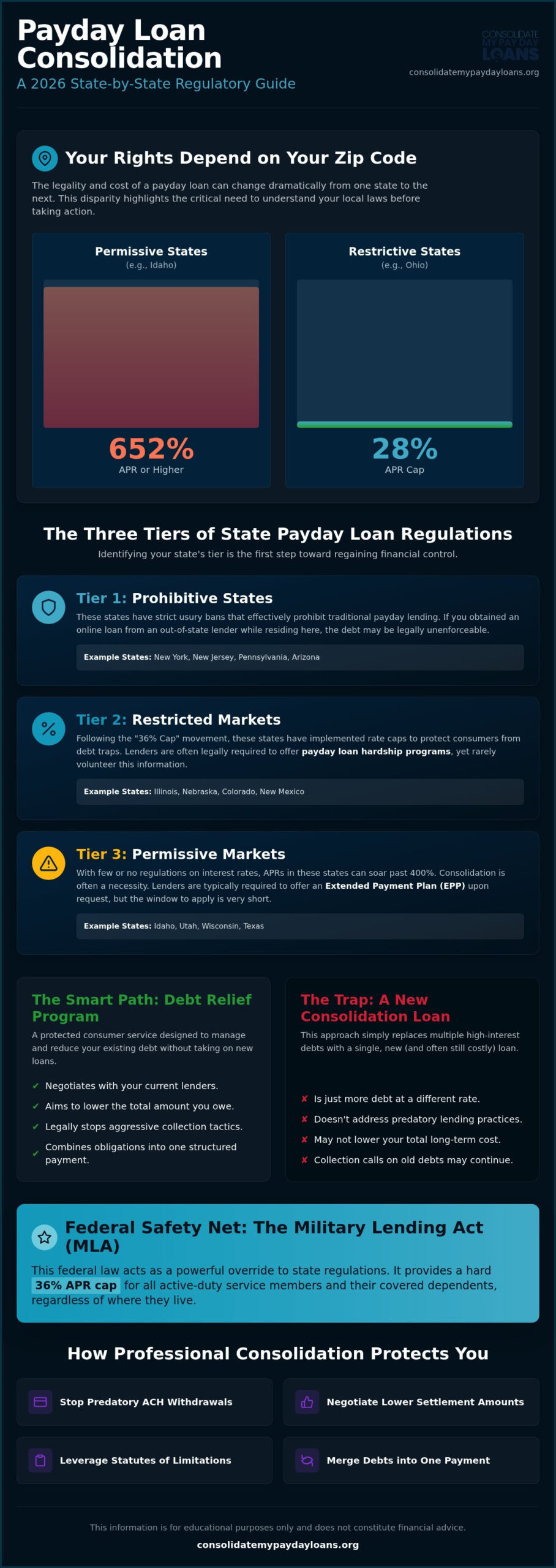
Did you know that the same $500 loan could carry a 652% APR in Idaho while being capped at 28% in Ohio? This massive disparity in payday loan consolidation laws by state often leaves borrowers feeling like their financial survival depends entirely on their zip code. If you feel trapped by aggressive lenders or confused by conflicting regulations, you aren’t alone. It’s frustrating to face harassment from out-of-state companies while wondering if seeking help is even legal in your area.
We understand the weight of this stress, and we’re here to tell you that a way out exists. You deserve a clear, legal path toward lower monthly payments and protection from predatory practices. In this 2026 regulatory guide, we’ll break down the complex web of state interest rate caps and licensing requirements together. You’ll gain a firm understanding of your rights and discover how to consolidate your debt into a manageable plan that finally puts you back in control of your financial future.
Key Takeaways
- Identify your state’s specific regulatory tier to understand whether you are in a prohibitive, restricted, or permissive lending environment.
- Gain a clear understanding of payday loan consolidation laws by state to ensure you are using a legal and protected path to debt relief.
- Leverage state-specific usury caps and statutes of limitations to negotiate lower settlement amounts and stop the cycle of high-interest debt.
- Learn how federal protections like the Military Lending Act override local rules to provide a 36% APR cap for service members nationwide.
- Discover how professional negotiation can legally stop predatory ACH withdrawals and merge multiple obligations into one manageable payment.
The Legal Landscape of Payday Lending and Consolidation in 2026
In 2026, the definition of payday loan consolidation has evolved. It’s no longer just about moving debt; it’s about shifting the power balance between you and the lender. For a foundational Payday loan overview, it’s clear these high-interest products are designed to be difficult to escape. Consolidation is the process of grouping multiple high-interest obligations into a single, structured repayment plan. This isn’t just a financial convenience. It’s a protected consumer action. The Consumer Financial Protection Bureau (CFPB) strengthened this in March 2025 by tightening disclosure requirements, ensuring you have transparency before you ever sign a contract.
Many online lenders use “choice of law” clauses to claim they only follow the laws of their home state, even if they’re lending to you in a more restricted area. However, your right to seek relief remains universal. Understanding payday loan consolidation laws by state is essential because while a lender might try to skirt local caps, a professional relief program operates under national consumer protection standards. You aren’t bound by the lender’s preferences when you choose to reorganize your debt legally.
Federal vs. State Authority: Who Rules Your Debt?
States generally hold the power to set interest rate (APR) caps. This is why you’ll see a 36% cap in states like Illinois or Nebraska, while other states have no limit at all. Federal authority acts as a safety net. For example, the Military Lending Act (MLA) provides a hard 36% APR cap for all active-duty service members, regardless of where they live. The 2026 federal Small Dollar Loan guidelines further encourage lenders to offer more sustainable terms, but when they don’t, state-level consumer protection acts give you the leverage to consolidate. This interplay between local and federal rules is the core of payday loan consolidation laws by state and how they protect you from predatory cycles.
The Legality of Consolidation Programs
It’s vital to distinguish between taking out a new loan to pay off old ones and entering a relief-based consolidation program. A new loan is just more debt at a different rate. Relief-based programs focus on negotiating with your existing lenders to lower the total amount owed and stop aggressive collection tactics. These programs aren’t subject to the same APR caps as lenders because they aren’t providing credit; they’re providing a service to manage it. Debt relief is a protected consumer service in 2026 that allows you to reclaim your financial agency.
Understanding the Three Tiers of State Payday Loan Regulations
To understand payday loan consolidation laws by state, you must first recognize that the U.S. is divided into three distinct regulatory tiers. Regulation is not uniform. It’s a complex patchwork. Some states protect you with firm caps, while others allow lenders to charge whatever they wish. Identifying your state’s tier is the first step toward regaining your financial agency. This framework determines your legal rights and the specific leverage you have when negotiating with lenders.
Tier 1: States Where Payday Lending is Prohibited
States like New York, New Jersey, and Pennsylvania have strict usury bans that effectively prohibit payday lending. If you live in one of these jurisdictions but have an online loan from an out-of-state lender, that debt may be legally unenforceable. You don’t have to accept harassment from unlicensed collectors. Legal strategies exist to consolidate and resolve debt that violated local usury laws. Understanding the State-by-state payday lending statutes is vital to knowing if your lender is operating outside their legal boundaries. If they are, you have a powerful tool to stop the cycle of debt immediately.
Tier 2 & 3: Restricted and Permissive Markets
Tier 2 states represent the 36% Cap movement. States like Illinois and Nebraska have recently capped interest rates to protect consumers from the debt trap. These restricted markets often mandate payday loan hardship programs, which provide a structured way to exit debt without further damage. These programs are often required by law, yet lenders rarely volunteer this information to struggling borrowers.
Tier 3 states are permissive markets. In places like Idaho, Utah, or Wisconsin, APRs can still exceed 400%. If you live in a permissive state, consolidation isn’t just an option; it’s a necessity for survival. Many of these states require lenders to offer an Extended Payment Plan (EPP) upon request, but the window to apply is usually very short. Because payday loan consolidation laws by state vary so wildly, knowing these local nuances allows you to negotiate from a position of strength. If you’re feeling overwhelmed by triple-digit interest, you can explore professional consolidation options to regain your peace of mind.
How State Laws Impact Your Consolidation Options
State usury laws aren’t just dry legal text. They’re your primary tools for negotiation. When you understand the specific payday loan consolidation laws by state, you can challenge settlements that don’t align with local caps. If a lender charges 400% in a state with a 36% usury limit, that contract is often legally fragile. This legal friction allows a payday loan consolidation service to negotiate settlements that are significantly lower than the original balance. They use the law as a lever to force lenders to the table.
You might have encountered “Tribal Lenders” claiming sovereign immunity to bypass state regulations. While they use this as a shield, many courts now rule that they must still comply with the laws of the state where you reside. Constant efforts in reforming state payday loan laws have made it harder for these entities to evade consumer protections. Additionally, the statute of limitations on payday debt varies wildly, ranging from three to ten years depending on your location. Once this period passes, the lender loses the legal right to sue you. A professional strategy tracks these dates to ensure you aren’t paying on debt that’s legally expired.
Unlicensed Lenders and State Law Violations
Check if your lender is licensed to operate in your specific state. If they aren’t, they’re often operating illegally. This provides massive leverage. An unlicensed lender usually has no legal standing to use your state’s court system to collect from you. You can use this fact to demand a zero-interest repayment plan or even a total waiver of fees. Negotiation tactics for loans that exceed state interest rate limits focus on the lender’s desire to avoid regulatory scrutiny. They’d often rather take a smaller settlement than risk a state attorney general’s investigation.
State Laws on Wage Garnishment and Collection
Collection laws are your last line of defense. States like North Carolina and Pennsylvania largely prohibit wage garnishment for consumer debts like payday loans. In other states, lenders must win a lawsuit and obtain a judgment before they can touch your paycheck. Consolidation is a proactive defense against court-ordered collections. By entering a relief program, you resolve the debt before it ever reaches a courtroom. This stops the legal escalation and protects your income from aggressive, court-ordered seizures. You regain control before the situation spirals into a judgment.
Federal Overrides: The Military Lending Act and Beyond
While payday loan consolidation laws by state create a complex patchwork of regulations, federal law establishes a baseline of protection that no lender can ignore. These national standards serve as a vital safety net. They ensure that your rights don’t vanish simply because you cross a state line or borrow from an out-of-state entity. For many, federal overrides are the key to breaking the cycle when local laws fall short. Understanding these higher-level protections is essential for anyone feeling trapped by predatory lending.
Service Member Protections Regardless of State
The Military Lending Act (MLA) is perhaps the most powerful federal override in existence. It mandates a strict 36% APR cap for active-duty service members and their dependents nationwide. If a lender issues a loan exceeding this rate to a covered borrower, the contract is legally void from the start. You don’t owe the interest, and in many cases, the principal itself becomes uncollectible. If you suspect an MLA violation, you should report it to your local Judge Advocate General (JAG) office or the CFPB immediately. Military families have access to specialized payday loan relief programs that leverage these federal protections to resolve debt quickly and honorably.
Stopping Automatic Withdrawals Legally
One of the most stressful aspects of payday debt is the constant fear of your bank account being emptied. Federal Regulation E provides a solution. It grants you the legal right to revoke ACH authorization at any time. You aren’t required to let a lender keep dipping into your account. To stop the cycle, you must notify your bank and the lender simultaneously that the authorization is withdrawn. This is a critical step in any professional consolidation strategy. You can use a payday loan consolidation calculator to see how much you could save once those predatory withdrawals stop and a structured plan begins.
Federal law also protects the “honest debtor” through various bankruptcy and consumer protection statutes. However, consolidation often provides a more stable path than bankruptcy. It allows you to fulfill your obligations without the long-term credit damage of a court filing. The Fair Debt Collection Practices Act (FDCPA) further ensures that no matter what the payday loan consolidation laws by state say, you are protected from harassment and deceptive collection tactics nationwide. If you’re ready to stop the harassment and reclaim your income, speak with a consolidation expert today to build your defense.
Navigating State Laws with a Professional Consolidation Strategy
Understanding the nuances of payday loan consolidation laws by state is a full-time job. Lenders often count on you being too overwhelmed to research your local rights. A professional negotiator acts as your shield, translating complex legal jargon into a clear plan of action. They consolidate diverse state-level obligations into one cohesive national strategy. This process simplifies your life by replacing chaos with a predictable, managed path forward. You no longer have to track fifty different sets of rules; you only have to focus on one single, affordable payment.
Merging these debts requires an insider’s perspective on how different jurisdictions interact. While a lender might try to enforce a contract based on their home state’s permissive rules, an expert knows when your home state’s protections take precedence. This strategic alignment ensures that you aren’t paying a penny more than what is legally required. It’s about regaining your personal agency and stopping the drain on your hard-earned income.
The Benefit of an Expert Advocate
Expert advocates use state usury laws as a primary weapon. If a lender is pushing a high APR in a state with strict caps, a professional knows exactly how to challenge that balance. They also target the “rollover” cycle. This predatory practice of extending loans with new fees is strictly illegal in many states, yet it continues because borrowers don’t know they can stop it. Having an expert advocate provides psychological peace. It creates a firm legal barrier between you and the constant harassment of collection calls. You can finally breathe again knowing someone is fighting for your rights.
Your 2026 Exit Plan
Choosing payday loan consolidation instead of bankruptcy is often the smartest strategic move. It protects your long-term credit while ending the immediate debt cycle. Use this 2026 checklist to ensure your consolidation plan is legally compliant and effective:
- Audit every active loan: Compare your current interest rates against the specific APR caps defined by payday loan consolidation laws by state.
- Verify lender licensing: Confirm if each lender is actually authorized to do business in your state. Unlicensed debt is often unenforceable.
- Review “Choice of Law” clauses: Don’t let a lender tell you that your local consumer protections don’t apply.
- Validate settlement terms: Ensure every negotiation is documented in writing and legally binding before making payments.
You don’t have to face this financial turbulence alone. The legal landscape is complicated, but the solution is clear. By partnering with a national relief program, you can execute a plan that respects your rights and restores your stability. Take the first step toward legal debt relief today.
Reclaim Your Financial Agency Today
You’ve seen how the complex web of payday loan consolidation laws by state can work in your favor when you have the right guide. Whether you’re protected by a strict 36% cap or navigating a permissive market, your right to seek relief is a national standard. You don’t have to accept harassment or predatory interest rates as a permanent reality. By leveraging federal protections and state-specific usury limits, you can stop the drain on your bank account and start building a stable future.
Solid Ground Financial has spent over 20 years perfecting A+ rated debt management strategies to protect consumers. We’ve successfully negotiated thousands of predatory loans, turning financial turbulence into manageable progress. It’s time to put our expertise to work for your family. Start Your State-Compliant Consolidation Plan Now. Relief is closer than you think. You have the legal right to a fresh start, and we’re ready to help you take that first step toward lasting peace of mind.
Frequently Asked Questions
Is payday loan consolidation legal in my state if payday loans are banned?
Yes, payday loan consolidation is legal in every state, regardless of whether payday lending itself is prohibited. Debt relief is a protected consumer service that helps you manage existing obligations. Even if your state, like New York or Maryland, bans high-interest lending, you still have the right to seek professional help to resolve out-of-state or online debts. Consolidation programs focus on negotiation rather than issuing new credit.
Can a payday lender sue me if I live in a state where they aren’t licensed?
It is very difficult for a lender to successfully sue you if they aren’t licensed to operate in your state. Most state courts require lenders to prove they hold a valid license before they can obtain a judgment. If a lender is unlicensed, the debt is often considered legally unenforceable. This lack of licensing provides significant leverage for professional negotiators to settle the debt for a fraction of the original balance.
What is the maximum interest rate a payday lender can charge in 2026?
There is no single national maximum interest rate because payday loan consolidation laws by state determine these limits individually. In 2026, many states have adopted a 36% APR cap to protect borrowers. However, in permissive states like Idaho or Utah, rates can still exceed 400%. The only universal federal cap is the 36% limit established by the Military Lending Act for active-duty service members and their dependents.
How do state laws affect my ability to stop ACH withdrawals?
While Federal Regulation E gives you the right to revoke ACH authorization, state-level consumer protection acts often provide additional layers of defense. Some states have specific banking regulations that make it easier to stop predatory withdrawals by requiring lenders to acknowledge your revocation immediately. Professional relief programs use these combined legal frameworks to help you secure your bank account and stop the cycle of unauthorized debits.
Are online payday loans subject to my home state’s laws?
Yes, online payday loans are generally subject to the laws of the state where you reside. Lenders often include “choice of law” clauses in contracts to try and follow more permissive regulations from their home state. However, 2026 regulatory standards and recent court rulings consistently favor the borrower’s home state laws. This means your local usury caps and consumer protections usually take precedence over the lender’s preferences.
Can I consolidate both credit cards and payday loans under state law?
You can certainly consolidate both credit cards and payday loans into a single management plan. Professional services like Consolidate My Payday Loans specialize in merging various unsecured debts to simplify your monthly obligations. This strategy allows you to apply consistent legal protections across all your debts. It reduces the stress of managing multiple lenders while ensuring that your total monthly payment remains affordable and sustainable.
What happens if a lender violates my state’s usury laws?
If a lender violates your state’s usury laws, the loan contract may be legally voided or restructured. Depending on your location, a lender who exceeds interest rate caps might lose the right to collect any interest or even the original principal amount. These violations create powerful opportunities for negotiation. A professional consolidation strategy identifies these legal breaches to force lenders into settling for significantly lower amounts than they originally demanded.
Does every state require lenders to offer an Extended Payment Plan (EPP)?
No, not every state requires lenders to offer an Extended Payment Plan (EPP). Mandatory EPP programs are only available in specific states like Florida, Washington, and Michigan. These plans allow you to pay off your balance over a longer period without additional fees. Because these options aren’t universal, understanding the specific payday loan consolidation laws by state is vital to knowing which relief strategies are available to you locally.