
With over 80% of payday loans rolled over within 14 days, the “quick fix” usually becomes a five-month cycle of debt that feels impossible to break. You’re likely exhausted by the relentless harassment from lenders and the sinking feeling that your money is vanishing into interest fees rather than reducing your balance. It’s natural to feel paralyzed by the fear of falling for payday loan consolidation scams when you’re already struggling to keep your head above water. You deserve a clear path to zero debt that doesn’t involve more risk or hidden fees.
We’re here to provide the peace of mind you need by showing you exactly how to distinguish professional debt relief from predatory schemes. Drawing on over 18 years of experience as a consumer advocate, we’ve developed a method to verify any company’s legitimacy before you commit your finances. This guide outlines our comprehensive 2026 verification checklist, covering everything from state licensing requirements to the specific red flags that help you protect your financial future and regain control over your life.
Key Takeaways
- Identify the specific red flags, such as demands for upfront fees, that signal you are dealing with payday loan consolidation scams rather than a legitimate service.
- Use our 5-step safety checklist to verify a company’s physical address and state licensing before sharing any personal financial information.
- Distinguish between the high-pressure sales tactics of predators and the transparent, empathetic consultation style of professional debt advocates.
- Understand why legitimate relief programs focus on structured management and legal compliance instead of making impossible “100% success” guarantees.
- Learn how 18 years of specialized experience and adherence to federal guidelines provide a secure foundation for your journey to financial recovery.
Identifying Payday Loan Consolidation Scams in 2026
A modern payday loan consolidation scam is no longer just a poorly designed website or a suspicious email. In the current market, these operations have evolved into sophisticated criminal enterprises that mirror the branding and professional tone of legitimate financial institutions. Their primary goal isn’t to help you manage your debt; it’s to extract the little remaining liquidity you have through deceptive fees and stolen data. Because the Consumer Financial Protection Bureau received over 6.6 million complaints in 2025, scammers know that millions of Americans are actively searching for a way out of the high-interest trap. They view your financial distress as an opportunity for exploitation.
These predators often utilize “phantom debt” tactics, where they contact you claiming you owe money on a loan you never actually took out or one that was settled years ago. They rely on the fact that many borrowers have used multiple apps and lenders, making it difficult to track every past obligation. To understand the root of these abusive practices, it helps to look at What is predatory lending and how it creates a foundation for secondary scams. By creating a false sense of urgency, these groups pressure you into making immediate payments to “avoid arrest” or “stop a bank levy,” neither of which a debt relief company has the legal authority to do. Real help is methodical and transparent; scams are frantic and threatening.
The Evolution of Scams: AI and Deepfakes
Technology has given scammers powerful new tools to bypass your natural skepticism. In 2026, we’re seeing a surge in AI-generated voice cloning and deepfake videos used to mimic government officials or bank representatives. You might receive a call that sounds exactly like a local credit union employee, using personal details leaked from old loan applications to build trust. Be extremely wary of social media ads promising “total debt forgiveness” or “federal bailouts” for payday loans. These are almost always lures designed to capture your Social Security number and banking credentials. If a bot-driven call offers an immediate solution based on your specific debt amount, it’s likely using harvested data to trick you into a fraudulent program.
Why Desperation Drives the Scam Cycle
When you’re trapped in a cycle of high-interest debt, your emotional state becomes a target. Scammers specifically look for individuals seeking payday loan rollover help because they know these borrowers are often at a breaking point. They exploit the fear of legal action or the shame of financial struggle to bypass your better judgment. This leads many into what we call a “predatory relief cycle.” A predatory relief cycle is a fraudulent service that charges desperate borrowers for financial assistance it never intends to provide. Instead of finding a stable anchor, you’re pulled deeper into turbulence by a company that prioritizes its own profit over your recovery.
Red Flags: How to Spot a Debt Relief Scam Instantly
Speed is the enemy of safety when you’re facing a financial crisis. Most payday loan consolidation scams rely on your desire for a quick resolution to bypass your natural intuition. These predatory groups create a sense of frantic urgency, hoping you’ll overlook the obvious warning signs in favor of immediate relief. The most glaring warning sign is a demand for money before any work is performed. If a company asks for an “enrollment fee,” “membership fee,” or “processing charge” before they’ve settled a single debt, you should hang up the phone immediately. Legitimate relief is earned through performance, not promised through a paywall.
Another major red flag involves the promise of “guaranteed” results. In the complex world of debt negotiation, no legitimate company can promise a 100% success rate or claim they can make your debt “vanish” legally. Creditors are not required by law to accept a settlement or consolidation plan. A professional advocate will be honest about the challenges and provide a realistic outlook based on your specific lenders. If the offer sounds too good to be true, it’s likely a trap designed to capture your bank account information rather than clear your balances.
The Telemarketing Sales Rule (TSR) and Your Rights
The Telemarketing Sales Rule (TSR) is a critical federal protection that many consumers don’t realize exists. Under this rule, debt relief companies that provide services over the phone are legally prohibited from collecting any fees until they have actually settled or reduced at least one of your debts. This means any “setup fee” or “advance payment” is not just a red flag; it’s a violation of federal law. Legitimate services operate on a contingency basis or through structured programs where fees are only collected after a successful outcome is achieved. If you encounter a company demanding payment upfront, report them to the FTC and move on to a verified provider.
Vague Contracts and Hidden Terms
Transparency is the hallmark of a legitimate service. You should never share your Social Security number or banking details before reviewing a formal, written agreement. Scammers often use verbal promises to lure you in, only to provide a contract that looks nothing like the initial pitch. It’s essential to see the benefits of payday loan consolidation clearly outlined in writing, including the total cost of the program and the expected timeline. Watch out for “fine print” traps that allow the company to keep your deposits even if they fail to negotiate your loans. If you’re feeling overwhelmed by conflicting claims, using a payday loan consolidation calculator can help you see the real numbers and maintain your personal agency.
Finally, be wary of any company that instructs you to stop all communication with your lenders without providing a specific legal or strategic reason. While reducing harassment is a goal, simply “ghosting” lenders without a structured plan can lead to lawsuits or bank levies. A protective expert will guide you on how to handle calls while they work on your behalf, ensuring you stay informed throughout the recovery process.
Legitimate Companies vs. Scammers: A Direct Comparison
The difference between a legitimate advocate and a predator often comes down to the first ten minutes of interaction. Scammers focus on the transaction. They want your bank details or a signature on a digital contract before they’ve even asked about your monthly income. In contrast, a professional service focuses on the transformation. You’ll experience an empathetic consultation where the representative listens to your struggles with high-interest debt without judgment. Their goal is to build a stable anchor for your recovery, not to rush you into a decision you don’t understand. This patient approach is the first sign that you’re dealing with a partner in recovery rather than a predator.
Communication styles vary wildly between these two groups. Scammers rely on high-pressure sales tactics, often claiming that their “limited-time offer” will expire if you don’t act immediately. This artificial urgency is a classic sign of payday loan consolidation scams. Legitimate companies maintain a methodical rhythm and a steady, predictable flow. They provide you with a structured path and encourage you to take the time to verify their credentials. While a scammer operates out of the shadows with no verifiable physical address, a trusted partner will have a transparent history and a physical office location you can verify through official records.
Fee structures provide another clear distinction. Legitimate firms follow federal performance-based guidelines. They don’t demand flat upfront costs before they’ve performed the work of negotiating your debt. If a company insists on a large initial payment to “open your file,” they’re likely prioritizing their own profit over your financial stability. A professional organization earns its keep by successfully reducing your burden, aligning their success directly with yours. For borrowers juggling multiple lenders, exploring single payment payday loan consolidation can help you understand how merging those chaotic obligations into one predictable payment restores control over your finances.
Verification Metrics That Actually Matter
A flashy website is easy to build, but a reputation takes decades to earn. Look for companies with a long-standing history, such as those operating since 2007. This longevity indicates they’ve successfully weathered regulatory changes and helped thousands of clients regain their personal agency. You can verify any organization by contacting your state Attorney General’s office to check for active complaints or legal actions. Transparency is the ultimate litmus test. A legitimate company will offer tools like a payday loan consolidation calculator to provide you with concrete math. This allows you to see the potential reduction in your payments based on facts, not vague promises of “saving you thousands.”
The Role of Non-Profit vs. For-Profit Relief
Many people assume that only non-profit organizations are safe, but both non-profit and for-profit firms can be legitimate. Non-profits often focus on general credit counseling and must maintain 501(c)(3) status with the IRS. However, specialized payday loan expertise is frequently found in for-profit firms that have dedicated the last 20 years to mastering the nuances of high-cost lending. These companies often have deep relationships with specific lenders that general non-profits might lack. The key is to examine the fee structure rather than the tax status. A reputable for-profit firm will follow federal guidelines and only collect fees after they’ve delivered results, ensuring your money is safe throughout the process.
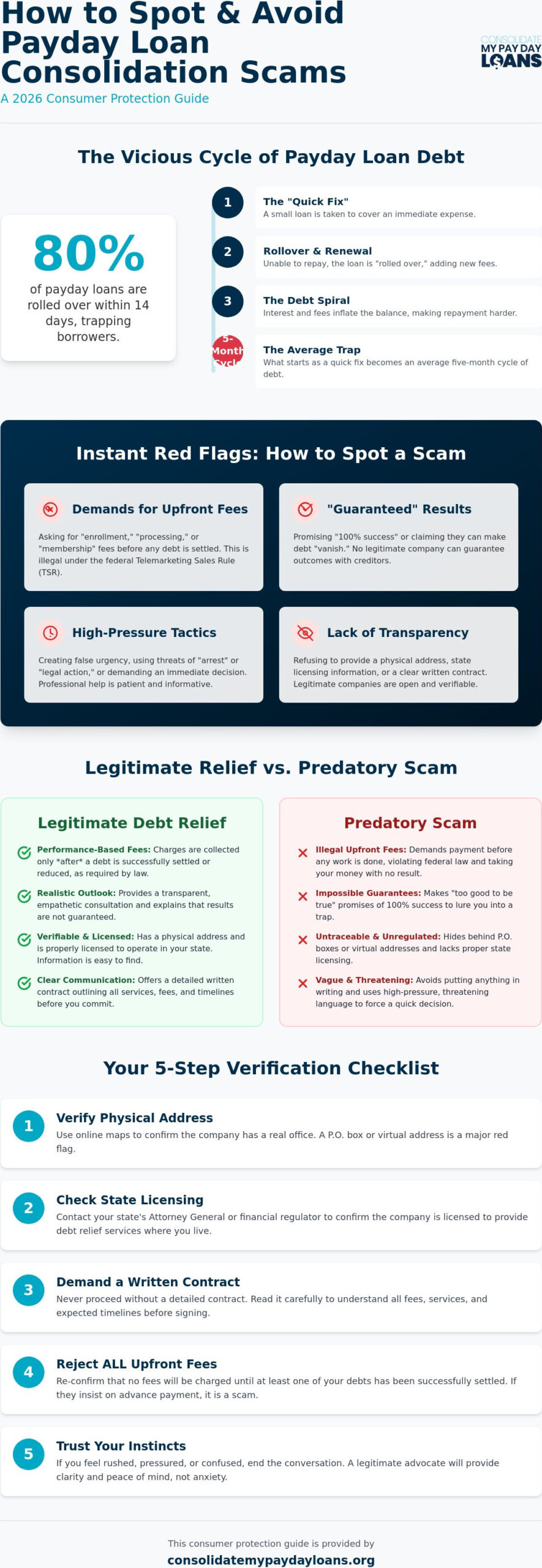
Your 2026 Safety Checklist: Vetting a Consolidation Service
Vetting a company while you’re under the pressure of collection calls is difficult. To protect your finances, you need a methodical approach that moves beyond emotional appeals. Use this five-step checklist during your initial consultation to identify and avoid payday loan consolidation scams before they can cause further harm. A legitimate company will welcome your scrutiny; a predator will try to rush past it.
- Step 1: Verify the physical address and state licensing. Scammers often hide behind virtual suites or P.O. boxes. Ask for their physical office address and verify that they’re licensed to provide debt relief services in your specific state.
- Step 2: Ask the “Fee Question.” Explicitly ask if they require any payment before your first debt is settled or consolidated. If they demand an “enrollment fee” or “setup charge” upfront, they’re violating the Telemarketing Sales Rule (TSR) and you should end the call.
- Step 3: Check for data protection standards. Ensure the company has a clear, written privacy policy. They should explain how they use 256-bit encryption to protect your sensitive data and confirm they won’t sell your information to third-party marketers.
- Step 4: Request a sample contract. Never provide bank access or a Social Security number before reviewing their terms. A professional advocate will provide a sample contract for you to review for 24 hours without any high-pressure tactics.
- Step 5: Review independent feedback. Look for reviews on third-party platforms like Trustpilot or state regulatory databases. Avoid relying solely on on-site testimonials, which can be easily fabricated by payday loan consolidation scams.
Questions to Ask on the First Call
You can quickly expose a fraudulent operation by asking three specific questions: “What is your registered license number for my state?”, “Can you provide the direct phone number for your compliance officer?”, and “Will you put your ‘guaranteed’ results in a signed, legally binding document?” A scammer will likely evade these questions or hang up. A legitimate company will always explain the risks, such as potential credit score impacts, because they prioritize your long-term stability over a quick sale. Full disclosure in debt relief means providing a comprehensive, written explanation of all program costs, potential credit impacts, and the legal reality of creditor negotiations before any commitment is made.
Red Flag Review: The “Instant Exit” List
There are certain phrases that should trigger an immediate exit from any conversation. If a representative claims they’re offering “Official government-backed relief” or a “special stimulus bailout,” hang up. Programs named after specific political figures or “government programs” for payday loans are common lures used in payday loan consolidation scams. Additionally, walk away if they ask you to lie to your current lenders or suggest you pay them a “security deposit” to activate your file. To begin vetting your options with a team that respects these standards, you can start your path to zero debt today with a transparent consultation.
Why Consolidate My Payday Loans is a Trusted Partner
Finding a legitimate path out of debt requires a partner who understands the systemic traps of high-interest lending. Since 2007, Consolidate My Payday Loans has served as a stable anchor for thousands of individuals facing financial turbulence. We don’t just offer services; we provide a protective environment where your stress is met with calm reassurance and actionable solutions. Unlike the predatory groups behind payday loan consolidation scams, our firm is built on a foundation of legal compliance and consumer advocacy. We strictly adhere to all federal guidelines, including the Telemarketing Sales Rule, ensuring that your financial recovery is never compromised by illegal upfront fees or hidden charges.
Many of our clients struggle with multiple forms of high-cost debt simultaneously. We provide a unified exit strategy through credit card and payday loan consolidation, simplifying your monthly obligations into a single, manageable plan. This integrated approach reduces the complexity of your finances and allows you to regain personal agency over your life. Throughout this process, our team maintains an empathetic, non-judgmental tone. We understand that financial struggles can happen to anyone. Our role is to lead you toward a safer alternative without the pressure or shame often associated with the lending industry.
Transparency Through Technology
We believe that information is your strongest weapon against predatory lending. Our proprietary payday loan consolidation calculator empowers you with real-world data, allowing you to see exactly how a structured program can reduce your burden. By entering your current balances and interest rates, you receive a transparent look at your path to zero debt. This technology isn’t a marketing gimmick; it’s a tool for clarity and momentum. Your dedicated counselor acts as a protective expert and advocate, using these numbers to create a custom exit plan tailored to your specific needs. They handle the mechanics of the process so you can focus on your psychological peace.
Taking the First Step Securely
The journey to recovery begins with a zero-obligation consultation. We provide a supportive space where you can discuss your situation openly and learn how to escape the payday loan trap without the extreme measure of bankruptcy. Our methodical approach ensures that you feel informed and guided at every turn. We’ve spent over 18 years refining our methodology to build consumer confidence and deliver tangible results. You don’t have to face the threats of payday loan consolidation scams or the harassment of original lenders alone. Our team is ready to help you regain your financial freedom through a structured, legal, and compassionate path.
Get your free debt analysis and see how much you can save.
Reclaim Your Financial Agency Today
Breaking the cycle of high-interest debt is possible when you have the right tools and a verified partner by your side. True legitimacy in this industry is found in transparency, legal compliance, and a commitment to your long-term stability. By following our 2026 verification checklist, you can confidently identify and avoid payday loan consolidation scams that thrive on financial desperation. Remember that professional advocates will never demand fees before delivering results and will always provide clear, written documentation of their process.
Consolidate My Payday Loans has spent over 18 years specializing in high-interest debt relief with a strict policy of no upfront fees. We act as a protective guide, helping you manage the mechanics of consolidation while shielding you from the harassment of original lenders. You deserve to live without the crushing weight of predatory interest rates and the constant fear of the next rollover. Taking control of your future starts with a single, secure step toward a structured repayment plan. If you’re tired of multiple lenders dipping into your account on their own schedules, learning about single payment payday loan consolidation can show you how to align your debt obligations with your actual life. See if you qualify for a legitimate payday loan relief program today. Better days are ahead, and you don’t have to navigate this path alone.
Frequently Asked Questions
Is it possible to consolidate payday loans without being scammed?
Yes, it’s entirely possible to consolidate your debt safely by working with established, licensed organizations. Legitimate companies follow federal laws and provide clear, written agreements before any action is taken. You can verify a company’s standing by checking with the Better Business Bureau or your state Attorney General. We’ve been helping individuals find relief since 2007, proving that ethical debt management is the standard for long-term financial recovery.
What is the most common payday loan consolidation scam?
The most frequent of all payday loan consolidation scams is the demand for an upfront fee. Scammers often claim they need a “setup fee” or “first month’s payment” before they can begin negotiating with your lenders. Federal law prohibits this practice for telemarketed debt relief services. If a company insists on payment before they’ve successfully settled or consolidated at least one of your debts, they’re likely operating a fraudulent scheme.
Can a legitimate company ask for my bank login info?
No, a legitimate debt relief provider will never ask for your private bank login credentials or passwords. While they’ll need your account numbers and current balance information to negotiate with lenders, they don’t require direct access to your online banking portal. Sharing your login details exposes you to identity theft and unauthorized withdrawals. Always keep your passwords private and only provide official statements or account numbers when enrolling in a program.
How do I report a debt relief scam to the FTC?
You should report any fraudulent activity directly to the Federal Trade Commission at ReportFraud.ftc.gov. Providing specific details like the company name, phone number, and the nature of their “offer” helps federal authorities track and shut down predatory operations. You should also contact your state Attorney General’s office. Reporting these incidents protects other vulnerable borrowers from falling victim to the same deceptive tactics and helps maintain the integrity of the industry.
Do legitimate consolidation companies charge monthly fees?
Legitimate companies do charge for their services, but these fees are only collected after specific milestones are met. Under the Telemarketing Sales Rule, fees for debt settlement services can only be charged after a debt has been successfully renegotiated. In a consolidation program, all costs must be clearly disclosed in your initial contract. Transparency regarding fees is a hallmark of a professional advocate; vague or hidden costs are a sign of trouble.
What happens if I stop paying my payday loans during consolidation?
Stopping payments without a structured legal strategy can lead to late fees, credit score damage, and potential lawsuits. Legitimate companies will explain these risks in detail during your initial consultation so you can make an informed decision. Scammers often give the dangerous advice to “just stop paying” without providing any protective framework. A professional advocate works to resolve the debt while keeping you informed of the consequences every step of the way.
Is Consolidate My Payday Loans a legitimate company?
Yes, Consolidate My Payday Loans is a legitimate service operated by Solid Ground Financial, which has been in business since 2007. With over 18 years of industry experience, we’ve established a reputation for specialized payday loan relief and consumer advocacy. We follow all federal regulations and offer a proprietary calculator to ensure total transparency for our clients. Our long history and adherence to ethical standards provide a stable anchor for those seeking recovery.
How can I tell if a debt relief review is fake?
You can often spot fake reviews by looking for overly generic language or clusters of high ratings posted on the same day. Real reviews usually include specific details about the client’s struggle and the actual outcome of the program. Be wary of testimonials that sound like marketing copy or appear only on the company’s own website. Check independent, third-party platforms for a more balanced and authentic view of the company’s performance and reliability.