
What if you could flip a switch and prevent a predatory lender from draining your bank account before you even wake up on Friday morning? Most borrowers feel trapped when they realize their entire paycheck is already spoken for by a high-interest lender. You’re likely exhausted from watching your balance hit zero while rent and groceries remain unpaid. It’s a cycle that feels impossible to break, especially when you fear that trying to stop automatic payments on payday loan accounts might lead to legal trouble or aggressive retaliation.
You have the legal right to regain control. In this guide, you’ll learn the exact steps to revoke your ACH authorization and shield your income from unauthorized withdrawals. We’ll walk through the process of providing the required three-day notice to your bank and explain your protections under current 2026 regulations. We’ll also look at how to distinguish a tactical stop payment from a default and how to transition toward a professional relief plan that ends the debt cycle for good.
Key Takeaways
- Understand your legal protections under the Electronic Fund Transfer Act (EFTA), which ensures you can stop preauthorized transfers regardless of your contract terms.
- Learn the precise steps to notify both your bank and your lender to successfully stop automatic payments on payday loan accounts and protect your balance.
- Discover why revoking ACH authorization is a more powerful, permanent solution for securing your bank account than a standard stop payment order.
- Prepare for the tactical shift lenders make after a revocation, including how to manage increased collection efforts while keeping your cash safe.
- Identify how to move beyond temporary “bandage” fixes by exploring permanent relief options like payday loan consolidation to end the debt cycle.
Myths vs. Reality: Is it Illegal to Stop Automatic Payments on a Payday Loan?
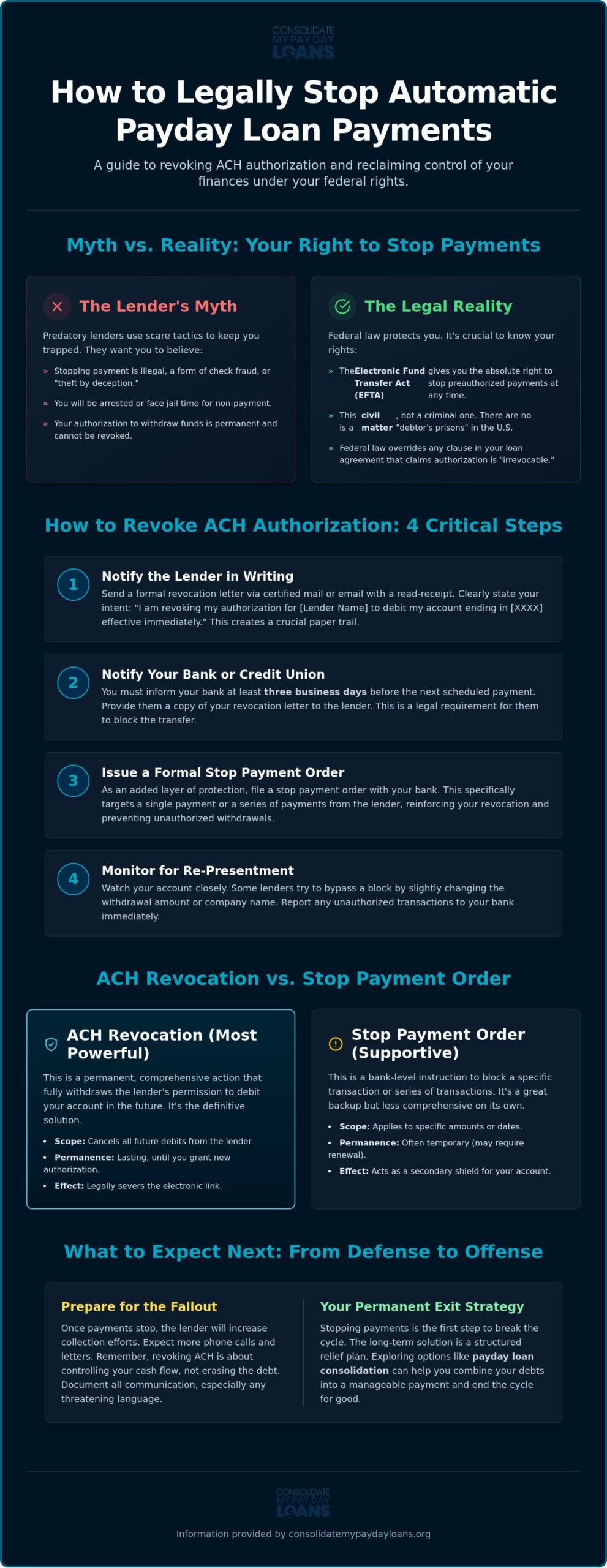
Fear is the primary tool of the high-interest lending industry. When you consider the decision to stop automatic payments on payday loan accounts, you might encounter aggressive messaging from your lender. Many predatory companies want you to believe that revoking access to your bank account is a form of check fraud, theft, or “theft by deception.” This is a deliberate tactic designed to keep you paralyzed. They frame your initial “authorization” as a permanent surrender of your financial agency, but that is simply not the case.
It’s vital to distinguish between your obligation to pay a debt and your right to control your bank account. Revoking a payment method is not the same as saying the debt doesn’t exist. You are simply choosing to stop a specific, recurring electronic withdrawal that is currently causing you financial harm. Lenders use the concept of “authorization” as a psychological weapon to keep you in a cycle of debt, hoping you’ll prioritize their high fees over your rent or food. However, no private contract can force you to give up your federal banking protections.
Your Rights Under the Electronic Fund Transfer Act
Federal law provides a shield that overrides any fine print in a payday loan contract. The Electronic Fund Transfer Act (EFTA) grants every consumer the legal right to stop any preauthorized electronic fund transfer. Because these authorizations are voluntary, you have the power to revoke them at any time. Even if you signed a digital document stating the authorization is “irrevocable,” federal law says otherwise. The Consumer Financial Protection Bureau (CFPB) continues to monitor these lenders in 2026, ensuring they don’t use aggressive ACH tactics to drain your account after you’ve clearly withdrawn your permission.
Debunking the ‘Jail Time’ Scare Tactic
One of the most common myths is that stopping a payday loan payment will lead to criminal charges or jail time. This is a blatant scare tactic. Payday loan defaults and payment revocations are civil matters, not criminal ones. In the United States, we do not have “debtor’s prisons,” and you cannot be arrested for exercising your rights under the EFTA.
If a lender threatens you with legal action or arrest for stopping a payment, they are likely crossing a legal line themselves. You should document these threats carefully. Remember, a loan contract cannot sign away your federal banking rights. You have the authority to protect your cash and regain control of your financial life without the fear of criminal prosecution hanging over your head.
How to Revoke ACH Authorization: A Step-by-Step Guide
Regaining control of your bank account requires a methodical approach. It’s not enough to simply delete a lender’s app or send a casual text to a representative. To effectively stop automatic payments on payday loan accounts, you must follow a specific legal protocol that leaves a verifiable paper trail. This process protects your balance and provides the evidence you need if a lender attempts to ignore your request. In 2026, with the rise of real-time payment rails, acting quickly is more important than ever to stay ahead of automated withdrawal systems.
- Step 1: Notify the lender in writing. Send a formal revocation letter to the lender. This document officially withdraws their permission to access your funds.
- Step 2: Notify your bank or credit union. You must inform your financial institution at least three business days before the next scheduled transfer to ensure they have time to process the block.
- Step 3: Submit a formal Stop Payment Order. If you suspect the lender will ignore your letter, a stop payment order through your bank acts as a secondary layer of security.
- Step 4: Monitor for re-presentment. Some lenders try to bypass bank blocks by slightly altering the withdrawal amount or changing the transaction description. Regular account monitoring is essential.
Drafting Your Revocation Letter
Your letter doesn’t need to be complex, but it must be precise. Include your full name, the specific account number, the date, and a clear statement of your intent. A strong template sentence to use is: “I am revoking my authorization for [Lender Name] to debit my account ending in [XXXX] effective immediately, and I direct you to cease all future electronic fund transfers from this account.” Send this via certified mail with a return receipt or via email with a read-receipt enabled. This documentation is your primary defense if a lender illegally continues to pull funds from your paycheck.
Dealing with Uncooperative Lenders
Predatory lenders often claim that their digital contracts are “irrevocable” or that you must pay the balance in full before revoking access. These are false statements intended to keep you in the debt trap. According to the CFPB, you have the right to stop a payday lender from taking automatic electronic payments regardless of what their internal policy says. If they refuse to acknowledge your request, keep a log of the time, date, and name of the representative you spoke with. This evidence is crucial for filing a formal complaint later. If you are currently figuring out how to manage multiple payday loans, staying organized across all accounts is the only way to prevent a cascade of overdraft fees.
Once you’ve secured your bank account, the next step is addressing the underlying debt so you don’t face aggressive collections. You can explore a professional payday loan consolidation strategy to replace high-interest chaos with a single, manageable plan that fits your budget.
Stop Payment Orders vs. Revoking Authorization: Which is Better?
When you decide to stop automatic payments on payday loan accounts, you’ll encounter two primary tools: revoking authorization and issuing a stop payment order. While they seem interchangeable, understanding the technical difference is vital for your financial security. Revoking authorization is your legal “divorce” from the lender. It’s a permanent move that tells the company they no longer have the right to touch your account. A stop payment order, however, is a specific instruction to your bank to block a particular transaction. For the most robust defense, you should use both. The revocation provides the legal foundation, while the stop payment provides the mechanical barrier at the bank level.
The Cost and Limitations of Stop Payment Orders
Most banks in 2026 continue to charge fees for stop payment orders, often ranging from $25 to $35 per request. This can be a significant burden when you’re already struggling to cover essentials. It’s also critical to remember the “14-day rule.” If you give an oral stop payment order over the phone, it typically expires after two weeks unless you follow up with a written confirmation. Lenders are aware of these technicalities. They may try to bypass a stop payment by slightly altering the withdrawal amount by a few cents, which is why this Consumer Financial Protection Bureau guide recommends being as specific as possible when talking to your bank’s fraud or customer service department.
When to Consider Closing Your Bank Account
Sometimes, a lender’s persistence makes it necessary to walk away from the account entirely. Closing your bank account is the “nuclear option.” It’s highly effective at stopping the bleeding, but it comes with the massive hassle of moving your direct deposits and legitimate autopays for things like rent and utilities. You must also be wary of “zombie debits.” Some financial institutions will automatically reopen a closed account if a lender submits a withdrawal request, which can lead to a cascade of new overdraft fees. If the pressure of these withdrawals is becoming too much to handle, learning how to lower payday loan payments through a structured relief plan is often a safer long-term strategy than simply jumping from one bank to another.
What Happens After You Stop the Payment? Preparing for the Fallout
Stopping the bleeding is a major victory, but it is not the end of the war. Once you successfully stop automatic payments on payday loan accounts, the lender’s strategy will shift immediately. They can no longer rely on automated withdrawals to drain your paycheck, so they will pivot to manual collection efforts. It’s crucial to understand that your debt hasn’t vanished. You have simply moved the battle from your bank account to your phone and mailbox. This transition is often when lenders become their most aggressive, using every psychological trick in the book to regain access to your cash.
Expect a surge in communication. You’ll likely receive “hardship” offers that sound helpful but often just add more fees to the total balance. If you don’t respond, the lender may eventually sell your account to a third-party collection agency. This is actually a turning point where you gain new legal protections, but it requires you to stay vigilant and organized. You are no longer a passive victim of automated theft; you are now a consumer in a dispute.
Managing Collection Harassment
You have rights, and it’s time to use them. Under the Fair Debt Collection Practices Act (FDCPA), third-party collectors must follow strict rules regarding how and when they contact you. Even with original lenders, you can limit the disruption to your life. Send a written “cease and desist” letter specifically demanding they stop calling your workplace. Lenders are legally prohibited from contacting you at your job if they know your employer forbids it. Always keep copies of every letter you send and receive. Moving all communication to writing creates a paper trail that protects you from verbal bullying and false promises. It’s much harder for a lender to harass you when they know every word is being documented for a potential legal complaint.
The Impact on Your Credit Score
Many borrowers worry about their credit score instantly plummeting after a revocation. While a default is never ideal, most payday lenders don’t report to the major national credit bureaus right away. Instead, they use specialized reporting agencies like Teletrack or Clarity Services. These reports are primarily seen by other high-interest lenders. However, if the debt is sold to a traditional collection agency, it could eventually land on your main credit report provided by the primary reporting institutions.
To avoid long-term damage, you need a plan that goes beyond just blocking a withdrawal. Taking a proactive approach through payday loan consolidation allows you to settle these obligations on your terms. If the calls are becoming overwhelming and you’re ready to stop the harassment, it’s time to explore professional relief and close this chapter of your financial life forever.
Beyond the Stop Payment: Your Permanent Exit Strategy
While revoking ACH access protects your immediate cash flow, it is essentially a financial emergency brake. It stops the immediate drain on your resources, but it doesn’t resolve the underlying debt that brought you here. If you simply stop automatic payments on payday loan accounts without a follow-up plan, you risk facing lawsuits or aggressive collection activity that could haunt your financial future for years. A permanent exit strategy requires moving from defensive maneuvers to a proactive recovery plan that addresses the root of the problem.
Professional payday loan relief is designed to replace the chaos of multiple high-interest lenders with a single, structured payment. Instead of juggling five different due dates and five different sets of predatory fees, you merge them into one manageable obligation. This process often involves professional negotiation to lower the total balance and interest rates, ensuring that more of your money actually goes toward the principal rather than endless fees. You can see the potential impact of this shift by using a payday loan consolidation calculator to estimate your path to freedom.
How Payday Loan Consolidation Works
The core benefit of consolidation is the psychological and financial breathing room it provides. When you work with a professional team, they handle the direct communication with your lenders, shielding you from the harassment we discussed in previous sections. This allows you to focus on rebuilding your life while your debt is managed systematically. It is important to understand the nuances of your options, such as debt settlement vs consolidation for payday loans, to choose the path that best protects your long-term interests and credit health.
Regaining Financial Agency in 2026
The ultimate goal of this process is to move out of survival mode and into a state of financial peace. This involves building a sustainable budget that eliminates the need for predatory lending in the future. By securing your bank account today and consolidating your debt tomorrow, you take back the agency that these lenders tried to strip away. You don’t have to face these companies alone or live in fear of the next withdrawal. If you are ready to stop the cycle and start your recovery, you can contact Consolidate My Payday Loans for a free relief consultation and begin your journey toward a debt-free life.
Reclaiming Your Financial Agency
You now have the legal foundation and the tactical steps required to protect your paycheck from predatory withdrawals. Exercising your federal right to stop automatic payments on payday loan accounts is a powerful act of self-defense, but it is just the beginning of your recovery. While revoking access provides immediate relief for your bank balance, a permanent exit requires a structured plan to handle the underlying debt without falling back into the cycle of high-interest borrowing.
Our team brings over 18 years of debt management expertise to your corner, offering a specialized focus on high-interest predatory loans through an A+ rated consumer advocacy approach. We understand the stress of financial turbulence and are committed to helping you transition from survival mode to lasting peace. Stop the cycle today with a professional payday loan relief program. You’ve already taken the hardest step by deciding to act; let us help you finish the journey toward the financial freedom you deserve.
Frequently Asked Questions
Can I stop a payday loan payment if I already signed the contract?
Yes, you can legally stop a payday loan payment even if your signed contract says the authorization is irrevocable. Federal law through the Electronic Fund Transfer Act ensures that consumers maintain control over their bank accounts at all times. No private agreement can strip away your right to withdraw consent for electronic debits. Simply notify the lender in writing and alert your bank to ensure the protection is enforced.
Will my bank charge me a fee to stop an automatic withdrawal?
Most banks and credit unions do charge a fee for processing a formal stop payment order. These fees typically range from $25 to $35 per request, depending on your financial institution’s policy. While revoking authorization is a legal right, the bank views the manual block of a specific transaction as a service. It’s helpful to check your bank’s 2026 fee schedule to understand the exact cost before submitting your request.
What should I do if the payday lender ignores my revocation letter?
If a lender continues to attempt withdrawals after you’ve revoked authorization, you should immediately provide your bank with a copy of your dated revocation letter. Your bank has a legal obligation to stop the payments once they’re notified. Additionally, you should file a formal complaint with the Consumer Financial Protection Bureau. Documenting the lender’s refusal to comply provides essential evidence if you need to pursue further legal or regulatory action.
Is it better to stop the payment or close my bank account entirely?
Stopping the payment is generally the preferred first step because it targets the specific predatory lender without disrupting your entire financial life. Closing an account is a drastic measure that requires moving all direct deposits and legitimate bill payments, which can lead to missed obligations. You should only consider closing the account if the lender repeatedly bypasses stop payment orders or if your bank refuses to honor your legal right to stop automatic payments on payday loan accounts.
Can a payday lender sue me for revoking ACH authorization?
A lender cannot sue you specifically for revoking your ACH authorization, as this is a protected legal right. However, they can still pursue a civil lawsuit to collect the underlying debt if the loan remains unpaid. Revoking access to your bank account doesn’t erase the money you owe; it simply changes how the lender is allowed to collect it. Most lenders prefer aggressive phone calls over expensive court dates, but the debt remains a legal obligation.
How many days notice do I need to give my bank to stop a payment?
You’re legally required to provide your bank or credit union with at least three business days’ notice before the scheduled transfer date. This timeframe ensures the bank has enough operational time to process the block and prevent the funds from leaving your account. If you provide less than three days’ notice, the bank may not be able to stop the immediate withdrawal, though they must still honor the revocation for all future attempts.
Can I stop automatic payments on a tribal or offshore payday loan?
Yes, you have the right to stop automatic payments on payday loan accounts regardless of whether the lender claims tribal immunity or is based offshore. While these lenders often argue they aren’t subject to state laws, your bank or credit union is a U.S. institution and must comply with federal banking regulations. By instructing your bank to block the transfers, you effectively cut off the lender’s access to your funds, regardless of their location or status.
Does stopping a payment affect my credit score?
The act of revoking ACH authorization does not directly impact your credit score, as it is a banking instruction rather than a credit event. However, if stopping the payment leads to a default and you don’t resolve the debt through other means, the lender may eventually report the delinquency. While many payday lenders use specialized reports, a long-term default that is sold to a traditional collection agency can eventually appear on your reports at the major national credit bureaus.