
Nearly 50% of payday loan borrowers default at least once within two years, yet many people still believe they’re trapped in a permanent cycle of interest. You aren’t alone if you’re currently staring at a bank account emptied by automatic ACH withdrawals or silenced by the anxiety of aggressive collection calls. It’s exhausting to watch your hard-earned money disappear into fees without ever touching the principal balance. You’ve likely reached a point where the traditional “just pay it off” advice feels impossible. The reality is that you have the right to negotiate payday loan debt and stop the predatory cycle of rollovers before it consumes your entire paycheck.
We understand the weight of this stress, and we’re here to act as your stable anchor through the turbulence. In this strategic guide for 2026, you’ll learn the exact methods to communicate with lenders to lower your total balance and regain control. We’ll show you how to transition from temporary relief to a permanent exit plan. By exploring professional consolidation options and using tools like a debt calculator, you can finally collapse multiple payments into one manageable step forward. It’s time to move past the fear and start your journey toward psychological peace and financial freedom.
Key Takeaways
- Understand why lenders are often willing to restructure your terms, as they prefer receiving a partial payment over a total default or bankruptcy.
- Master the exact steps to negotiate payday loan debt by documenting your financial hardship and gathering critical loan data before you start the conversation.
- Learn how to legally protect your bank account by revoking ACH authorizations to stop automatic withdrawals from depleting your balance.
- Compare the emotional demands of DIY negotiation against the benefits of professional relief programs that leverage established lender relationships.
- Discover how to transition from temporary debt relief to a permanent exit plan by consolidating multiple high-interest loans into one predictable payment.
Understanding the Power of Negotiating Payday Loan Debt
When you feel trapped by debt, it’s easy to view your financial situation as a personal failure. It isn’t. A Payday loan is a commercial product, and your inability to keep up with triple-digit interest rates is a common systemic outcome, not a lack of character. To negotiate payday loan debt is simply to engage in a business restructuring. You’re asking the lender to accept a realistic payment plan or a reduced lump sum instead of watching the account descend into a total default. This process shifts the power dynamic from the lender back to you.
The primary goal is to halt the interest death spiral. In 2026, many borrowers find themselves paying fees that exceed the original principal every few weeks. Negotiation breaks this cycle by forcing a conversation about the actual balance owed. By reaching an agreement to pay less than the full amount or extending the repayment term without additional penalties, you reclaim your agency over your bank account. You transition from being a source of recurring revenue for a lender to a person with a clear exit strategy.
Why Payday Lenders Are Open to Settlements
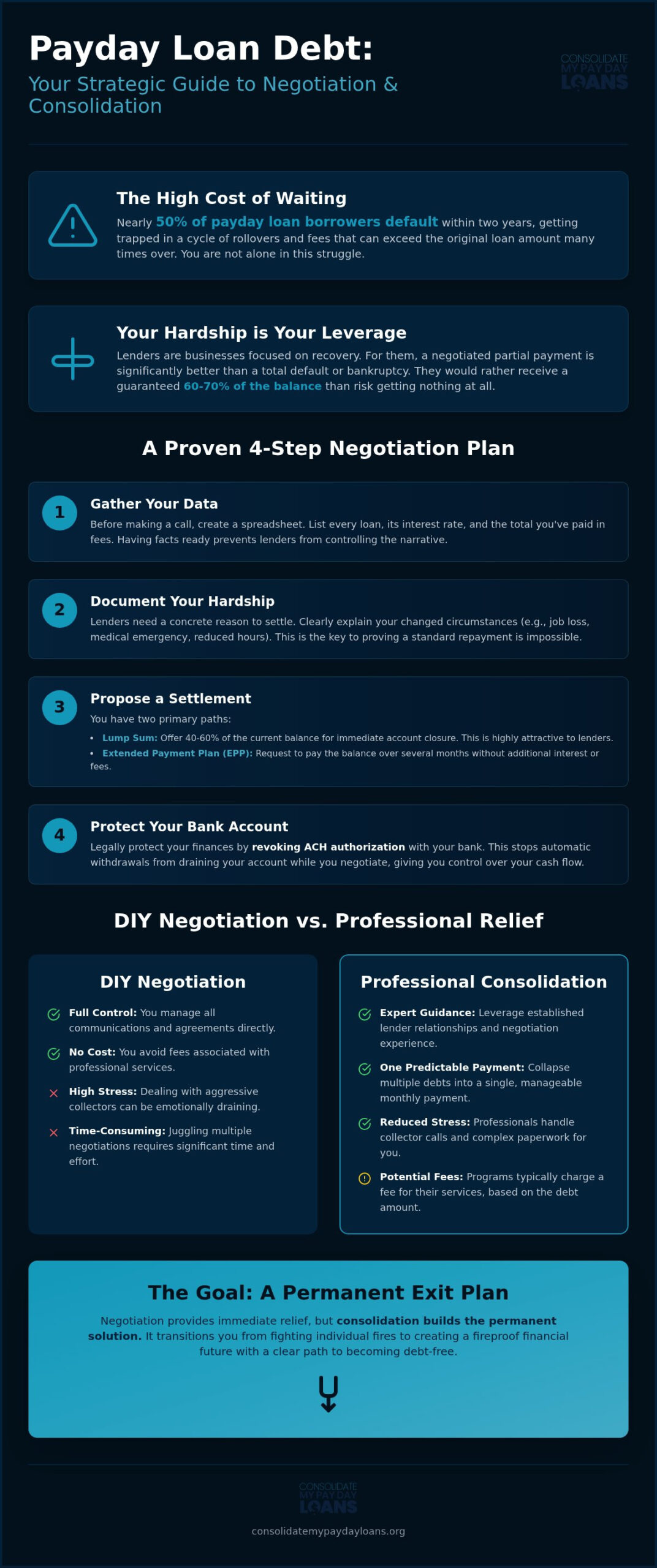
Lenders are motivated by one thing: recovery. They know that nearly 50% of borrowers default at least once within two years. From their perspective, receiving 60% or 70% of a balance through a negotiated settlement is far better than receiving nothing if you’re forced into bankruptcy or simply stop paying. They’d rather secure a guaranteed partial payment today than spend months on aggressive collection efforts that may never yield a cent. Your financial hardship actually gives you leverage in these discussions.
The Difference Between Negotiation and Consolidation
It’s vital to distinguish between these two paths. When you negotiate payday loan debt on your own, you’re often dealing with one lender at a time to settle a specific balance. It’s a tactical move. Payday loan consolidation is a broader strategy. It involves rolling multiple high-interest obligations into a single, structured payment with a clear end date. While negotiation provides immediate relief for one fire, consolidation builds the fireproof house that prevents future relapses into the debt cycle by managing the entire landscape of your obligations at once.
Proven Strategies for Successful Payday Loan Lender Negotiation
Successful negotiation starts with a spreadsheet, not a phone call. Before you pick up the phone to negotiate payday loan debt, you must have a clear, documented view of your financial landscape. List every active loan, the specific interest rate, and the total amount you’ve already paid in fees and rollovers. In many cases, you’ll discover you’ve already paid back the original principal multiple times over. Having these facts ready prevents the lender from steering the conversation toward their preferred narrative of “missed obligations.”
Once your data is ready, establish your hardship case. Lenders need a concrete reason to deviate from their standard collection protocol. Be prepared to explain, with dates and details, why your circumstances have changed. Whether it’s a job loss, a medical emergency, or an unexpected reduction in hours, your hardship is the leverage that proves a standard repayment is impossible. Highlighting these Payday Loan Dangers and your inability to meet them often makes a settlement the most logical path for the lender’s recovery department.
You generally have two primary paths for settlement. The “Lump Sum” strategy involves offering 40% to 60% of the current balance for immediate closure of the account. This is often the most attractive option for lenders who want to get the debt off their books quickly. If you don’t have a lump sum, request an Extended Payment Plan (EPP). In many jurisdictions, lenders are legally required to offer an EPP that allows you to pay the balance over several weeks or months without additional interest or fees. If managing these individual conversations feels like a full-time job, exploring payday loan relief can provide a structured way to handle multiple lenders at once.
Communication Tips for Dealing with Aggressive Collectors
Keep your emotions out of the conversation. Collectors are trained to use urgency and fear to provoke a payment. Stay calm and stick to your script. If a collector becomes abusive or threatens legal action they cannot take, remind them of your rights. You can also request that all future communication happen only via mail or email. This creates a paper trail and stops the constant ringing of your phone, giving you the mental space to think clearly about your next move.
How to Request a Written Agreement Before Paying
Never send a single cent until you have a signed, written agreement in your possession. A verbal promise over the phone is not a legal settlement. Ensure the document clearly states that the payment will satisfy the debt in full and that the lender will report the account as “settled” or “paid in full” to the credit bureaus. Check the math on the document carefully. Once you have the PDF or letter, keep a copy in a safe place for at least seven years to protect yourself against future collection attempts on the same debt.
DIY Negotiation vs. Professional Payday Loan Relief Programs
Choosing to handle your financial recovery alone is a brave decision, but it’s one that comes with a heavy emotional price tag. The DIY approach allows you to avoid service fees, yet it requires a level of emotional resilience that many find draining. You must be prepared for hours of repetitive phone calls, aggressive collection tactics, and the constant need to defend your rights against lenders who profit from your confusion. It’s a battle of endurance that can last for months without the guarantee of a favorable outcome.
Professional intervention offers a different path. Experts like Solid Ground Financial have been acting as a debt management anchor since 2004. Because we have established relationships with many of these lenders, we often bypass the initial layers of resistance that a borrower faces alone. This “insider knowledge” is a powerful tool. We understand the specific settlement thresholds for different companies and the legal nuances of 2026 regulations. When you use our payday loan relief programs, you’re hiring a dedicated advocate to handle the fighting so you can focus on rebuilding your life.
When to Stop Negotiating Alone
There is a specific point where trying to negotiate payday loan debt independently becomes counterproductive. If you have more than three lenders, or if the total debt exceeds your monthly take-home pay, the complexity of managing multiple agreements can lead to costly mistakes. If a lender refuses to stop automatic withdrawals despite your legal requests, or if the stress is impacting your health and job performance, it’s time to step back. Recognizing that you need a professional ally isn’t a sign of weakness; it’s a strategic move to protect your mental and financial health.
How Professional Consolidation Streamlines the Process
Professional programs move beyond simple talk. They provide a structured methodology that replaces chaos with predictability. Instead of juggling five different due dates and fluctuating interest rates, professional consolidation simplifies your life into one manageable monthly payment. This process typically includes the immediate cessation of lender harassment and the verification of all loan balances to ensure you aren’t paying more than legally required. By using a proprietary consolidation calculator, we help you visualize exactly when you’ll be debt-free. This clarity is the ultimate antidote to the anxiety caused by high-interest lending traps.
Essential Steps to Protect Your Bank Account and Rights
Stop the drain. Before you can successfully negotiate payday loan debt, you must first secure the funds you need for survival. Many borrowers feel paralyzed because their entire paycheck is spoken for before it even hits their account. This happens through automatic withdrawals that prioritize the lender’s profit over your rent or groceries. Protecting your bank account is the first step in reclaiming your agency. It transforms you from a passive victim of high-interest cycles into an active participant in your financial recovery.
The most powerful tool in your arsenal is the legal right to revoke your Automated Clearing House (ACH) authorization. This is not the same as a “stop payment” request on a single check. By revoking authorization, you are officially withdrawing the lender’s permission to access your bank account electronically. Under 2026 CFPB regulations, you have a clear path to stop these withdrawals by notifying both the lender and your bank. Once this permission is removed, any further attempts to pull funds are unauthorized and can be disputed through your financial institution.
Revoking Your ACH Authorization Legally
To revoke authorization effectively, you must provide written notice to the lender. Send this via email or certified mail so you have proof of receipt. Simultaneously, contact your bank to inform them that you have revoked the lender’s right to withdraw funds. Most banks require this notice at least three business days before the next scheduled transfer. If a lender ignores your request and continues to attempt withdrawals, they are in violation of federal law. This documentation becomes vital leverage when you eventually negotiate payday loan debt settlements.
If a lender continues to “re-present” the debt under different names or via different processing networks, you may need to utilize the “New Account” strategy. This involves moving your banking to a completely different institution. Simply closing an account at your current bank can sometimes result in “zombie” charges or overdraft fees if the bank allows the lender’s request to go through. Opening a fresh account at a new bank ensures a clean break and keeps your income safe while you work on a long-term resolution.
Stopping Harassment at Your Workplace
You are protected by the Fair Debt Collection Practices Act (FDCPA), which limits how and when collectors can contact you. If you receive calls at your place of employment, tell the collector clearly that you are not allowed to receive personal calls at work. Once they are notified of this, they are legally required to stop calling your job. Always keep a log of these interactions. Note the date, time, and the name of the person you spoke with. This paper trail serves as your shield against aggressive tactics.
Securing your bank account gives you the breathing room needed to evaluate your options without the constant fear of a zero balance. If you’re tired of the constant battle and want a professional to handle the defense for you, you can consolidate your payday loans into one manageable plan. This move stops the harassment and allows you to focus on a permanent exit from the debt cycle.
Moving Beyond Negotiation to Permanent Consolidation
Negotiation is a victory, but it’s often a temporary one. If you’re managing multiple high-interest obligations, trying to negotiate payday loan debt line by line can feel like an endless game of financial whack-a-mole. You settle one account only to have another lender ramp up their collection efforts or empty your bank account via a surprise withdrawal. This fragmented approach provides a short-term band-aid rather than a systemic cure. To truly break the cycle, you need a strategy that addresses the entire landscape of your debt simultaneously.
The transition to payday loan consolidation represents a shift from defense to offense. Instead of reacting to aggressive calls, you move into a structured environment where one payment, one interest rate, and one clear end date define your future. This isn’t just about the math; it’s about the psychological relief of knowing exactly when the burden will be lifted. You can use our payday loan consolidation calculator to visualize this timeline and see how a single manageable payment replaces the chaos of multiple due dates.
The Long-Term Benefits of a Single Monthly Payment
Simplicity is the ultimate shield against predatory lending. When you collapse several high-cost loans into a single monthly payment, you regain hours of mental energy previously spent tracking balances and due dates. This predictability allows you to rebuild your budget with confidence. More importantly, it stops the constant drain on your bank account, ensuring that you have the funds needed for essential living expenses while still making progress toward a debt-free life. It’s a methodical path toward regaining personal agency over your financial world.
Starting Your Recovery with Consolidate My Payday Loans
Since 2004, Solid Ground Financial has served as a stable anchor for thousands of individuals facing financial turbulence. We aren’t just a service provider; we’re a powerful ally committed to leading you toward a safer alternative to high-interest debt. Our team understands the pitfalls of the industry and handles the stressful interactions so you don’t have to. You don’t have to face these complex financial traps alone. Regain your financial agency today by partnering with experts who prioritize your recovery and peace of mind. We’re here to help you move from temporary relief to a permanent, debt-free exit plan.
Take the Final Step Toward Financial Peace
You now have the tools to break the cycle of high-interest lending. By securing your bank account through ACH revocation and understanding your legal rights, you’ve already taken the first steps toward recovery. While you can certainly attempt to negotiate payday loan debt on your own, you don’t have to carry that emotional burden in isolation. Professional consolidation offers a methodical, predictable path that replaces the stress of multiple lenders with a single, manageable monthly payment.
Solid Ground Financial has been a trusted debt management anchor since 2004. Our expert negotiators understand the specific tactics of predatory lenders and maintain an A+ commitment to providing non-judgmental support. It’s time to stop the rollovers and reclaim the psychological peace that comes with regaining personal agency over your financial life. Calculate Your Savings and Start Negotiating Your Exit Plan. Your recovery starts with a single, decisive step toward a safer alternative.
Frequently Asked Questions
Can I really negotiate my payday loan debt by myself?
Yes, you can. It requires patience and a clear record of your payments. Lenders often settle because they’d rather have some money than nothing. However, you must be prepared for aggressive collection tactics. Many people find that while they can start the process, managing multiple lenders becomes overwhelming without professional help. It’s often safer to have an advocate who understands the industry’s pitfalls.
Will negotiating a payday loan settlement hurt my credit score?
A settlement usually shows as “paid for less than the full balance” on your credit report. This might cause a temporary dip in your score. However, this is often better than having an open collection account or a default. Once the debt is settled, you can stop the cycle of late payments, which is the most damaging factor for your long-term credit health.
What happens if a payday lender refuses to negotiate?
If a lender refuses to negotiate payday loan debt, you still have legal protections. You can revoke your ACH authorization to stop bank withdrawals and force a different conversation. You might also consider consolidation programs that have established relationships with these lenders. Professional intervention often succeeds where individual attempts fail because experts know the specific settlement thresholds that lenders are willing to accept.
Is it legal to stop an ACH withdrawal for a payday loan?
Yes, it’s absolutely legal under federal law. You have the right to revoke authorization by notifying both the lender and your bank in writing. You should do this at least three business days before the next scheduled payment. Stopping these withdrawals doesn’t eliminate the debt, but it gives you control over your bank account while you work on a permanent repayment plan.
How much can I expect to save through professional debt negotiation?
Savings vary based on your specific lenders and the age of the debt. Professional negotiators aim to reduce the total balance by settling for a percentage of what’s owed or eliminating accrued fees. While we don’t guarantee specific dollar amounts, the goal is always to create a single, lower payment that fits your budget. You can use a consolidation calculator to visualize how these changes impact your path to freedom.
What is the difference between an extended payment plan and a settlement?
An extended payment plan (EPP) allows you to pay the full balance over a longer period without extra interest. A settlement is an agreement to pay a lump sum that is less than the total amount owed to close the account. Settlements are often better for those with a bit of cash on hand, while EPPs help those who need more time to pay the original principal.
Can a payday lender sue me if I am trying to negotiate?
While lenders have the right to sue for unpaid debts, it’s rare for small payday loans. The legal costs often exceed the loan amount. Most lenders prefer to negotiate payday loan debt rather than spend money on court fees. By staying in communication and showing a willingness to resolve the balance, you significantly reduce the likelihood of facing any legal action or a lawsuit.
How long does the negotiation and consolidation process typically take?
The initial setup for a relief program happens quickly, often within a few days. However, the full process of settling multiple loans can take several months. The duration depends on your budget and how many lenders are involved. A structured program provides immediate relief from collection calls while working steadily toward a final settlement for every account, ensuring you reach a permanent debt-free status.