
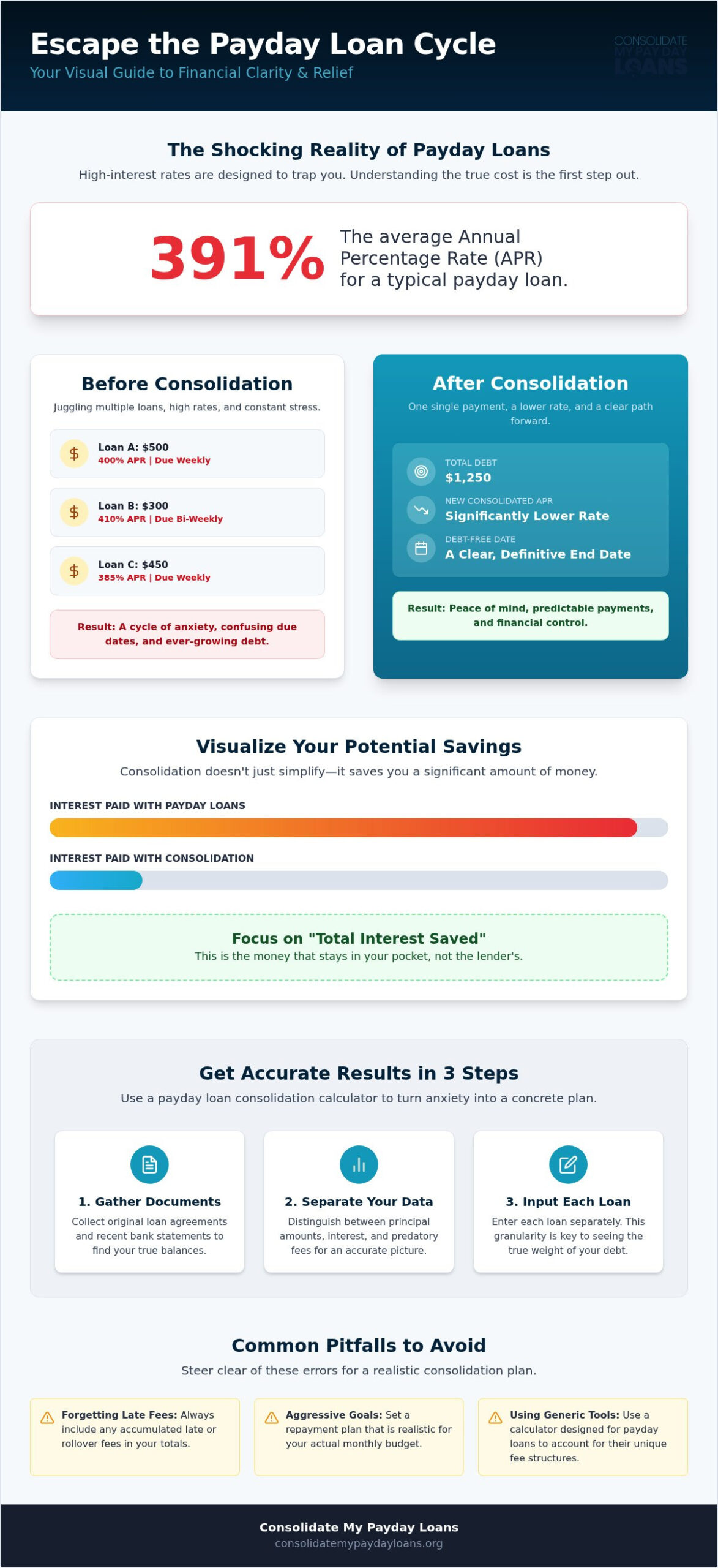
Did you know that the average annual percentage rate for a typical payday loan in 2026 is approximately 391%? This staggering figure is exactly why you might feel trapped in a cycle of high interest and aggressive collection tactics. If you’re struggling to keep track of multiple due dates or feeling anxious every time you check your bank balance before a withdrawal, you aren’t alone. It’s difficult to find clarity when you’re caught between confusing flat fees and skyrocketing APRs. Understanding how to use a payday loan consolidation calculator is the first step toward regaining control. This tool isn’t just about math. It’s a psychological anchor that transforms abstract fear into a predictable, structured repayment plan.
By accurately inputting your current debt data, you’ll move from uncertainty to a place of stable reassurance. We’ll show you how to gather your balances and rates to visualize your exact path toward financial freedom. You’ll learn how to generate a clear monthly payment figure and, most importantly, a definitive date for when you’ll be entirely debt-free. This article provides a methodical breakdown of the consolidation process, helping you transition from the burden of high-cost debt to the peace of mind that comes with a professional relief strategy.
Key Takeaways
- Transform financial anxiety into a concrete plan. Visualizing your path to a debt-free life is the first step toward regaining control.
- Master how to use a payday loan consolidation calculator by organizing your paperwork and accurately separating principal balances from predatory fees.
- Focus on the “Total Interest Saved” figure to see exactly how much money stays in your pocket rather than going to lenders.
- Steer clear of common errors like forgetting late fees or setting repayment goals that are too aggressive for your monthly budget.
- Transition from digital estimates to real-world results by using your calculator data as a roadmap for professional relief and expert negotiation.
Why a Payday Loan Consolidation Calculator is Your First Step to Relief
A payday loan consolidation calculator serves as a specialized digital interface designed to bridge the gap between financial chaos and structured recovery. It compares your current high-interest obligations against a realistic relief plan, allowing you to see the potential for a lower monthly payment. Many people feel paralyzed by their debt because they’re guessing their totals rather than knowing them. This uncertainty triggers a constant state of panic and keeps your stress levels high. By seeing the numbers clearly, you can reduce your cortisol levels and regain a sense of agency. It’s about moving from a reactive state to a proactive one where you’re in control of the narrative.
Standard financial tools often fail because they don’t account for the unique mechanics of short-term lending. Payday loans aren’t structured like traditional credit cards; they rely on rapid cycles and predatory fee-based rollovers. Understanding how to use a payday loan consolidation calculator correctly ensures your data reflects your actual financial situation rather than a generic estimate. Keep in mind that this tool provides a roadmap for your recovery. It’s a powerful guide to help you visualize the path, though it’s not a final legal contract. Learning how to use a payday loan consolidation calculator allows you to input these specific variables and prepare for a professional consultation.
Visualizing the End of the Debt Cycle
One of the most impactful features of this tool is the “Debt Free Date.” When you’re stuck in a loop of taking out new loans to pay off old ones, the end feels impossible to find. The calculator breaks down the “Infinite Rollover” math into a finite, manageable payment schedule. The debt cycle is a systemic trap that requires a mathematical exit strategy. Seeing a specific month and year for your exit changes your entire financial mindset. It turns an abstract, heavy burden into a finish line you can actually reach. This visualization is often the first moment of hope for those facing aggressive collection tactics.
Comparing APR vs. Flat Fees
Payday lenders frequently use flat fees to mask the true cost of borrowing. A fee of $15 per $100 borrowed might sound manageable, but it actually represents an APR of approximately 391%. The calculator translates these confusing fees into annual percentages for an honest comparison. This allows you to understand the “Real Cost” of your debt over a six-month period. By using debt consolidation, you can often replace these triple-digit rates with a significantly lower interest structure. Seeing the difference in black and white makes it easier to commit to a long-term relief plan.
Step-by-Step Guide: Inputting Loan Data for Results
Before you begin, gather your original loan agreements or your most recent bank statements. These documents contain the specific numbers that define your current financial situation. When reviewing your paperwork, it is vital to distinguish between the “Principal” amount you actually received and the “Interest and Fees” that have accumulated. Many short-term lenders rely on daily or weekly fee structures that standard financial tools often ignore. To get the most accurate estimate, you must input each loan from every lender separately. This granularity helps you see the true weight of each individual obligation rather than viewing them as one blurry mass of debt.
The Data You Need Before You Start
Organizing your information before you open the tool ensures the results are reliable. You’ll need the current outstanding balance, the interest rate or fee amount, and your next due date for every active loan. If you’re dealing with storefront lenders, check the physical receipts for fine print regarding rollovers. For online lenders, log into your portals to find the “Payoff Amount” rather than just the next scheduled payment. If you cannot find your original contract, your bank statement history is your best resource. Look for recurring ACH withdrawals to identify the lender and the frequency of payments.
Understanding how to use a payday loan consolidation calculator requires looking past the simple monthly payment. You must account for your current payment frequency, whether you pay weekly or bi-weekly. This timing is often the reason bank accounts fall into the negative. While you can find a generic debt consolidation calculator for basic credit card debt, payday loans require a more nuanced approach to handle their predatory nature. Factoring in these specific dates allows the tool to build a realistic timeline for your exit.
Entering Your Information into the Calculator
Once your data is ready, follow these three steps to see your potential savings. First, input the total balance of all payday loans combined. Don’t leave anything out; even a small $200 loan can derail a recovery plan if ignored. Second, estimate your current average interest rate. In 2026, many borrowers face rates between 300% and 600%. If you’re unsure, use 391% as a baseline, which is the national average for a typical two-week loan. Finally, select your desired monthly payment to see how it affects your total repayment term. Learning how to use a payday loan consolidation calculator empowers you to test different scenarios before you commit. If these numbers still feel overwhelming, you can explore a payday loan consolidation calculator specifically designed for these high-interest traps to find a more manageable path forward.
Interpreting Your Results: Savings, APRs, and Monthly Payments
Once you’ve entered your data, the calculator provides a “Total Interest Saved” figure. This number represents the actual cash that stays in your pocket instead of being funneled into predatory rollovers. It’s the most important metric for understanding your recovery. Seeing this total helps you realize that consolidation isn’t just about moving money around; it’s about stopping the financial bleeding. It’s the difference between sinking and swimming in a sea of high-interest obligations.
The monthly payment comparison is where you’ll see immediate cash-flow relief. By lowering your immediate cash outflow, you can finally cover essential expenses like rent and groceries without taking out a new loan. A longer, stable repayment term is often safer than the impossible two-week cycles typical of payday lending. It provides a steady rhythm you can actually maintain. You should also identify the break-even point. This is the moment when the interest savings from consolidation outweigh any associated costs of the relief program.
Analyzing Your New Monthly Payment
A single, structured payment replaces the anxiety of managing four or five separate bank withdrawals. This simplification is a core part of learning how to use a payday loan consolidation calculator effectively. You must ensure the new payment fits within your actual household budget. Remember that lower isn’t always better if the term is stretched so long that you lose momentum. The goal is a balance between a payment you can afford and a timeline that leads to freedom. It’s about finding a sustainable pace that prevents future relapses into high-interest borrowing.
Total Cost of Debt: Current vs. Consolidated
The math behind payday lending is shocking once it’s laid bare. A $2,000 balance can easily balloon into $10,000 over a single year if you only pay the minimum fees. This happens because the average APR of 391% compounds rapidly with every rollover. Visualizing this reduction through professional negotiation shows you how much of your hard-earned money is currently being wasted. To see these numbers for your specific situation, you can access the payday loan consolidation calculator to begin your analysis. Understanding how to use a payday loan consolidation calculator transforms these scary figures into a manageable, step-by-step plan for 2026.
Common Pitfalls When Using Debt Calculators and How to Avoid Them
Using a calculator is a vital first step, but it’s only as effective as the data you provide. One of the most frequent mistakes is underestimating total debt by forgetting to include late fees or pending interest. These small amounts accumulate quickly, skewing your results and leaving you short when it’s time to make a payment. Similarly, don’t overestimate your ability to pay. Being too aggressive with your monthly goal might look good on paper, but it can lead to another cycle of borrowing if the payment isn’t sustainable. It’s better to choose a figure that allows your household to breathe while still making progress.
Another major pitfall is mistaking an estimate for a guaranteed loan offer. A calculator is a planning tool, not a contract. It shows you what is possible through consolidation, but the final numbers depend on negotiation and your specific lender agreements. You must approach the results with a sense of realistic optimism. Use the data to inform your decisions, but remain flexible as you move toward a professional relief program. Clarity is your best defense against the confusion that payday lenders rely on to keep you in the debt cycle.
The Danger of Inaccurate Interest Rates
Many people mistakenly use a standard 20% credit card interest rate when learning how to use a payday loan consolidation calculator. Payday loans operate on a completely different scale, with the average 2026 APR hovering around 391%. If your lender only lists a flat fee, such as $15 per $100 borrowed, you need to find your “Effective APR” to get a real comparison. Accurate data is the only way to build a legitimate exit strategy. Without it, the calculator provides false hope instead of a functional roadmap. Take the time to find your actual rates so your plan stands on a solid foundation.
Protecting Your Bank Account During the Process
A common misconception is that running numbers through a calculator somehow stops your current lenders from accessing your funds. It doesn’t. The tool helps you plan, but it doesn’t revoke existing ACH authorizations or stop scheduled withdrawals. You need a proactive plan to manage these debits while you transition to a relief program. Understanding how to use a payday loan consolidation calculator involves timing your move with your next pay cycle to ensure you aren’t hit with unexpected withdrawals that cause overdraft fees. This coordination is essential for maintaining your financial stability during the transition.
Protecting your cash flow is just as important as reducing your interest rates. You can learn how to stop payday loan automatic withdrawals to keep your money where it belongs while you finalize your consolidation plan. This step ensures that your bank account remains a safe harbor rather than a target for predatory lenders. If you’re ready to move beyond digital estimates and secure your financial future, you can start your payday loan relief journey with our expert team today.
Beyond the Calculator: Turning Your Results into a Consolidation Plan
The calculator has given you the numbers. Now, you need a strategy to implement them. While some companies suggest taking out a new personal loan to cover your debt, this often isn’t an option for those trapped in the payday cycle. Traditional lenders look for high credit scores that the debt cycle has already damaged. A relief program is a safer alternative because it focuses on restructuring your current obligations rather than adding new ones. Professional negotiators use the data from your calculation to speak with lenders from a position of strength. They work to stop the rollovers and predatory fees that keep you stuck. Understanding how to use a payday loan consolidation calculator provides the foundation, but the relief program provides the execution.
The first 30 days of your consolidation plan are a critical transition period. This is when your new, verified budget takes effect. You’ll move from the chaos of multiple due dates to the simplicity of a single, organized payment. During this time, you’ll stop being a target for aggressive collection tactics and start being a partner in your own recovery. Finalizing your budget based on the calculator’s verified output ensures that you won’t fall back into the trap. It’s a methodical shift that replaces panic with a predictable rhythm.
Starting Your Payday Loan Relief Program
Consolidate My Payday Loans takes your initial estimate and validates it through a free consultation. This step is vital because it ensures your data is accurate before the negotiation begins. Advocacy is a major part of this process. We step in to help stop lender harassment, giving you the psychological space needed to focus on your recovery. For a deeper dive into the mechanics of this shift, you can refer to our payday loan consolidation guide. We verify every input to make sure your path forward is realistic and sustainable.
Your Path to Financial Peace
Your journey began with learning how to use a payday loan consolidation calculator to see what was possible. Now, that vision is turning into a reality. The long-term goal isn’t just to pay off the debt, but to improve your overall financial health and credit score. Once the burden of high-interest debt is gone, you can begin rebuilding your personal agency. You’ve done the math. Now, it’s time to take the final step toward a debt-free 2026. Get your free payday loan consolidation estimate today and start your path to peace.
Take the First Step Toward Your Debt-Free 2026
Regaining control over your finances starts with clarity. Throughout this guide, you’ve learned that visualizing your debt is the most effective way to break the psychological grip of high-interest lenders. By mastering how to use a payday loan consolidation calculator, you’ve moved from guessing your totals to knowing your exact path forward. You now understand the importance of distinguishing between principal and predatory fees to ensure your repayment plan is grounded in reality.
A calculator provides the vision, but professional relief provides the results. Our team focuses on expert negotiation with high-interest lenders to stop the cycle of rollovers and predatory fees for good. We help you replace the chaos of multiple due dates with a single manageable monthly payment that fits your actual household budget. Don’t let another month of 391% interest drain your bank account or your peace of mind.
Get Your Custom Payday Loan Relief Estimate Now
You have the tools and the knowledge to make 2026 the year you finally break free. We are here to help you turn that mathematical roadmap into a permanent financial victory.
Frequently Asked Questions
Is a payday loan consolidation calculator accurate?
Yes, it provides a highly reliable estimate based on the specific data you provide. Accuracy depends on inputting your correct principal, interest rates, and fees for every active debt. While it offers a mathematical roadmap, it’s an estimation tool rather than a final contract. Our experts at Consolidate My Payday Loans use these results as a starting point to negotiate the final terms with your lenders.
How much can I save by consolidating my payday loans?
Savings vary but often represent thousands of dollars in interest and predatory fees. Payday loans frequently carry APRs near 391%, and consolidation aims to replace these high-cost cycles with a structured, lower-interest plan. By stopping rollovers and late fees, you keep more of your income. The calculator helps you visualize the total interest saved by comparing your current payments against a unified relief strategy.
Do I need to enter my credit score into the calculator?
No, our calculator doesn’t require a credit score to generate an estimate. Traditional debt tools focus on creditworthiness for new loans, but payday loan relief focuses on restructuring your existing debt. Because we specialize in relief programs rather than traditional lending, your current score isn’t a barrier to seeing your potential savings. This allows you to explore options without the fear of a hard credit inquiry.
Can I use this calculator for multiple lenders?
Yes, you can and should include every active lender for the most accurate results. Learning how to use a payday loan consolidation calculator effectively involves listing each loan separately. Whether you have debt from storefronts or online apps, combining them into one calculation provides a comprehensive view of your financial situation. This total picture is essential for our negotiators when they begin working with your various creditors.
What is the difference between a savings estimate and a loan offer?
A savings estimate is a projection of what you could save, whereas a loan offer is a legal contract. The calculator shows the potential benefits of moving from high-interest debt to a structured relief plan. It isn’t an application for a new loan. Instead, it serves as a planning tool. Once you have your estimate, our advocates verify the numbers during a consultation to build your finalized consolidation plan.
Will using a debt calculator affect my credit score?
No, using our online calculator has zero impact on your credit score. It’s a purely educational tool that doesn’t perform a credit pull. You can test different repayment scenarios safely. While the calculator itself doesn’t change your score, successfully completing a consolidation program often leads to long-term credit improvement by eliminating high-interest debt and preventing future defaults or collection actions that would damage your report.
What information do I need to use the payday loan calculator?
You’ll need your current balances, interest rates or fee structures, and payment frequencies. To understand how to use a payday loan consolidation calculator, gather your recent bank statements or loan agreements. Knowing whether you pay weekly or bi-weekly is crucial for mapping out a sustainable schedule. Having these numbers ready allows the tool to generate a clear debt-free date and a manageable monthly payment figure.
What should I do if the calculator shows I still cannot afford the payments?
If the estimate feels out of reach, contact our team for a professional consultation. The calculator provides a baseline, but our experts have over 20 years of expertise through parent company Solid Ground Financial in negotiating deeper concessions. We can often work with lenders to extend terms or further reduce fees beyond what a digital tool predicts. Don’t let a high estimate discourage you; it’s the starting point for personalized advocacy.