
Did you know that 80% of payday loan borrowers in 2026 are repeat customers? This isn’t a personal failure or a lack of discipline. It is the mechanical reality of a system designed to keep you paying indefinitely. If you feel like you’re stuck in a payday loan trap because automatic withdrawals empty your account before you can buy groceries, you aren’t alone. It’s exhausting to watch interest fees climb higher than the original amount you borrowed while lenders continue their relentless harassment.
This cycle of debt is a state of emergency for many, but it’s actually a structural problem that requires a structured exit strategy. Our goal is to provide you with the professional tools and insider knowledge needed to regain your financial agency and find psychological peace. We’ll show you exactly how to protect your bank account from unauthorized hits, stop the cycle of rollovers, and move toward a single, manageable monthly payment that actually reduces your balance. By understanding the architecture of these loans, you can finally dismantle the burden and start your recovery.
Key Takeaways
- Understand the mathematical mechanics of high-interest debt that cause interest fees to quickly surpass your original loan amount.
- Discover the legal framework for protecting your bank account and stopping automatic withdrawals from predatory lenders.
- Identify the specific steps required to break free if you feel stuck in a payday loan trap and stop the cycle of endless rollovers.
- Compare DIY fixes with professional relief programs to determine the most effective way to merge multiple payments into one manageable amount.
- Map out your first 30 days of financial recovery to ensure a permanent transition from debt stress to long-term stability.
Recognizing the Payday Loan Trap: Why You Feel Strangled
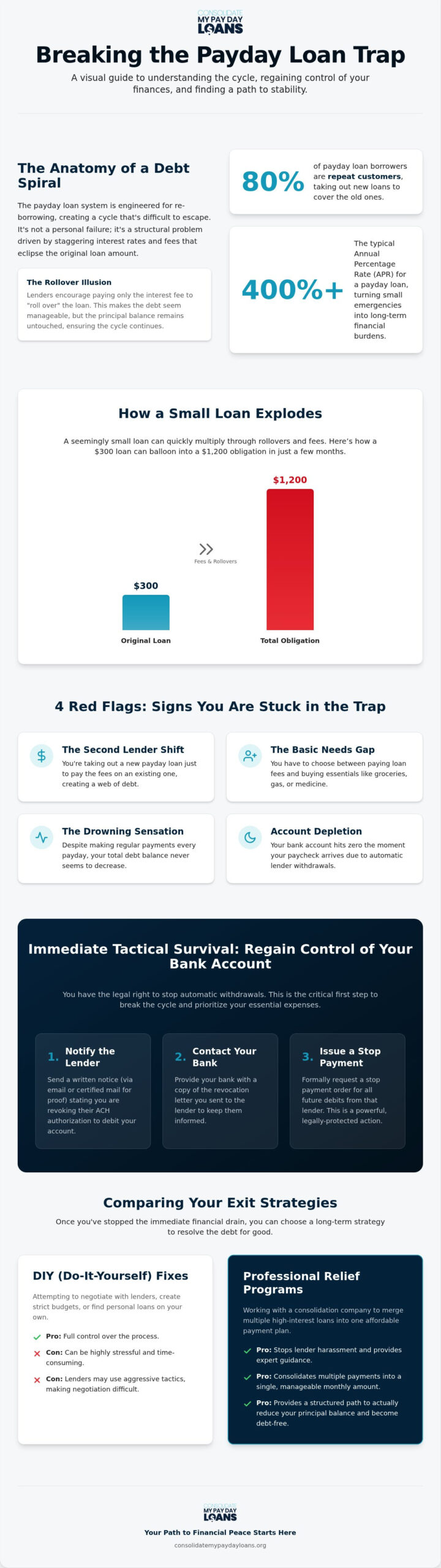
The payday loan trap is rarely a one-time event. It is a calculated cycle of re-borrowing specifically engineered to keep you in debt. When you take out a small loan to cover an emergency, you aren’t just borrowing cash; you are entering a mathematical stranglehold where interest rates often exceed 400% APR. This isn’t a reflection of your character or your intent to pay. The system is built to prevent you from ever touching the principal amount, ensuring that every dollar you earn goes toward interest and fees.
Many people describe this experience as a financial merry-go-round. You pay the fee to keep the lender at bay, but the original balance remains untouched. This emotional stress is exhausting. It’s a constant state of panic where your hard-earned money disappears before you can even use it. Understanding that this is a systemic design, rather than a personal failure, is the first step toward reclaiming your life.
The Anatomy of a Debt Spiral
The mechanics of a debt spiral are deceptively simple. A $300 loan can easily balloon into a $1,200 obligation within just a few months. This happens through “rollovers” and “renewals.” Instead of paying the loan in full, lenders encourage you to pay only the interest fee to extend the due date. This masks the total cost and makes the debt feel manageable in the short term. However, the “new money” illusion is the primary trap mechanism. Lenders may offer you a slightly larger loan to “pay off” the old one, but this simply resets the clock on a higher balance with even more aggressive fees.
Signs You Are Officially Stuck
Identifying the moment you’ve become stuck in a payday loan trap is vital for your recovery. It often starts with subtle shifts in your budget that eventually become impossible to ignore. Look for these red flags:
- The Second Lender Shift: You find yourself taking out a new loan from a different company just to cover the interest or fees on your first loan.
- The Basic Needs Gap: You are forced to choose between paying loan fees and buying essentials like groceries, gas, or medicine.
- The Drowning Sensation: You make regular payments every two weeks, yet your total debt balance never actually decreases.
- Account Depletion: Your bank account hits zero or goes into the negative the same day your paycheck is deposited due to automatic lender withdrawals.
If these scenarios sound familiar, you are facing a structural problem that a simple budget cannot fix. The cycle is spinning because the lenders have direct access to your bank account, giving them priority over your survival. To break free, you must disrupt these mechanics and move toward a solution that prioritizes your stability over their profit.
Immediate Tactical Survival: Taking Back Control of Your Bank Account
To break the cycle of being stuck in a payday loan trap, you must first stop the bleeding. Many borrowers feel powerless as automatic bank withdrawals empty their accounts on payday, but you have significant legal protections. You aren’t just skipping a payment when you take action; you are exercising your right to control how your money is handled. Taking back your bank account is the essential first step before you can look at long-term payday loan relief strategies. You must prioritize your survival expenses, such as rent and food, over the predatory demands of high-interest lenders.
How to Stop Payday Loan Automatic Withdrawals
Regaining control starts with revoking ACH authorization. This is a formal process that tells the lender they no longer have permission to pull funds from your account. ACH revocation is a legal consumer right under the Electronic Fund Transfer Act. To execute this effectively, follow these specific steps:
- Notify the lender: Send a written notice to the lender stating that you are revoking their authorization to debit your account. Use email or certified mail to ensure you have a paper trail.
- Contact your bank: Provide your bank with a copy of the revocation notice you sent to the lender.
- Issue a Stop Payment: Formally request that your bank place a stop payment order on all future attempts from that specific lender. Banks may charge a small fee for this service, but it’s a fraction of a payday loan’s interest.
In extreme cases where lenders ignore these notices or use different merchant names to bypass blocks, you may need a clean slate strategy. This involves opening a new account at a completely different financial institution and moving your direct deposits immediately. This creates a physical firewall between your income and the lenders, ensuring they cannot touch your money without your express permission.
The Extended Payment Plan (EPP) Option
If your lender is a member of the Community Financial Services Association of America (CFSA), they are required to offer an Extended Payment Plan (EPP). This is a legal requirement in many states that allows you to pay back the loan in smaller installments over a longer period without additional interest or fees. You must usually apply for an EPP at least one business day before your loan is due. Negotiating this option can provide the breathing room needed to organize a more permanent solution. It transforms a lump-sum crisis into a manageable schedule, giving you the space to breathe while you plan your final exit from high-interest debt.
Comparing Your Exit Strategies: DIY vs. Professional Relief
When you find yourself stuck in a payday loan trap, the most common instinct is to look for another loan to pay off the first. This is the “Band-Aid” approach. It provides a few days of quiet but leaves the underlying infection of high-interest debt untouched. Real recovery requires structural relief that changes the math of your debt rather than just moving it from one lender to another. Expert negotiation is often the only way to lower the total amount you owe by identifying and removing predatory fees that have ballooned over time.
Many borrowers try to navigate this alone, but the lending industry is designed to be confusing. Lenders count on your panic to keep you in the cycle of rollovers. Moving from a DIY survival mindset to a professional relief strategy is how you transition from just getting by to actually getting out. It’s about building a firewall between your income and the people trying to drain it.
Why Traditional Debt Consolidation Loans May Not Work
Standard bank loans are rarely an option for those caught in a debt spiral. Most people stuck in a payday loan trap have credit scores between 500 and 600, which acts as a major barrier to traditional personal loans. Even if you qualify for a high-risk personal loan, you might just be shifting the debt without stopping the high interest. Payday Alternative Loans (PALs) from credit unions are a lower-cost option, but they come with strict membership requirements. You usually need to be a member for at least 30 days before you can even apply, which doesn’t help if your bank account is being emptied today. Without a high credit score or existing credit union relationship, the traditional path is often a dead end.
The Benefits of Professional Payday Loan Relief
Professional payday loan relief programs offer a different path by acting as a protective expert between you and the lender. By entering a payday loan hardship program, you can effectively freeze the accumulation of interest. This ensures that every dollar you pay actually reduces your principal balance instead of just covering fees. A professional advocate uses their industry knowledge to negotiate settlements and remove junk fees that lenders often hide in the fine print. This process consolidates multiple debts into one manageable monthly payment, giving you a clear, predictable roadmap toward financial peace and personal agency.
Consolidation: The Structural Solution to Break the Cycle
If you feel like you’re perpetually stuck in a payday loan trap, you need more than a temporary fix. You need a fundamental change to your financial architecture. Consolidation serves as a protective firewall between you and the aggressive collection tactics of high-interest lenders. It stops the frantic juggling of multiple due dates and replaces it with a single, predictable path forward. This approach isn’t just about moving money around; it’s about reclaiming your income so it works for you instead of your lenders.
The psychological relief of this transition cannot be overstated. When you’re caught in the rollover cycle, there is no end in sight. Consolidation provides a definitive “exit date” for your debt. Knowing exactly when you’ll be free from these obligations allows you to plan for the future with confidence rather than living in a state of constant financial panic.
How Payday Loan Consolidation Works in 2026
Payday loan consolidation merges your various high-interest obligations into one manageable monthly payment. Instead of dealing with five different lenders who all want access to your bank account on the same day, you work with a single intermediary. This professional advocate manages the communication with your lenders and ensures your payments are applied toward the principal balance. Consolidation replaces a chaotic cycle of rollovers with a structured, declining balance. This shift is vital because it ensures that every dollar you pay actually reduces what you owe, rather than just covering another extension fee.
Consolidating Loans and Credit Cards Simultaneously
Many people facing high-interest debt aren’t just struggling with payday lenders; they’re often managing maxed-out credit cards as well. Implementing a strategy for credit card and payday loan consolidation creates a unified exit strategy that addresses your entire debt profile. By merging these different types of debt, you reduce the total number of “points of failure” in your monthly budget. Every separate bill is a chance for a missed payment, a late fee, or a hit to your credit score. A unified strategy prevents the need for new debt by ensuring your income is actually sufficient to cover your structured obligations.
To see how this transition affects your specific situation, use our payday loan consolidation calculator to visualize your potential savings and path to freedom. Taking this step allows you to see the mechanical reality of your recovery. If you’re ready to stop the cycle today, you can start your payday loan consolidation plan and finally regain your financial agency.
Your Path to Financial Peace: Moving Beyond the Trap
Breaking free from being stuck in a payday loan trap is a significant victory. It marks the transition from survival mode to intentional living. The first 30 days after entering a relief program are often the most transformative. During this time, you’ll experience the quiet of a bank account that isn’t being drained by unauthorized hits. This period is about establishing a “safety-first” budget that prioritizes your essential living expenses like rent, utilities, and groceries. It’s a time to breathe and reset your expectations for what your financial life can look like.
Reclaiming Your Financial Agency
Once your payments are structured, you can focus on building a stable foundation. You might still receive “phantom calls” from old lenders whose systems haven’t caught up with your new status. Don’t let these calls rattle you. Your consolidation team acts as your protective expert, handling these communications so you don’t have to. As you follow the roadmap, your successful payday loan consolidation becomes the engine for your credit growth. As your total debt balance decreases, your credit utilization improves, naturally lifting your score over time.
Is Consolidation Better Than Bankruptcy?
Many people consider bankruptcy when they feel stuck in a payday loan trap, but it’s important to understand the long-term trade-offs. Bankruptcy is a severe legal action that can stay on your credit report for seven to ten years, affecting your ability to rent an apartment or buy a car. Choosing payday loan consolidation instead of bankruptcy offers a more strategic exit plan. It allows you to protect your long-term credit profile while maintaining the dignity of paying back your debt on terms you can actually afford. This approach demonstrates financial responsibility to future lenders while providing you with immediate psychological peace.
We aren’t just a service provider; we’re your partner in this recovery process. Our team is committed to leading you toward a safer financial alternative and ensuring you never fall back into the high-interest cycle. If you’re ready to stop the stress and start your journey toward financial agency, contact us for a free consultation today. Let’s build a structured path to your freedom together.
Step Into Your Financial Freedom Today
Breaking free from the cycle requires more than just willpower. It takes a structural shift in how your debt is managed. You’ve learned how to take back control of your bank account and why professional consolidation is often the most effective firewall against predatory lending practices. Since 2004, we’ve operated as a protective expert for people across the United States. Our expert negotiators focus exclusively on high-interest debt to ensure you stop the rollover cycle for good.
If you feel stuck in a payday loan trap, don’t wait for the next withdrawal to empty your account. You have the right to a predictable financial life and psychological peace. Take the first step toward a single, manageable payment and a definitive debt-free date. Calculate your path to freedom with our Payday Loan Consolidation Calculator and see the mechanical reality of your recovery. You are not alone in this fight, and a stable, debt-free future is closer than you think.
Frequently Asked Questions
How do I legally stop a payday lender from taking money from my bank account?
You can legally stop withdrawals by revoking your ACH authorization. Under the Electronic Fund Transfer Act, you have the right to cancel automatic payments by notifying the lender in writing and informing your bank. It’s best to send this notice at least three business days before the scheduled transfer. This action prevents the lender from emptying your account, though the debt still exists and must be managed through other means.
Can I go to jail for not paying back a payday loan?
No, you cannot go to jail for failing to repay a payday loan. Payday loans are civil debts, not criminal matters. While lenders or collectors may use aggressive language or illegal threats of arrest to intimidate you, being unable to pay a debt is not a crime in the United States. However, a lender can still take you to civil court to obtain a judgment or attempt to garnish your wages.
What happens if I simply stop paying my payday loans?
If you stop paying without a structured plan, the lender will likely initiate aggressive collection efforts. This usually includes frequent phone calls, emails, and eventually selling the debt to a third-party collection agency. While the original loan might not appear on your credit report, a collection account will significantly damage your score. In some cases, lenders may file a lawsuit to recover the funds through wage garnishment or bank levies.
Is there a way to consolidate payday loans with bad credit?
Yes, consolidation programs are specifically designed for individuals who are stuck in a payday loan trap and have low credit scores. Unlike traditional bank loans that require a high score, these programs focus on your ability to make a single, manageable monthly payment. By merging your high-interest obligations into one structured plan, you can stop the cycle of rollovers and begin rebuilding your financial stability without needing a perfect credit history.
How much does a payday loan consolidation program typically cost?
The cost of a consolidation program varies depending on the total amount of debt and the specific terms negotiated with your lenders. Generally, these programs are structured so that your new monthly payment is significantly lower than the combined total of your previous loan fees. The goal is to ensure the plan fits within your budget while providing a clear path to full repayment. You should always review the program’s fee structure during your initial consultation.
Will consolidating my payday loans stop the harassing phone calls?
Yes, entering a professional consolidation program typically stops the harassment from lenders. Once you are represented by a consolidation company, the lenders are often required to communicate directly with your advocate rather than calling you. This provides immediate psychological relief and allows you to focus on your recovery. If a lender continues to contact you illegally, your consolidation team can provide guidance on how to handle those violations.
Can I consolidate both credit cards and payday loans together?
You can certainly consolidate both credit cards and payday loans into a single unified plan. This approach is often more efficient because it reduces the number of monthly points of failure in your budget. By merging these different types of high-interest debt, you can apply a consistent strategy to lower your overall interest burden. This holistic method ensures that all your predatory obligations are handled simultaneously, preventing new debt while you pay off the old.
How long does it take to get out of a payday loan trap using consolidation?
Most individuals can break free from the payday loan cycle within 6 to 24 months through a structured consolidation program. The exact timeframe depends on the total amount of debt you owe and the monthly payment amount you can comfortably afford. Unlike the endless cycle of rollovers, consolidation provides a definitive end date. You’ll know exactly when your debt will be fully repaid, allowing you to plan for a future with total financial agency.