
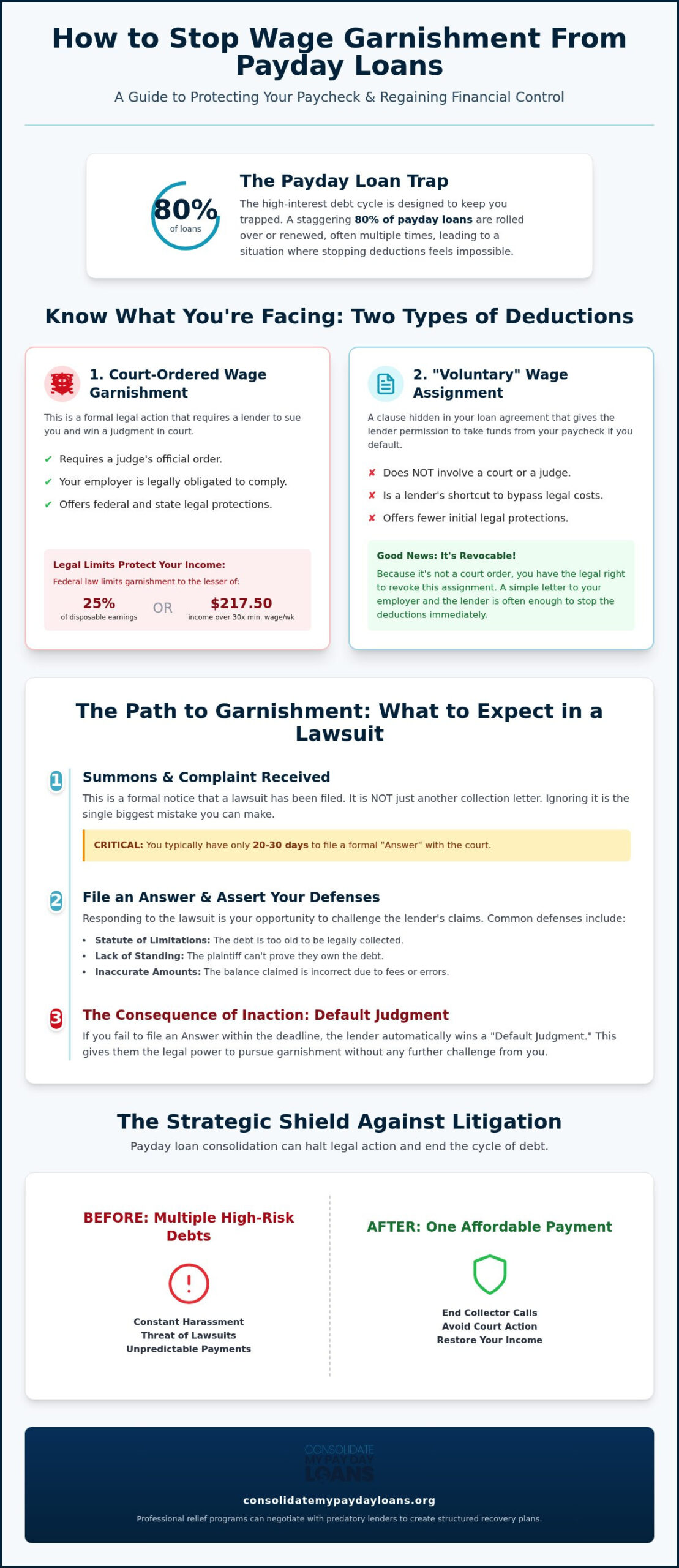
What if the money disappearing from your paycheck every Friday wasn’t a permanent loss, but a reversible legal situation? It’s exhausting to watch your hard-earned income vanish before you can even pay for groceries, and finding a way to stop wage garnishment from payday loans can feel like an impossible task when you’re facing constant collector harassment. We understand that the cycle of high-interest debt is designed to keep you trapped, especially when 80% of these loans are rolled over into new debt.
You shouldn’t have to choose between your bills and your peace of mind. This 2026 recovery guide will teach you the legal strategies and relief programs available to halt garnishment and regain control of your paycheck today. We’ll explain the difference between voluntary wage assignments and court orders, highlight federal exempt income thresholds, and show you how consolidation can turn a legal crisis into a manageable monthly payment.
Regaining your financial agency starts with knowing your rights. Let’s look at the specific steps you can take to protect your income and end the courtroom drama for good.
Key Takeaways
- Distinguish between voluntary wage assignments and court-ordered garnishments to identify which legal protections apply to your specific situation.
- Take immediate action to stop wage garnishment from payday loans by revoking ACH authorizations and wage assignments with both your lender and employer.
- Understand the 2026 legal requirements for debt judgments to ensure you protect your rights and avoid the consequences of an ignored court summons.
- Explore how payday loan consolidation serves as a strategic shield against litigation, replacing high-risk debt with one predictable and affordable payment.
- Learn how professional relief programs negotiate with predatory lenders to end harassment and restore your disposable income through structured recovery plans.
Understanding Payday Loan Wage Garnishment vs. Wage Assignment
Seeing a smaller number on your pay stub is a gut-punch that leaves you wondering how you’ll cover rent or put food on the table. If you’re trying to figure out how to stop wage garnishment from payday loans, you first need to identify exactly what legal mechanism the lender is using to take your money. Most people assume that any deduction from their paycheck is a “garnishment,” but in the world of high-interest lending, there’s a significant difference between a court order and a voluntary agreement you might have signed without realizing it. Knowing the difference is the first step toward reclaiming your income.
What is a Court-Ordered Wage Garnishment?
A true wage garnishment doesn’t happen overnight. It requires a specific legal sequence: the lender must file a lawsuit, win a judgment against you, and then obtain an order from a judge. The Legal Process of Garnishment ensures that there are boundaries on how much can be taken from your check. Under federal law in 2026, the maximum amount an ordinary consumer debt collector can seize is the lesser of 25% of your disposable earnings or the amount by which your weekly income exceeds 30 times the federal minimum wage ($217.50 per week). In this scenario, your employer acts as the “garnishee.” They are legally obligated to send those funds to the creditor until the debt is fully satisfied or the order is vacated.
The Wage Assignment: The Payday Lender’s Shortcut
Payday lenders often skip the courtroom entirely by using a “wage assignment.” This is a clause buried in the fine print of your original loan agreement where you “voluntarily” agreed to let the lender contact your employer if you default. Lenders prefer this method because lawsuits are expensive and time-consuming; they would rather use this shortcut to bypass the judge and go straight to your payroll department. Because it didn’t go through a court, it doesn’t offer you the same legal protections or notice periods that a formal judgment provides.
The good news is that these assignments aren’t as powerful as they look. A wage assignment is not a court order and can often be stopped with a simple letter. In many states, you have the legal right to revoke this authorization at any time without hiring a lawyer. If you haven’t been served with a summons or seen a judge, you are likely dealing with an assignment rather than a garnishment. Taking this first step is a critical part of the process to stop wage garnishment from payday loans before it drains your bank account. You can usually identify which one is affecting you by asking your HR department for a copy of the document the lender sent them. If it doesn’t have a court seal and a judge’s signature, it’s an assignment you can likely cancel today.
The Legal Process: How a Payday Lender Secures a Judgment
Receiving a legal summons in the mail is a terrifying experience, but understanding the timeline of a lawsuit can replace that fear with a clear plan of action. A payday lender cannot simply call your boss and demand money; they must first navigate a specific litigation cycle. This process begins long before a single cent is taken from your check. Recognizing the transition from aggressive collection calls to formal legal action is vital for anyone trying to stop wage garnishment from payday loans.
The Summons and Complaint Phase
The transition to legal action starts when you are served with a summons and a complaint. This is a formal notice that a lawsuit has been filed against you in civil court. Many borrowers make the mistake of treating these documents like just another collection letter. In 2026, ignoring a lawsuit is the most common reason people lose their income. You typically have a narrow window of 20 to 30 days to file a formal “Answer” with the court. If you fail to respond, the lender wins a “Default Judgment” automatically. This allows them to bypass any scrutiny regarding illegal payday loan garnishment tactics or unconscionable interest rates that might otherwise have been challenged in court.
When you file an answer, you can present several defenses, such as:
- Statute of Limitations: The debt may be too old to legally pursue in your state.
- Lack of Standing: The debt buyer may not have the original contract proving they own your debt.
- Inaccurate Amounts: The lender might be claiming fees that aren’t allowed under state law.
Post-Judgment: When the Garnishment Becomes Active
Once a lender secures a judgment, they obtain a “Writ of Garnishment.” This is the specific court order served to your employer’s payroll department. Because you likely provided your employer’s name on the original loan application, the lender already knows where to send the paperwork. Your employer is then legally required to notify you of the pending deduction. However, certain income sources are protected. Social Security, disability benefits, and specific “head of household” exemptions in some states can prevent a lender from taking your money, even with a judgment in hand.
The best way to stop wage garnishment from payday loans is to prevent the judgment from being finalized in the first place. If you’re currently facing the threat of a lawsuit, exploring payday loan relief can help you settle the debt before it ever reaches a courtroom. Proactive management is always more effective than trying to reverse a court order after it has already been served to your HR department.
Immediate Actions to Stop or Prevent Payday Loan Garnishment
If you’ve just received a court summons or noticed a sudden deduction in your pay, your first instinct might be to panic or ignore the problem. Some online forums suggest “financial ghosting” by closing your bank accounts or quitting your job, but these tactics often lead to deeper legal trouble and damaged credit. You have more effective, legal options to protect your income. Taking decisive steps right now can help you stop wage garnishment from payday loans before the situation spiraling out of control.
Stopping the Bleeding: ACH and Wage Revocation
Many payday lenders use pre-authorized ACH transfers to pull funds directly from your bank account the moment your paycheck is deposited. You have the legal right to stop these automatic withdrawals. Under federal law, banks must honor your request to stop a payment if you provide notice at least three business days before the scheduled transfer. While this doesn’t erase the debt, it prevents the immediate drain on your liquid cash. Simultaneously, you should send a formal “Notice of Revocation” to both the lender and your employer’s payroll department to cancel any voluntary wage assignments you may have signed.
Initiating a formal payday loan hardship program is a professional way to signal that you intend to resolve the debt but cannot meet the current predatory terms. This documentation can be vital if the case ever goes before a judge, as it proves you made a good-faith effort to negotiate. It moves the conversation away from aggressive collection and toward a structured resolution.
Negotiating a Settlement Before the Court Date
Lenders are often more interested in recovering a portion of the principal than paying high legal fees for a full trial. If you’ve been served with a summons, you can still negotiate a settlement to dismiss the lawsuit. This might involve a lump-sum payment for less than the total balance or a structured repayment plan that fits your actual budget. To successfully stop wage garnishment from payday loans through negotiation, you must ensure any agreement is put in writing and filed with the court to formally vacate the case.
Before you sign any settlement, audit your loan for predatory violations. In 2026, many states have strict interest rate caps, and the Military Lending Act provides a 36% APR limit for active-duty service members and their families. If your loan exceeds these legal limits, the entire contract may be unenforceable in court. Use these specific points during your audit:
- Check if the lender is licensed to operate in your specific state.
- Verify if the APR exceeds state-mandated usury caps.
- Determine if the lender followed the CFPB’s rules regarding repeated withdrawal attempts.
By addressing these violations early, you gain significant leverage in negotiations. This proactive approach is your strongest defense against losing your essential income to a court-ordered deduction.
Strategic Debt Consolidation: The Shield Against Litigation
While previous sections focused on immediate legal defenses, the most effective long-term strategy is to remove the reason for litigation entirely. Choosing payday loan consolidation allows you to replace predatory, high-risk debt with a structured, managed plan. This shift fundamentally changes your relationship with lenders. Instead of dealing with aggressive collectors who use the threat of lawsuits as a weapon, you work with a third-party advocate who handles the communication for you. This professional intervention is often the fastest way to stop wage garnishment from payday loans because it moves the debt out of the “default” category and into a active repayment status.
Consolidation acts as a vital “reset” for your financial life. It allows you to address the debt privately, which avoids the embarrassment of your employer being notified through a writ of garnishment. When you enter a consolidation program, the lender’s incentive to sue diminishes because they are now receiving regular, negotiated payments. You can use a payday loan consolidation calculator to determine exactly what your new, lower monthly payment will be, giving you a clear mathematical path out of the trap.
Why Consolidation is Better Than Bankruptcy
Many people consider bankruptcy as a last resort, but the long-term consequences are severe. A bankruptcy filing stays on your credit report for up to 10 years, making it difficult to secure housing or future credit. In contrast, consolidation helps you build a positive payment history as you systematically eliminate your balances. By choosing to consolidate payday loans instead of bankruptcy, you avoid the public record and the heavy legal fees associated with Chapter 7 or 13 filings. It is a faster, more discreet way to recover your financial standing without the courtroom drama.
Merging Multiple Debts into One
If you’re juggling several high-interest obligations, the psychological relief of having a single payment date cannot be overstated. A comprehensive approach that includes credit card and payday loan consolidation simplifies your entire financial life into one affordable monthly cost. This strategy is designed to eliminate the “rollover fees” that make payday loans nearly impossible to pay off. When you stop the compounding fees, every dollar you pay actually goes toward reducing your principal balance. To start protecting your paycheck and ending the cycle of debt, you should explore your payday loan relief options today.
How a Payday Loan Relief Program Ends the Cycle
Breaking free from the high-interest debt trap requires more than just a temporary stop-gap. While legal revocations and consolidation provide immediate protection, a comprehensive relief program addresses the systemic issues that keep you anchored in debt. By working with professional negotiators, you move away from the “courtroom drama” and toward a structured recovery plan. These programs are designed to stop wage garnishment from payday loans by replacing adversarial collection tactics with a professional, mediated resolution that lenders are often more willing to accept.
One of the most tangible benefits of entering a relief program is the immediate restoration of your disposable income. Experts in predatory loan negotiation can often lower your total monthly payments by up to 50%, allowing you to prioritize essential expenses like rent and groceries. This reduction isn’t just a convenience; it’s a vital tool for survival that prevents the need for new, high-interest loans to cover basic living costs. When you have a professional advocate handling the communication, the constant harassment from debt collectors stops, providing the psychological peace necessary to focus on your long-term financial health.
What to Expect in a Relief Program
The journey toward a debt-free life begins with a detailed assessment of your current financial landscape. During the initial consultation, an expert will audit your total debt, interest rates, and monthly income to determine the best path forward. This leads into the negotiation phase, where the program works to reduce interest rates and waive the predatory late fees that cause balances to skyrocket. Once the terms are settled, you enter the maintenance phase. This stage simplifies your life into one affordable payment, ensuring you stay on track toward full repayment without the threat of legal action looming over your paycheck.
Participation in a structured payday loan relief program can also serve as a legal shield. Many lenders will pause pending garnishment proceedings once they see a borrower is working with a recognized relief advocate, as they prefer a guaranteed repayment plan over the uncertainty and expense of a prolonged trial.
Regaining Your Financial Agency
The final step in your recovery is ending the “shame cycle” that often accompanies payday lending. Predatory lenders rely on your fear and silence to keep you trapped, but taking proactive steps restores your personal agency. As your debt decreases, you can begin building a 2026 budget that accounts for savings and emergency funds, rather than just debt service. This shift from a defensive posture to an offensive financial strategy is the ultimate goal of any relief effort. You don’t have to face these complex financial traps alone; help is available to protect your income and your future. Get your free payday loan relief consultation today and take the first step toward reclaiming your paycheck.
Reclaim Your Financial Agency and Protect Your Future
Watching your earnings disappear before you can pay for basic needs is a heavy burden, but it’s one you don’t have to carry alone. By distinguishing between voluntary wage assignments and formal court orders, you’ve already taken the first step toward a resolution. Whether you need to revoke an ACH authorization immediately or require a long-term strategy to stop wage garnishment from payday loans, the tools for recovery are within your reach. Proactive consolidation and specialized relief programs offer a clear path away from the courtroom and toward lasting stability.
With over 20 years of debt management expertise, Solid Ground Financial serves as a national advocate for consumer rights. Our specialized payday loan relief programs are designed to negotiate directly with predatory lenders, lowering your payments and ending the cycle of harassment. You have the power to replace financial turbulence with a steady, predictable plan for growth. Stop the garnishment cycle and consolidate your payday loans today. Your journey toward a debt-free 2026 starts with a single, decisive action. Peace of mind is possible, and it begins the moment you decide to take back control.
Frequently Asked Questions
Can a payday lender garnish my wages without a court order?
No, a payday lender cannot legally garnish your wages without first filing a lawsuit and obtaining a formal court judgment. While they may use aggressive language in collection letters, they have no legal authority to force your employer to withhold funds until a judge signs an order. If you haven’t been served with a summons, any money currently being taken is likely through a voluntary wage assignment rather than a legal garnishment.
How much of my paycheck can a payday lender legally take in 2026?
For ordinary consumer debts in 2026, the maximum amount that can be garnished is the lesser of 25% of your weekly disposable earnings or the amount by which your pay exceeds $217.50 per week. This threshold is based on 30 times the federal minimum wage of $7.25. These federal limits ensure you keep enough of your paycheck to cover basic living expenses even while a debt is being collected through the courts.
What is the difference between a wage assignment and wage garnishment?
Wage garnishment is a court-ordered process that requires a legal judgment, whereas a wage assignment is a voluntary agreement often hidden in the fine print of your loan contract. Because a wage assignment isn’t a court order, you can typically revoke it by sending a formal notice to your lender and employer. This is a critical distinction for those trying to stop wage garnishment from payday loans before a lawsuit is ever filed.
How do I stop a payday lender from taking money out of my bank account?
You can stop automatic bank withdrawals by revoking your ACH authorization in writing with both the lender and your bank. According to federal rules, your bank must stop these transfers if you provide notice at least three business days before the scheduled payment. Taking this step prevents lenders from draining your account the moment your paycheck hits, giving you the breathing room needed to seek professional relief or consolidation.
Will my employer fire me if they receive a wage garnishment order?
Federal law prohibits your employer from firing you because your wages are being garnished for any single debt. Protection under Title III of the Consumer Credit Protection Act ensures that you aren’t penalized at work for one financial mistake. However, this protection might not apply if you have multiple garnishments from different creditors, so it’s vital to resolve the debt through a relief program as quickly as possible.
Can I consolidate my payday loans if my wages are already being garnished?
Yes, you can still seek help to stop wage garnishment from payday loans through consolidation even if an order is currently active. While it’s more effective to consolidate before a judgment is secured, professional relief programs can often negotiate with creditors to vacate the judgment in exchange for a structured repayment plan. This can restore your full paycheck and simplify your debt into one affordable monthly payment.
Is Social Security income exempt from payday loan garnishment?
Yes, Social Security benefits are generally exempt from garnishment for consumer debts like payday loans under federal law. These funds are protected to ensure that retirees and individuals with disabilities have a guaranteed income for survival. If a lender attempts to seize these funds, you can file a claim of exemption with the court to protect your benefits from being touched by creditors.
How long does a wage garnishment for a payday loan last?
A wage garnishment continues until the total debt, including the original principal, interest, and any court-awarded legal fees, is paid in full. Because payday loans often carry an average national interest rate of 391% APR in 2026, the balance can grow faster than you can pay it off through standard deductions. Entering a relief program can help freeze these costs and significantly shorten the time it takes to become debt-free.