
What if your next paycheck actually stayed in your bank account instead of vanishing the moment it hit your balance? For many, the reality of 2026 involves a constant state of “financial triage” where automatic withdrawals and 391% average interest rates make it impossible to stop the payday loan cycle. It’s exhausting to feel like you’re borrowing just to pay back what you already owe, especially when you’re facing harassment from collectors or the fear of an emptied account. You deserve a path out that doesn’t involve more high-interest debt or the complexity of bankruptcy.
We understand the pressure you’re under, and we’re here to act as your ally in reclaiming your financial agency. This article provides a clear, step-by-step exit strategy designed for the current regulatory environment. You’ll learn exactly how to revoke bank access under the Electronic Fund Transfer Act to protect your cash flow immediately. We’ll also walk you through the mechanics of negotiating with lenders and using consolidation to replace multiple predatory loans with one manageable payment. It’s time to stop the rollovers and start your recovery with a plan that puts you back in control.
Key Takeaways
- Identify the predatory mechanics of loan renewals and rollovers that cause small balances to spiral into massive debt.
- Execute a formal ACH revocation to legally protect your bank account and reclaim control over your immediate cash flow.
- Navigate the “hardship” conversation to secure an Extended Payment Plan, a rights-based option many lenders fail to mention.
- Evaluate professional relief options to stop the payday loan cycle by replacing high-interest traps with one predictable, lower-cost payment.
- Build a sustainable “emergency buffer” that ensures you never have to rely on short-term cash advances to cover future expenses.
Why the Payday Loan Cycle is Designed to Keep You Trapped
The payday loan cycle is a systemic trap built to exploit temporary cash flow gaps rather than a personal failure of financial management. To understand how to stop the payday loan cycle, you first have to recognize that the product is working exactly as intended. According to the standard definition of what is a payday loan?, these are short-term, high-interest obligations. However, they rarely remain short-term. Lenders rely on “rollovers,” a process where you pay a fee to delay the principal balance for another two weeks. This creates a mountain of debt from a molehill of a loan.
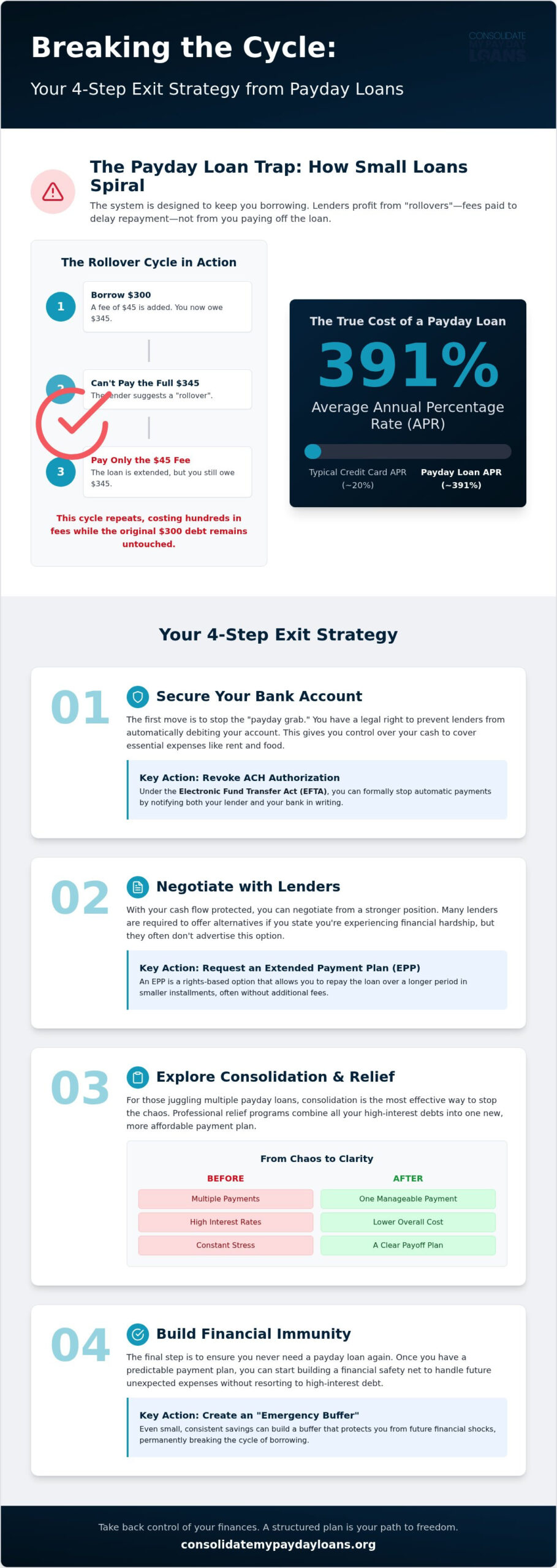
Consider a typical $300 loan. With a standard fee of $15 per $100 borrowed, you owe $345 in just 14 days. If you can’t pay the full amount, the lender invites you to “renew” by paying just the $45 fee. Two weeks later, you still owe the original $345. If this repeats for a few months, you’ve paid hundreds in fees while the $300 principal remains completely untouched. In many cases, a single $300 borrowing event can balloon into over $1,000 in total payments. Lenders prefer this renewal because it generates pure profit without ever reducing their claim on your future income.
The psychological toll of this arrangement is heavy. You find yourself “borrowing from Peter to pay Paul,” taking out a new loan from a second lender just to cover the interest at the first one. This constant juggling creates a state of chronic financial stress. It clouds your decision-making and makes the trap feel inescapable, but understanding the mechanics is the first step toward breaking free.
The True Cost of High-Interest Rollovers
High-interest rollovers are designed to be deceptive. When the average annual percentage rate (APR) is approximately 391%, the interest climb is vertical. Most of your payment goes toward fees rather than the principal. This “fee-only” trap ensures your balance never moves, effectively turning a two-week loan into a permanent drain on your resources. Over time, this destroys your debt-to-income ratio. It makes it nearly impossible to qualify for traditional, lower-interest credit that could actually help you rebuild your stability.
How Predatory Lending Targets Your Paycheck
Lenders don’t just want your money; they want priority access to it. They often time automatic withdrawals to hit the second your direct deposit lands, often before you can pay rent or buy groceries. This aggressive timing leads to “loan stacking,” where you’re forced to carry three or more loans simultaneously just to survive the week. Recognizing these predatory tactics is the first step toward finding payday loan relief and reclaiming your financial peace.
Step 1: Secure Your Bank Account and Stop Automatic Withdrawals
The most immediate threat to your financial stability is the “payday grab,” where lenders drain your account the moment your paycheck arrives. To stop the payday loan cycle, you must first reclaim control over your own cash flow. Federal law is on your side here. Under the Electronic Fund Transfer Act (EFTA), you have the legal right to revoke a lender’s authorization to take automatic payments from your account. This is a powerful tool for anyone feeling suffocated by high-interest withdrawals. Revoking a lender’s access to your account does not discharge the debt, but it does ensure your paycheck stays in your pocket so you can cover essential living expenses like rent and food.
Many borrowers believe they are trapped because they signed a contract. However, the Consumer Financial Protection Bureau on payday loans clarifies that you can stop a debit even if you previously authorized it. Taking this step shifts the power dynamic. It moves you from a passive victim of automatic drafting to an active participant in your own debt resolution. Once your survival cash is safe, you can use a payday loan consolidation calculator to see how a structured plan might replace these chaotic withdrawals with a single, manageable payment.
The ACH Revocation Process
Stopping the cycle requires a formal, two-pronged approach. First, send a certified letter to your lender stating that you are revoking your ACH (Automated Clearing House) authorization. Keep a copy of the signed mail receipt as proof. Second, notify your bank or credit union. You should provide them with a copy of the revocation letter you sent to the lender.
Timing is critical in this process. You must notify your bank at least three business days before the scheduled transfer to ensure they have time to block the transaction. When speaking with your bank’s ACH department, use clear language: “I am revoking my authorization for [Lender Name] to withdraw funds from my account, and I want to place a stop payment order on all future transfers from this company.” Be aware that banks may charge a small fee for stop payment orders, but this is a fraction of the cost of a typical payday loan fee.
Should You Open a New Bank Account?
If a lender ignores your revocation or if you have multiple predatory loans, opening a new bank account at a different institution might be necessary. This “fresh start” approach prevents “zombie withdrawals” where lenders attempt to draft funds under different business names. It’s a drastic but effective way to protect your income.
When switching, move your direct deposit immediately and ensure the old account is not linked to the new one through “overdraft protection” features. Lenders sometimes use sophisticated tracking to find new accounts, so complete separation is vital. This tactical maneuver gives you the breathing room needed to execute a long-term exit strategy without the constant fear of an empty balance on payday.
Step 2: Negotiate with Lenders and Request an Extended Payment Plan (EPP)
Negotiating with a lender can feel like a David vs. Goliath battle, but you have more leverage than you realize. To stop the payday loan cycle, you need to transition from high-interest rollovers to a structured repayment. The most effective tool for this is an Extended Payment Plan (EPP). An EPP allows you to repay your balance in smaller installments over several weeks or months without incurring additional interest or fees. Lenders rarely advertise this option because it’s far less profitable for them than a renewal. Understanding your rights with payday loans is essential before you pick up the phone to start this conversation.
The EPP Request Framework
Many states mandate that lenders offer an EPP to borrowers who cannot meet their obligations. In most jurisdictions, you must request the plan at least one business day before your loan is due. If you wait until after a missed payment, the lender may legally refuse. Unlike a rollover, which keeps you in debt indefinitely, an EPP provides a finite exit strategy with a clear end date. If your lender is uncooperative or claims they don’t offer such plans, reviewing a payday loan hardship program can help you identify specific legal protections available in your state.
If an EPP isn’t an option, initiate a “hardship conversation.” Be prepared to provide documentation of your situation, such as medical bills, a reduction in work hours, or unexpected emergency costs. This isn’t about asking for a favor; it’s about presenting a realistic payment alternative that ensures the lender recovers their principal. In some cases, you might even negotiate a lump-sum settlement for less than the total balance. Lenders often accept a percentage of the debt to avoid the high cost of the collections process.
Dealing with Debt Collection Harassment
If your loan has already moved to a collection agency, your strategy shifts to the Fair Debt Collection Practices Act (FDCPA). You have the right to request a “Validation of Debt,” which forces the collector to prove they have the legal right to collect the specific amount they are claiming. This often slows down the process and gives you valuable time to organize your finances. If the calls become overwhelming, send a written “Cease and Desist” letter. By law, they must stop calling you once they receive it. Taking these steps helps you stop the payday loan cycle by removing the emotional pressure of harassment, allowing you to focus on the actual math of debt recovery.
Step 3: Compare Payday Loan Relief and Consolidation Options
Once you have secured your bank account, you must decide how to address the remaining balances. DIY budgeting often fails in this scenario because the 391% average APR makes it nearly impossible to pay down the principal through sheer willpower. Credit counseling can offer guidance, but it may not be aggressive enough to handle multiple predatory lenders simultaneously. To truly stop the payday loan cycle, you need a strategy that attacks the root of the problem: the high interest and the chaotic payment schedule. Professional programs provide a structured environment where your debt is managed by experts who understand the industry’s pressure points.
Be cautious of the “New Loan” trap. Many online lenders suggest taking out a traditional personal loan to pay off your payday debt. While this sounds logical, it often backfires. If your credit score has already been impacted by the cycle, you may only qualify for another high-interest product. Even worse, if you don’t address the underlying cash flow issue, you might find yourself with a new personal loan and new payday loans within a few months. Choosing payday loan consolidation is a safer alternative because it focuses on restructuring your existing obligations into a single payment without requiring a new credit check or adding to your total debt load.
Using a Consolidation Calculator for Clarity
Clarity is the enemy of the payday lender. They want you to stay confused by multiple due dates and varying fee structures. Using a payday loan consolidation calculator is the most effective way to see exactly when you will be debt-free. By inputting your current balances and interest rates, you can visualize the difference between interest paid and principal reduced. This data-driven approach removes the emotional fog and gives you a concrete date to work toward. It transforms a vague hope into a predictable, manageable timeline.
Is Consolidation Better Than Bankruptcy?
Bankruptcy is a drastic measure that stays on your credit report for up to ten years. For many borrowers with small-to-midsize debt, choosing payday loan consolidation instead of bankruptcy is the smarter strategic move. It allows you to fulfill your obligations and regain your financial agency without the long-term legal and credit consequences of a court filing. The psychological relief of taking responsibility through a manageable plan is a powerful motivator for long-term success. It provides the stability you need to rebuild your life without the stigma of a legal insolvency.
If you’re ready to see how much you could save each month, explore our payday loan relief options to find a plan that fits your budget.
Step 4: Execute Your Exit Plan and Build Financial Immunity
Crossing the finish line of a debt exit strategy requires more than just making your final payment. To permanently stop the payday loan cycle, you must ensure that every account you’ve settled or consolidated is legally closed. Don’t simply assume the lender will update their records. Request a formal “Paid in Full” or “Settlement Satisfaction” letter for every account. These documents are your primary defense against future collection errors or “zombie debt” attempts that can resurface years later. Keeping these records organized is the final act of reclaiming your financial agency.
Building immunity against future debt traps also means identifying the original triggers that led to your first loan. Often, a single car repair or medical bill acts as the catalyst. While you are executing your consolidation plan, start a micro-savings habit. Even setting aside $15 or $20 a week creates an emergency buffer that prevents you from feeling the “urge” to borrow when the next crisis hits. For many, the most effective way to achieve a total reset is through a unified credit card and payday loan consolidation. This approach streamlines all high-interest obligations into one clear path, allowing you to focus on growth rather than just survival.
Monitoring Your Credit Post-Consolidation
Your credit report is the official record of your recovery, and you must guard it closely. After breaking the cycle, check your reports from all three major bureaus to ensure payments are being recorded accurately. It’s common for your credit score to dip slightly during the first few months of a consolidation program because of changes in account status or the closing of old lines of credit. This is a temporary adjustment. Most borrowers see a significant climb in their score within six to twelve months as their debt-to-income ratio improves and their history of on-time payments grows. If you find errors, dispute them immediately with both the lender and the credit bureau.
Sustainable Budgeting for the Future
Life after payday debt requires a fundamental shift in how you view your paycheck. Adopt a “Pay Yourself First” model where a small percentage of your income goes directly to savings before any bills are paid. This safety net is your best protection against predatory lenders. If a future emergency exceeds your savings, look for lower-cost alternatives. Federal credit unions offer Payday Alternative Loans (PALs) with interest rates capped at 28%. This is a stark contrast to the 391% average APR found in the payday industry. You have done the hard work of breaking free. By maintaining these new habits, you ensure that you remain the architect of your own financial future, free from the burden of high-interest traps.
Take the Final Step Toward Financial Freedom
Breaking free from high-interest debt is a tactical process that starts with protecting your income and ends with a sustainable plan. You now have the tools to secure your bank account and use state-mandated payment plans to your advantage. By moving away from predatory rollovers and choosing a structured path, you can finally stop the payday loan cycle and regain the peace of mind you deserve. Professional intervention can turn an overwhelming burden into a manageable checklist.
Solid Ground Financial has been a stable anchor for consumers since 2004, offering expert negotiation to halt fees and simplify your obligations. Our single monthly payment programs are designed to provide immediate relief and long-term stability. You don’t have to face predatory lenders alone when you have an advocate dedicated to your recovery.
Estimate your savings and stop the cycle with our Payday Loan Consolidation Calculator. This is your opportunity to trade chronic financial stress for a clear, predictable exit strategy. You have the power to rebuild your agency and secure your future starting today.
Frequently Asked Questions
Can I really stop a payday loan from taking money out of my account?
Yes, you have the legal right to stop these withdrawals under the Electronic Fund Transfer Act. You must notify your bank at least three business days before the scheduled transfer. While this doesn’t erase the debt, it prevents the lender from emptying your account without your consent. It’s a vital first step to stop the payday loan cycle and protect your survival cash for rent and groceries.
Will I go to jail if I can’t pay back my payday loan?
No, you cannot go to jail for failing to repay a payday loan. Payday loans are civil debts, not criminal matters. It is illegal for a lender or collector to threaten you with arrest or imprisonment. If a lender makes these claims, they are likely violating the Fair Debt Collection Practices Act. You should document these threats and report them to the Consumer Financial Protection Bureau immediately.
What is the fastest way to stop the payday loan cycle?
The fastest way to stop the payday loan cycle is to transition from high-interest rollovers to a structured repayment plan. Professional consolidation programs can often stop the cycle within 24 to 48 hours by taking over communication with your lenders. This replaces multiple high-interest drafts with a single, lower monthly payment. This immediate shift provides the breathing room you need to focus on long-term financial recovery.
Does revoking ACH authorization hurt my credit score?
Revoking your ACH authorization itself doesn’t impact your credit score. However, if you stop the withdrawals and don’t replace them with a negotiated payment plan, the resulting missed payments or defaults will likely be reported to the credit bureaus. To protect your score, it’s essential to follow up your revocation with a formal negotiation or a consolidation program that ensures your creditors are eventually paid in a manageable and predictable way.
Can I consolidate my payday loans if I have a very low income?
Yes, consolidation programs are specifically designed for individuals facing financial hardship. These plans focus on what you can realistically afford rather than a fixed percentage of the original loan. By reducing interest rates and eliminating fees, the monthly outgo often becomes significantly lower than the cost of constant rollovers. Many people with limited incomes find that consolidation is the only sustainable way to pay off the principal balance over time.
What happens if a payday lender sues me?
If a lender sues you, they’re seeking a civil judgment to potentially garnish your wages or levy your bank account. However, lawsuits are expensive and time-consuming for lenders. Most prefer to settle the debt through a negotiated payment plan or a lump-sum agreement. If you receive a court summons, don’t ignore it. Responding to the suit often provides an opportunity to negotiate a settlement before a judgment is actually entered against you.
Is a payday loan consolidation program legitimate?
Legitimate programs, like those managed by Solid Ground Financial since 2004, are highly effective and transparent. A reputable program won’t ask for upfront fees before providing services and will provide a clear contract outlining your new payment schedule. These programs act as your advocate, using industry expertise to negotiate with lenders who might otherwise ignore your individual requests for a hardship plan or a significant interest rate reduction.
How do I know if I qualify for an Extended Payment Plan (EPP)?
Your eligibility for an EPP often depends on your state’s specific laws or the lender’s membership in specific industry associations. In many states, lenders are legally required to offer an EPP if you request it before the loan is due. You typically qualify if you hasn’t used an EPP with that specific lender in the past twelve months. Reviewing your original loan agreement is the best way to confirm your specific rights.