
What if the best first step for credit card consolidation with low income isn’t taking out another loan? When income drops or stops, even minimum payments can compete with rent, groceries, and utilities. It’s understandable to worry that missing a payment could make a stressful situation worse, while wondering whether you might qualify for a balance transfer or consolidation loan.
You don’t have to solve everything at once. Adding a payment your budget can’t support may create more pressure. This guide explains which options may be realistic with low or no income, how to compare their tradeoffs, and what practical steps to take next. You’ll learn what to consider when reviewing income and repayment requirements, when to ask card issuers about hardship support, and how credit counseling may help you assess a repayment path. The goal is clarity, not another commitment you can’t afford.
Key Takeaways
- Credit card consolidation combines balances or payments; it isn’t the same as debt settlement.
- Compare options by whether they require new borrowing, creditor cooperation, or a structured payment plan.
- With credit card consolidation with low income, first check whether the proposed payment fits after essential expenses.
- Before making a request, map your available funds and note when income may resume, if you know.
- Consolidation may simplify repayment when the terms and payment are manageable.
Credit Card Consolidation With Low Income: What Changes When Income Stops?
When a paycheck shrinks or stops, the main question shifts from “Can I combine these balances?” to “Could I manage the payment that follows?” Credit card consolidation with low income can mean moving balances to a new loan or transfer offer, or arranging a structured repayment plan. Each approach has different eligibility rules and costs. None creates money to cover a payment your budget can’t support.
Debt consolidation combines multiple debts or payments into a repayment arrangement; it doesn’t erase what you owe. That’s different from debt settlement, which generally involves seeking an agreement to pay less than the full balance. For a broad overview of how consolidation works and its potential tradeoffs, see Debt Consolidation Explained. Don’t assume consolidation will lower your interest or total cost. The terms determine whether it helps.
Does having no income rule out credit card consolidation?
Not automatically, but a new loan or balance transfer isn’t guaranteed to be available or suitable. Lenders commonly assess whether you can repay, and application requirements vary. Some may consider documented income beyond wages, but eligibility rules differ. Review the lender’s criteria rather than assuming a particular income source will qualify. A lower monthly payment is useful only if you can afford it throughout the repayment period without sacrificing essentials or relying on more borrowing.
Low income and no income also create different constraints. With low income, some money may remain after essential expenses, but a proposed payment still needs to fit. With no current income, focus first on available cash, whether income may resume, and options that don’t require new borrowing. A new account or loan can add pressure when you don’t have a reliable way to repay it.
What should come before a credit card payment?
Start with a clear snapshot, not a judgment about how you got here. List the cash you have and income you can reasonably count on. Then write down essential expenses and their due dates. This won’t determine what a creditor will accept, but it will show what you can safely commit without guessing.
- Housing and basic household needs
- Food, utilities, and essential transportation
- Medical needs and other necessary expenses
- Available funds after those costs, plus any expected income and its timing
Compare any proposed debt payment with what remains. If there’s no reliable amount left, don’t treat a consolidation offer as affordable just because it combines bills or advertises a smaller payment. Review the account terms and consider discussing your circumstances directly with the card issuer. A hardship request may be an option, but acceptance and terms aren’t assured. If income is temporarily paused, note when you expect it might resume. A payment that depends on uncertain funds could leave you short when essential expenses come due. The next sections explain alternatives and how to compare them before making a commitment.
Options for Credit Card Debt When You Have No Income
If a new paycheck isn’t coming in, start with options that don’t depend on qualifying for another loan. Common paths include talking with your card issuer, applying for new borrowing, or setting up a structured repayment plan. Each has different requirements. An issuer may decline a hardship request or offer terms you need to review. A loan or balance transfer can add risk if repayment isn’t realistic.
Can a credit card issuer offer hardship options?
Call the issuer using the number on your statement and ask whether it offers a payment accommodation for your situation. Before the conversation, gather your account details, explain your current income status, and work out what you could realistically pay, if anything. Ask how long the proposed terms would last and whether they could affect the account. Available options and their effects depend on the issuer and the specific agreement.
This is a direct step that doesn’t involve taking out a new loan, but it doesn’t guarantee relief. If you can’t afford the amount discussed, say so rather than agreeing to a payment that leaves you short for essentials. Write down the terms and next steps, then compare them with your budget before committing.
When might counseling or a debt-management plan help?
A nonprofit credit counselor can help you organize unsecured debts, review your budget, and understand possible repayment approaches. The National Foundation for Credit Counseling (NFCC) is a U.S. nonprofit counseling entity and a place to learn about counseling resources. A debt-management plan may provide a structured way to repay eligible debts, but it still requires a payment you can sustain. Review the plan’s terms and affordability before enrolling.
If there’s no money available for a debt payment right now, counseling may still help clarify your next steps. A repayment plan, however, may not fit until your circumstances change. Debt settlement is different from consolidation and can involve risks; the CFPB’s guide to debt settlement explains the approach and considerations.
New borrowing is another option, but it isn’t a default solution. A personal loan or balance transfer requires approval, and lenders and issuers set their own eligibility criteria and terms. Without adequate repayment capacity, taking on a new payment or moving a balance may not solve the underlying budget gap. Compare the full payment obligation, not just whether the offer combines accounts.
If payday debt is also part of the picture, include both types of unsecured debt when mapping what you owe and what you can manage. The guide Credit Card and Payday Loan Consolidation: A Unified Exit Strategy for 2026 addresses that combined-debt situation. For credit card consolidation with low income, the central test is whether a proposed structured payment fits your budget. Credit card consolidation is one option to compare if the payment is affordable; if it isn’t, focus first on steps that don’t add an unaffordable obligation.
Compare Credit Card Debt Options by Eligibility, Payment, and Risk
Different approaches can look similar on a monthly statement but work very differently. Compare what each requires, who needs to agree, how payments are handled, and what could change for your accounts. Approval, availability, and terms depend on the lender, issuer, program, and your circumstances.
Personal loan: Requires lender approval and a repayment capacity the lender accepts. The loan pays off or replaces card balances, leaving you with a new loan payment. It may simplify repayment, but the rate, fees, term, and total cost vary, and you’ll take on new borrowing.
Balance transfer: Requires approval for a card with sufficient available credit and terms that suit your situation. You move eligible balances to the new card and make payments under its terms. Consider any transfer fee, the interest rate after an introductory period, and whether you can pay down the balance in time.
Issuer hardship arrangement: Requires the card issuer to offer and agree to an arrangement. Payments and other account terms depend on the agreement. It may address temporary financial strain without a new loan, but the issuer may decline the request or set terms that don’t fit your budget.
Counseling-based debt-management plan: Requires an assessment of your debts, budget, and ability to make a structured payment. A counselor helps organize repayment, while creditor participation and plan terms vary. A regular payment is still necessary, so a plan may not fit if you have no reliable amount available.
Negotiated debt relief: Involves seeking an agreement with creditors rather than replacing card balances with a loan. Availability and results aren’t assured. Review fees, potential risks, and possible credit or tax consequences before agreeing to an approach.
How do personal loans and balance transfers differ?
A consolidation loan replaces several balances with a new loan, while a balance transfer moves balances to another credit card. Both require approval and create repayment obligations. A lower payment on paper doesn’t make either option suitable if you can’t reliably pay it. Compare the full terms, not just the initial monthly amount.
How do hardship plans and debt relief differ?
A hardship arrangement is negotiated with the card issuer and follows the terms it agrees to offer. A debt-management plan organizes repayment through a structured approach, while debt relief may involve negotiating changes to what is owed. These paths aren’t interchangeable. Ask for terms in writing and understand any fees and possible account effects before deciding.
Missed payments, fees, account restrictions, and credit effects depend on the option and your circumstances. Don’t assume a single outcome applies to everyone. If you’re weighing credit card consolidation with low income, use this comparison to identify which requirements you can meet and what risks you’d take on. The best option is one whose terms and payment fit your realistic budget.
What to Do First: A Practical Credit Card Debt Action Plan
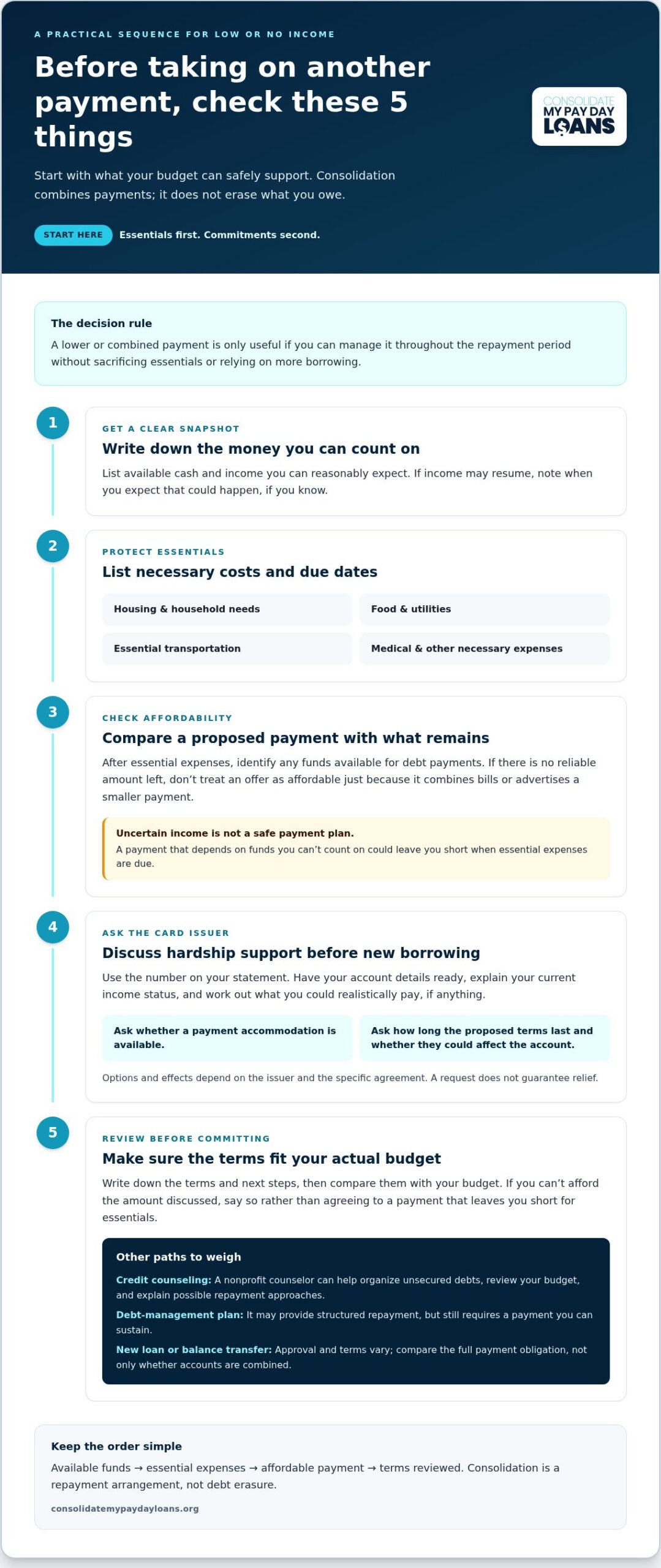
When income changes, a clear sequence can help you make decisions without assuming a creditor will agree to a request. Start with your household’s immediate needs, then gather account information, contact issuers if appropriate, and compare any response with what you can realistically manage. This creates a useful record whether income is paused briefly or has stopped without a known return date.
- Set out essential expenses and available cash. List housing, food, utilities, transportation, medical needs, and other necessary costs alongside the money currently available. Note when income might resume if you know, but don’t build a payment plan around an uncertain date.
- Make a card-by-card snapshot. Record each balance, minimum payment, due date, interest terms, and issuer contact details. Use recent statements or account information, and mark any upcoming due dates.
- Estimate a realistic payment amount. Compare your available funds with essential expenses and other commitments. If there’s nothing left for card payments, don’t invent an amount just to make a request sound acceptable. Your estimate is a planning tool, not a promise to the issuer.
- Contact the issuer and document the response. Explain the change in your circumstances and ask whether a payment accommodation may be available. Note the date, representative, response, proposed terms, and follow-up instructions. Review the terms against your budget before agreeing.
- Compare the next step with your actual capacity. Consider whether the proposed arrangement or another repayment option can work with funds you can reasonably count on. If not, keep reviewing your budget and account information rather than adding borrowing you can’t repay.
How should you prepare before calling a card issuer?
Before calling, write down your current income, essential expenses, and affordable payment estimate. Prepare a brief explanation, such as a job loss or reduced hours, and state what kind of help you’re requesting. During the call, take notes rather than relying on memory. Record the issuer’s response, any proposed terms, and what you’re asked to do next.
How can you avoid worsening the situation?
Don’t take out new debt before reviewing your ability to repay and the full terms. Be cautious of promises of guaranteed debt elimination, demands for upfront fees, or pressure to stop communicating with creditors. These warning signs deserve careful scrutiny. Check current consumer guidance from the Consumer Financial Protection Bureau or Federal Trade Commission, particularly before agreeing to debt-relief services.
If your balances include payday loans as well as credit cards, include both obligations in the same debt snapshot so you can see the whole payment picture. Payday Loan Consolidation: The Complete Guide to Breaking the Debt Cycle in 2026 discusses payday-loan debt specifically; keep its guidance distinct from decisions about card accounts. For credit card consolidation with low income, your next step should follow your budget, not pressure to choose a product quickly. If a structured credit card payment appears manageable, credit card consolidation options are one possible route to compare.
When Credit Card Consolidation May Fit, and How to Explore Help
Consolidation may be worth exploring when you can make a structured payment from income you can reasonably count on and the plan’s terms suit your circumstances. Combining balances may make repayment easier to organize, but it can’t create income or make an unaffordable payment sustainable. If your budget has no room for a new payment, pause before committing and focus on immediate needs and conversations with your card issuer.
What should you assess before considering a consolidation plan?
Compare the proposed payment with your current income and essential expenses, not an optimistic estimate of what you might earn later. Review how payments are structured, what fees may apply, and how the arrangement could affect your accounts or credit. Make sure you understand the full terms, including what happens if your income changes or you can’t make a scheduled payment.
- Budget fit: Can you make the payment while meeting necessary expenses?
- Plan terms: Do you understand the payment schedule, fees, and conditions?
- Account impact: Are any account restrictions or credit implications explained?
- Income reliability: Does the plan rely on money you can reasonably expect?
Consolidate My Payday Loans offers credit card consolidation intended to combine multiple card balances into one lower-interest payment plan. This may be worth considering if the payment is affordable and the terms make sense for your situation. It doesn’t guarantee eligibility, creditor acceptance, a particular interest rate, savings, or debt elimination. Compare the proposed arrangement with your budget before making a decision.
What is a realistic next step if payments are not affordable?
If there isn’t enough money for a sustainable payment, don’t force a consolidation plan or take on borrowing your budget can’t support. Return to your essential-expense budget and discuss your circumstances with your card issuer, understanding that any accommodation depends on the issuer and agreed terms. If income or expenses change, revisit repayment options with a clearer picture of what you can manage.
For mixed unsecured debt, keep credit card and payday loan obligations distinct as you assess options. Payday Loan Relief: Comprehensive Programs to Break the Debt Cycle in 2026 focuses on payday loan relief, which may be relevant if those debts are also affecting your budget.
Credit card consolidation with low income is most useful to explore when your budget can support a structured payment, not simply because you want fewer bills. If that payment is feasible, credit card consolidation support is one possible next step. Take time to understand the terms and choose a commitment that fits your circumstances.
Choose a Next Step That Fits Your Budget
Your financial circumstances can change, and the right debt plan may change with them. For now, focus on a commitment you can realistically maintain rather than one that only works if everything goes perfectly. If income returns or your budget shifts, reassess your options with a clearer view of what’s affordable.
Consolidate My Payday Loans offers credit card consolidation for unsecured debt and operates under Solid Ground Financial, a debt management and credit counseling organization. Consolidation may help organize repayment when its terms and payment fit your circumstances, but it can’t replace income or make an unmanageable payment sustainable.
If a structured payment is feasible, take the next step at your own pace: explore credit card consolidation support. If it isn’t affordable right now, continue prioritizing essentials and reviewing your options as circumstances change. A manageable plan starts with an honest picture of what you can pay.
Frequently Asked Questions
Can I consolidate credit card debt with no income?
It may be difficult to qualify for a new loan or balance-transfer card without income or another demonstrated ability to repay. Credit card consolidation with low income isn’t the only route to consider. You can ask issuers whether they offer hardship options or seek counseling to understand possible repayment approaches. Before agreeing to an arrangement, check when payments start, how long they last, and whether you can meet them without relying on uncertain funds.
What should I do about credit card debt if I have no income?
Start by organizing the information you’ll need to make decisions: household essentials, available funds, card balances, minimum payments, and due dates. Then contact issuers to explain your situation and ask about possible assistance. Keep a record of whom you spoke with and when to follow up. Before considering a loan or another card, assess whether you could repay it if income takes longer than expected to return.
Can credit card companies lower payments during unemployment?
Some issuers may discuss temporary payment arrangements or hardship options, but availability and terms vary by company and account. Explain what changed and ask whether an arrangement is available for your account. If the issuer proposes terms, clarify when they begin and end, whether fees or account access may change, and what payment would be due afterward. Wait for the issuer to confirm an arrangement rather than assuming a request has been approved.
Is debt consolidation a good idea when you have low income?
It depends on whether the new arrangement is affordable and its full terms suit your circumstances. A loan or balance transfer involves approval and a repayment obligation, so combining balances alone doesn’t make it a good fit. Compare the payment schedule, applicable fees, and total amount you may repay. If your income changes from month to month, consider whether you could still manage the payment during a lower-income period.
Will missing a credit card payment affect my credit?
A missed payment may have financial and credit consequences, but the effect depends on factors such as timing, account history, and applicable reporting practices. If you expect trouble paying, contact the issuer and review your account terms to understand possible fees or options. A hardship conversation doesn’t automatically mean a payment is waived or that reporting stops. For current credit-reporting information, consult authoritative consumer resources such as the Consumer Financial Protection Bureau.
Can a debt management plan help if I am unemployed?
A debt-management plan may help organize repayment, but it still needs to fit the money available to you. A counselor can review your budget and explain possible approaches. Unemployment alone doesn’t guarantee that a plan will be suitable or that creditors will agree to particular terms. Before enrolling, ask for a clear explanation of payment expectations, fees, and plan requirements, then compare them with essential expenses and any income you can reliably count on.