
A payday loan rollover isn’t a helpful financial service; it’s a mathematical certainty of insolvency designed to keep you trapped. You might think you’re buying time, but the true cost of payday loan rollover is often triple or quadruple the original amount you borrowed. Every time you pay that $15 or $30 fee to push the due date back, you aren’t touching the principal. You’re simply paying for the privilege of staying in debt while your lender waits for the next automatic withdrawal to hit your account.
It’s exhausting to feel like you’re working just to fund a lender’s interest margins. We understand the anxiety that comes with watching your bank balance or fearing the harassment that might follow if you stop the cycle. This guide will uncover the hidden traps within these high-interest loans and provide the exact steps to stop the fees. You’ll learn how to regain financial agency, protect your bank account from aggressive withdrawals, and find a single, manageable monthly payment that actually leads to freedom.
Key Takeaways
- Understand how “fee-only” payments keep your original debt balance frozen while draining your income every two weeks.
- See the math behind the true cost of payday loan rollover and how just four extensions can effectively double what you owe.
- Learn the exact process for revoking ACH authorization to protect your bank account from automatic, predatory withdrawals.
- Discover how to request an Extended Payment Plan (EPP) or use a consolidation calculator to visualize a clear path toward zero debt.
- Gain the tools to transition from perpetual rollovers to a single, manageable monthly payment through expert negotiation.
What is a Payday Loan Rollover and Why Does It Cost So Much?
A payday loan rollover occurs when you pay a fee to delay the full repayment of your debt until your next paycheck. It often feels like a necessary relief when funds are tight, but it’s actually a mathematical anchor. The primary cost of payday loan rollover isn’t just the fee itself; it’s the “fee-only” trap. When you roll over a loan, your payment covers only the interest or service charge. Not a single cent goes toward the principal balance you originally borrowed. This creates a cycle where you’re perpetually paying for the privilege of staying in debt.
Lenders prefer this cycle because it provides a steady stream of predictable revenue without reducing their risk. It’s a psychological burden that leaves you feeling stuck. While you might hope to pay it off “next time,” the lack of progress on the principal makes that goal harder to reach with every passing week. By 2026, many lenders have integrated “dark patterns” into their apps to make rolling over the default choice, steering you away from full repayment.
The Mechanics of a Standard Rollover
In a typical scenario, a lender charges between $15 and $30 for every $100 you’ve borrowed. To initiate a rollover, you must provide a new post-dated check or a fresh ACH authorization. This gives the lender direct access to your next paycheck before you can even pay for groceries or rent. Because Payday loan regulations in the United States vary by state, some lenders distinguish between a “rollover” and a “renewal.” In 2026, many lenders use renewals to bypass state-imposed rollover limits, essentially trapping you in a new contract to cover the old one.
Immediate Financial Impact
Rollovers drain your checking account at the exact moment you need liquidity. This constant siphoning of cash damages your debt-to-income ratio, making it nearly impossible to qualify for traditional, lower-interest loans in the future. It’s a downward spiral that affects your credit health and your mental well-being. A rollover fee is a purely defensive payment that buys you two weeks of time but zero progress on your debt.
Breaking this cycle requires a move toward structured relief. Tools like a payday loan consolidation calculator can help you visualize how much you’re actually losing to these fees. Instead of rolling over, many borrowers find success through a Payday Loan Hardship Program. These programs focus on ending the fees and settling the debt for good, providing a stable alternative to the chaos of bi-weekly rollovers.
The Math of the Trap: Calculating the True APR of Rollovers
Lenders often frame the cost of payday loan rollover as a small, manageable fee. They might tell you it’s only $15 or $30 for every $100 borrowed. While this sounds like a minor inconvenience, it’s a mathematical illusion designed to obscure the true Annual Percentage Rate (APR). Because these loans are meant to be repaid in just two weeks, that small fee translates into a staggering interest rate when calculated over a full year. Understanding how payday loan rollover fees are calculated reveals that most borrowers are actually paying between 390% and 600% APR.
The danger intensifies when you realize that these fees do not reduce your debt. If you borrow $500 and pay a $75 fee to roll it over, you still owe $500. You have effectively paid for time, not for progress. If you do this repeatedly, the financial weight becomes unsustainable. Within just a few months, you can easily pay more in fees than the total amount you originally received, yet your balance remains unchanged.
Cumulative Cost Breakdown over 12 Weeks
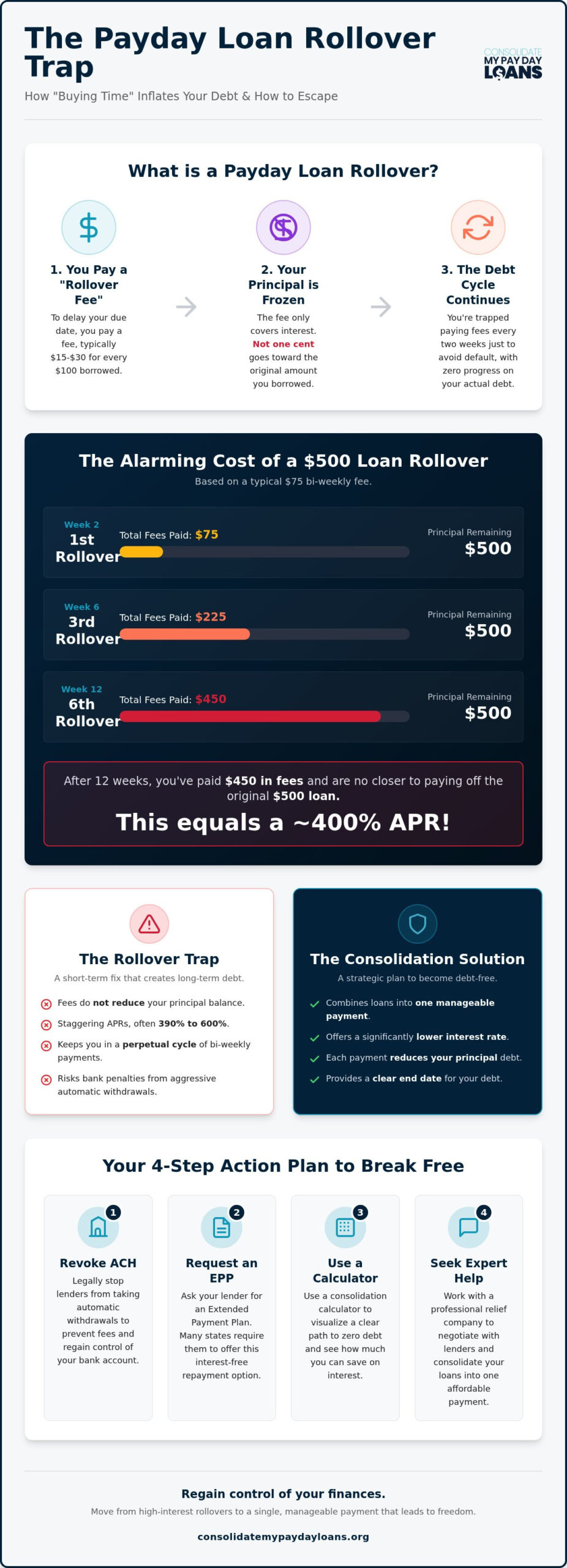
To see the snowball effect in action, consider a standard $500 loan with a $75 bi-weekly fee. The math quickly turns against the borrower:
- Week 2: You pay the initial $75 fee. You’ve spent $75, and your principal is still $500.
- Week 6: After three rollovers, you’ve paid $225 in fees. You still owe the full $500 principal.
- Week 12: By the sixth rollover, you have paid $450 in fees. You have nearly repaid the original loan amount in interest alone, but you still owe every cent of the $500 balance.
This cycle often triggers additional hidden costs. If your bank account lacks the funds when the lender attempts an automatic withdrawal, you may face $35 Non-Sufficient Funds (NSF) fees from your bank. Lenders may attempt these withdrawals multiple times, leading to hundreds of dollars in penalties in a single week.
Why APR Matters More Than the Flat Fee
Focusing on the flat fee is how lenders keep you in the cycle. When you compare a 400% APR rollover to a 15% or 30% APR consolidation plan, the difference in your monthly budget is life-changing. Using a payday loan consolidation calculator allows you to see these numbers side-by-side, providing the clarity needed to stop the drain on your finances.
Consolidation replaces the endless bi-weekly fee with a fixed payment that actually reduces your principal. It’s a structured way to stop the bleeding and reclaim your paycheck. If you’re tired of seeing your hard-earned money disappear into interest, you can explore professional relief options that prioritize your recovery over a lender’s profit.
Consolidation vs. Rollover: A Strategic Exit Analysis
Choosing between a rollover and consolidation is the difference between treading water and swimming to shore. A rollover is a perpetual cycle. It has no scheduled end date and offers no path to zero. In contrast, consolidation merges your various obligations into a single, fixed payment with a clear expiration date. While the bi-weekly cost of payday loan rollover might feel like a temporary fix, it’s actually a structural barrier to your financial recovery. It keeps you focused on surviving the next fourteen days rather than planning for the next fourteen months.
This choice also impacts your long-term credit health. Payday lenders rarely report your on-time rollover payments to major credit bureaus, so you get no credit for “staying current.” However, they’re quick to report a default. Consolidation stops the bleeding. By replacing high-interest chaos with a manageable plan, you eventually create the stability needed to heal your score and regain access to traditional banking. It interrupts the lender’s leverage by moving the debt into a professional framework where you are protected.
The Benefits of a Single Monthly Payment
Managing multiple lenders is a logistical nightmare. When different companies hit your bank account on different days, it’s impossible to maintain a budget. This constant uncertainty creates a state of high alert that drains your mental energy. By choosing payday loan consolidation, you align your debt repayment with your actual monthly income. You no longer have to worry about which automatic withdrawal will trigger an overdraft fee tomorrow. Simplification is the first step toward peace of mind.
Why Lenders Don’t Want You to Consolidate
Lenders rely on your “passive” fee income to meet their profit margins. They’ve built their business models on the assumption that you will roll over your loan at least four to eight times. When you consolidate, that stream of easy money evaporates. Professional negotiators can often force lenders to accept a lower total payout because they understand the regulations lenders must follow. Consolidation effectively turns a predatory debt trap into a structured term loan with a fixed end date. It shifts the power balance back to you, the consumer, by ensuring every dollar you pay actually reduces what you owe.
4 Steps to Legally Stop the Payday Loan Rollover Cycle
Breaking the cycle of debt requires more than just willpower; it requires a tactical shift in how you manage your lenders. The ongoing cost of payday loan rollover is fueled by the lender’s direct access to your bank account. As long as they can automatically withdraw fees every two weeks, they have no incentive to negotiate. By taking these four legal steps, you can halt the drain on your finances and force a more sustainable resolution.
- Step 1: Revoke ACH Authorization. You have the legal right to stop automatic bank withdrawals at any time.
- Step 2: Request an Extended Payment Plan (EPP). Many states require lenders to offer a no-cost extension if you notify them before the loan is due.
- Step 3: Document All Communication. Keep a log of every email, letter, and phone call to protect yourself against potential lender harassment.
- Step 4: Seek Professional Relief. Transitioning from bi-weekly fees to a structured plan often requires an advocate who understands the industry’s legal boundaries.
How to Revoke ACH Authorization Legally
To stop the automatic siphoning of your paycheck, you must notify the lender in writing that you are revoking their access to your account. Send a formal email or a certified letter stating clearly that their authorization to debit your account is cancelled. Once this is sent, contact your bank immediately to place a “stop payment” on any future entries from that specific lender. While some people consider closing their bank account entirely, this should be a last resort. It’s often better to exercise your legal rights to stop the payments first, as closing an account can lead to complications with your employer or other legitimate billers.
Utilizing Hardship Programs
If you find yourself unable to meet the original terms of the loan, you may qualify for a payday loan hardship program. When speaking with a lender, use professional terminology to describe your situation. State that you are experiencing “involuntary financial distress” and request a formal workout plan. There is a significant difference between a settlement, which might involve a lump sum, and an EPP, which simply stretches the balance over several months without new fees. A hardship program provides the structure needed to stop the cost of payday loan rollover from doubling your debt. If you are ready to stop the fees and start a real recovery, you can apply for professional payday loan relief today.
Professional Payday Loan Relief: Your Path to Financial Peace
Professional relief is the final step in moving from a state of financial survival to a state of long-term stability. While taking tactical steps like revoking ACH access is important, specialized consolidation services provide the structural defense you need to stay out of the trap. These services act as your advocate, stepping between you and the lender to halt the cycle of predatory collection calls and aggressive fee structures. By shifting the negotiation to a professional level, you ensure that the cost of payday loan rollover stops draining your income immediately.
Many individuals facing deep debt consider extreme measures, but choosing payday loan consolidation instead of bankruptcy is often the safer choice for your financial future. Bankruptcy can linger on your credit report for a decade, affecting your ability to rent an apartment or secure a job. Consolidation, however, focuses on settling your obligations through a manageable plan that eventually heals your credit profile. It’s a strategic exit that preserves your personal agency while providing a clear, documented path to zero balance.
What to Expect from the Consolidation Process
The journey begins with a comprehensive assessment of your current financial obligations. This includes an analysis of your total payday debt and any high-interest credit card balances that are contributing to your stress. Once the full scope of the debt is clear, a relief plan is customized to fit your specific 2026 budget. You’ll receive a clear timeline for becoming debt-free, typically without the need to take out any new loans. This structured approach ensures that every payment you make is directed toward reducing your principal balance rather than just buying another two weeks of time.
Starting Your Recovery Today
Regaining your peace of mind starts with a single, informed decision. You can use a consolidation calculator to visualize exactly how much you can save by stopping the bi-weekly fees. It’s essential to act before your next rollover fee is due, as every day spent in the cycle is a day your principal remains untouched. Waiting only increases the total amount you will eventually have to pay back. If you’re ready to break the cycle and protect your paycheck, you can get a free consultation for payday loan relief today. Recovery isn’t just about the money; it’s about the psychological freedom that comes with knowing your debt has a confirmed end date.
Take Back Your Financial Agency Today
The actual cost of payday loan rollover is measured in more than just dollars; it’s the loss of mental peace and personal agency. You’ve seen how the cycle is mathematically designed to keep your principal balance frozen while draining your paycheck every two weeks. By understanding your legal rights to revoke ACH access and utilizing structured hardship programs, you can finally interrupt the lender’s leverage and stop the bleeding.
It’s time to replace high-interest chaos with a single, manageable plan. With over 20 years of debt management expertise, our team specializes in helping individuals escape predatory lending practices. You don’t have to navigate these complex negotiations alone. Use our no-obligation savings calculation to visualize your path to freedom and see exactly how much you can save.
Stop the rollover cycle today with our expert payday loan consolidation services.
You deserve a future where your hard-earned money stays in your pocket rather than funding a lender’s interest margins. Taking the first step toward recovery is often the hardest, but we’re here to guide you toward a stable, debt-free life. Financial stability is within your reach.
Frequently Asked Questions
How much does a payday loan rollover typically cost?
A payday loan rollover typically costs between $15 and $30 for every $100 you borrowed. This fee only buys you another two weeks of time and does not reduce your original balance. If you borrowed $500, you might pay $75 to $150 every pay period just to keep the loan from defaulting. Over several months, the total cost of payday loan rollover can easily exceed the amount you originally received from the lender.
Can I stop a payday loan rollover if I already authorized the withdrawal?
Yes, you can legally stop a rollover by revoking your ACH authorization. You must notify the lender in writing that you are cancelling their access to your bank account. After sending this notice, contact your bank to place a stop payment on any future entries from that lender. This action interrupts the automatic cycle of fees and gives you the leverage needed to seek a more sustainable debt relief solution or consolidation plan.
Is a payday loan rollover the same as an extension?
While people often use the terms interchangeably, they differ in their financial impact. A rollover usually requires you to pay a new fee to push the due date back by two weeks. An extension can sometimes refer to a state-mandated Extended Payment Plan, which allows you more time to pay the principal without extra fees. Lenders prefer rollovers because they generate continuous fee income without ever requiring you to pay down the original debt.
How many times can a payday lender roll over a loan in 2026?
The number of rollovers allowed depends entirely on your specific state regulations. Some states strictly prohibit rollovers, while others limit them to a specific number, such as four or six extensions. In certain jurisdictions, lenders must stop rolling over the debt once it has reached a specific age, often 10 to 12 weeks. If you find yourself rolling over repeatedly, it’s a sign that the current loan structure is no longer manageable.
What happens if I refuse to pay a rollover fee?
If you refuse to pay the fee and don’t have the full balance available, the lender will typically attempt to withdraw the entire loan amount from your account. This often results in multiple Non-Sufficient Funds fees from your bank. Lenders may also initiate aggressive collection efforts, including frequent phone calls and emails. Instead of simply refusing to pay, it’s more effective to revoke authorization and enter a structured payday loan relief program to settle the debt.
Does rolling over a payday loan help my credit score?
No, rolling over a payday loan does not help your credit score. Most payday lenders do not report your on-time fee payments to the major credit bureaus, so you don’t build a positive credit history. However, if you default or the loan goes to a collection agency, that negative information will likely be reported. This one-sided reporting system means you take all the risk without receiving any of the traditional benefits of credit management.
Can consolidation stop the fees from a rollover cycle?
Yes, consolidation is specifically designed to stop the cycle of bi-weekly fees. By merging your various loans into one fixed payment, you eliminate the cost of payday loan rollover and start paying down the principal. Professional consolidation services negotiate with your lenders to end predatory fee structures and create a clear timeline for full repayment. This process simplifies your monthly budget and protects your bank account from the stress of multiple automatic withdrawals.
What is the difference between a rollover and an extended payment plan?
The primary difference is the cost. A rollover is a fee-based delay that keeps your principal balance exactly the same. An extended payment plan is often a no-cost option required by law in many states for borrowers in financial distress. While lenders rarely advertise these plans, they allow you to pay back the original loan over several months in smaller installments. Transitioning to an EPP is a significant step toward regaining control over your financial life.