
You are watching your bank balance vanish every payday as lenders sweep your account via ACH withdrawals, leaving you trapped in a cycle that feels impossible to break. It’s exhausting to live under the constant shadow of lender harassment and the paralyzing fear that seeking help will only make things worse. You are likely asking the most critical question: does payday loan consolidation hurt your credit? It’s a valid concern when you are already fighting to keep your head above water and want to protect what is left of your financial reputation.
The truth is that while any change to your debt structure can cause a temporary ripple, it’s often the only way to prevent a total credit collapse caused by inevitable defaults. In this guide, you’ll discover exactly how payday loan consolidation affects your FICO score and why the short-term impact is a small price for long-term financial freedom. We will walk you through the mechanics of credit recovery, show you how to stop the interest rate spiral, and provide a clear timeline for rebuilding your agency over your own money.
Key Takeaways
- Does payday loan consolidation hurt your credit? Yes, but only temporarily — the short-term dip from hard inquiries is far less damaging than the inevitable defaults that come from staying trapped in the payday cycle.
- Not all consolidation methods affect your score the same way — a personal loan and a Debt Management Program create very different credit footprints, and knowing the difference helps you choose the right path.
- Your recovery speed is not random — specific factors like payment consistency and how your debt is restructured directly determine how quickly your FICO score rebuilds after consolidation.
- A payday loan consolidation calculator is one of the most powerful first steps you can take, giving you a clear, numbers-backed picture of your exit timeline before you commit to any program.
- Financial peace has a measurable value that a three-digit score cannot capture — lower stress, stopped ACH withdrawals, and restored cash flow are the real wins that make consolidation worth it.
The Short-Term Reality: Does Consolidation Lower Your Score?
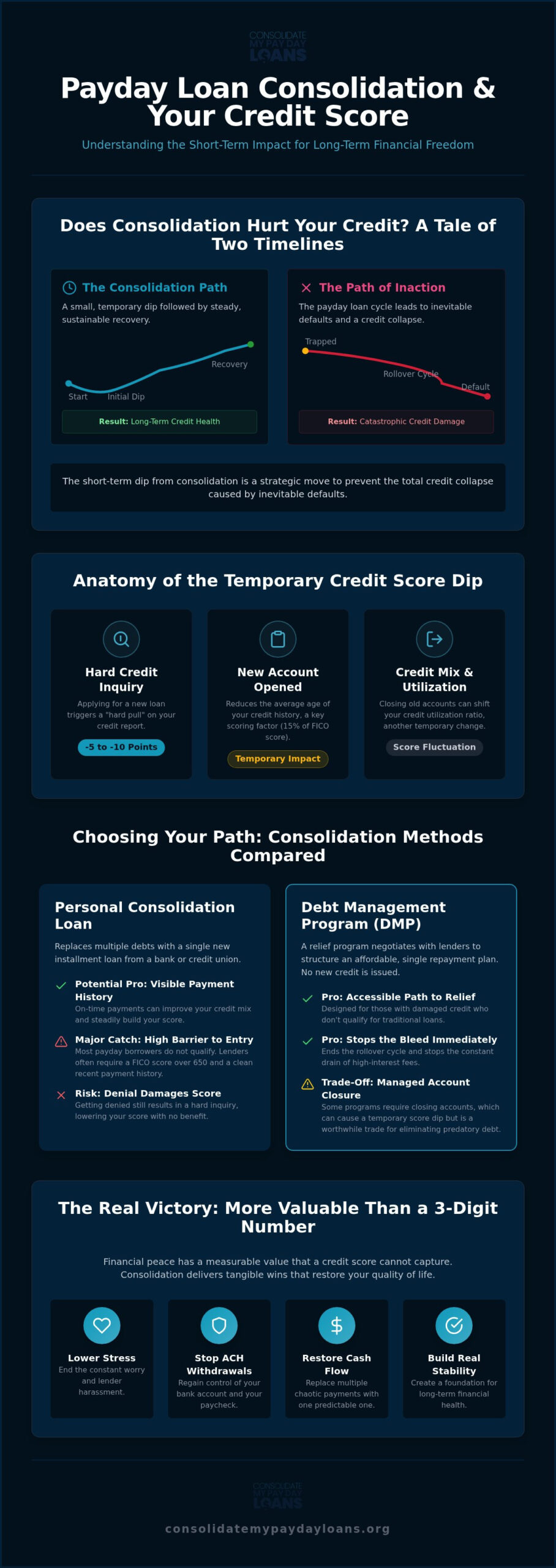
The short answer is yes; you will likely see a temporary dip in your numbers. However, this is not a sign of failure. It’s a strategic pivot. When you ask, does payday loan consolidation hurt your credit, you’re usually weighing a small, manageable drop against the total devastation of a default. Think of it as a tactical retreat to higher ground. You’re sacrificing a few points today to save your entire financial future tomorrow. This temporary fluctuation is a standard part of the debt restructuring process and rarely lasts more than a few months if you remain consistent.
Why Your Score Might Move Initially
Several technical factors cause this initial movement. If you apply for a traditional consolidation loan, the lender performs a hard credit inquiry. This typically shaves off five to ten points. Additionally, opening a new account reduces the average age of your credit history, which accounts for about 15% of your FICO score. If your consolidation plan involves closing high-interest credit card accounts, your credit utilization ratio might also shift. These are mechanical changes in a spreadsheet. They don’t reflect your actual ability to manage money; they simply reflect the math of a new beginning.
The Hidden Danger of Doing Nothing
Staying in the payday cycle is far more dangerous than a temporary consolidation dip. Most payday lenders don’t report your on-time payments to the major bureaus, so you get no credit for your struggle. They only report when you fail. When people worry about whether does payday loan consolidation hurt your credit, they often forget that the alternative is a catastrophic 100 point drop from a single missed payment. In the 2026 credit environment, lenders are increasingly sensitive to collection accounts and high-frequency borrowing patterns.
The rollover cycle, where you take out a new loan just to pay the interest on an old one, is a form of slow-motion credit suicide. It drains your cash flow until a default becomes inevitable. Consolidation stops this bleed immediately. By merging these obligations into a single manageable payment, you stop the rolling fees and start the clock on your credit recovery. You’re replacing unrated, predatory debt with a structured, visible payment history that actually works in your favor over time.
We must distinguish between your credit score and your credit health. A score is just a snapshot of your current debt profile. Credit health is your actual stability. Consolidation might lower the snapshot for a month or two, but it restores your health by stopping the interest rate spiral and ending the constant threat of bank account sweeps. Regaining control of your bank account is the first step toward a permanent score increase.
How Different Consolidation Methods Impact Your Credit
Not every consolidation path leaves the same footprint on your credit report. The method you choose matters enormously, and understanding the distinction is one of the most practical answers to the question of does payday loan consolidation hurt your credit. Two people can consolidate the same debt load and walk away with very different credit outcomes based entirely on which route they took.
Consolidation Loans vs. Relief Programs
A traditional personal consolidation loan works by replacing multiple debts with a single installment loan. When it works, it’s elegant: your credit mix improves, your payment history becomes visible to bureaus, and your score can climb steadily. The catch is significant. Most payday loan borrowers don’t qualify for the low-interest personal loans that financial comparison sites enthusiastically promote. Lenders typically require a FICO score above 650 and a clean recent payment history, which is precisely what the payday cycle erodes. Applying and getting denied triggers a hard inquiry without any of the benefits, leaving you worse off than before.
A Debt Management Program, or DMP, operates differently. Rather than issuing you new credit, a relief program negotiates directly with your lenders to reduce fees and structure an affordable repayment plan. Some programs require closing the accounts being managed, which can temporarily lower your score by affecting your credit utilization and account age. However, this trade-off is almost always worth it. You’re eliminating predatory debt faster, stopping the rollover cycle immediately, and replacing chaotic, unstructured obligations with a single predictable payment.
For someone already inside the payday cycle, a relief program is almost always the safer entry point. It doesn’t require a qualifying credit score to access, and it stops the financial bleeding on day one. Consolidate My Payday Loans offers payday loan relief programs specifically designed to interrupt the debt cycle rather than layer new credit on top of existing damage.
Settlement is a separate category entirely, and bureaus treat it harshly. When a debt is “settled,” it means you paid less than the full balance. That notation stays on your report for up to seven years and signals to future lenders that you didn’t honor your original obligation. Consolidation, by contrast, means you’re paying the full balance under restructured terms. That distinction is critical.
The Role of Debt-to-Income (DTI) Ratio
Your debt-to-income ratio is the percentage of your gross monthly income consumed by debt payments, and in 2026 it’s become a primary gatekeeping metric for mortgage and auto loan approvals. A high DTI can disqualify you even when your credit score looks acceptable. Consolidation addresses this directly. By merging several high-payment obligations into one lower monthly payment, you reduce your DTI immediately, which strengthens your borrowing profile for every major financial goal ahead.
Factors That Determine Your Credit Recovery Speed
Recovery isn’t an overnight event. It’s a series of small, deliberate wins. Many people ask, does payday loan consolidation hurt your credit, without realizing that the answer depends heavily on what happens after the paperwork is signed. Once you’ve stopped the interest rate spiral, your score begins a transformation that typically takes six to twelve months to stabilize. This period is your window to prove to future lenders that you’ve regained personal agency over your finances.
The 35% Rule: Rebuilding Your Payment History
Payment history is the single most influential factor in your credit score, accounting for 35% of the total calculation. Payday lenders often operate in the shadows of the credit reporting system, which means they rarely report your on-time payments, but they’re the first to report a default. When you enter a structured program for payday loan consolidation, you’re effectively creating a clean slate. One consistent, on-time consolidated payment is significantly better for your file than five missed individual payments to predatory lenders.
There’s a profound psychological benefit to this shift. Seeing a “paid as agreed” status on your credit report provides a sense of calm reassurance that you’re no longer fighting a losing battle. You’re replacing chaos with a predictable trail of financial responsibility.
Credit Mix and New Credit Inquiries
While you’re in the recovery phase, you must avoid applying for new credit. Every application triggers a hard credit inquiry, which can stall your progress. It’s natural to feel “hard pull” anxiety, but remember that a single inquiry is a minor ripple compared to the wave of damage caused by a payday default. Over time, a structured relief plan helps diversify your credit profile by proving you can manage a long-term installment-style obligation, which eventually improves your overall credit mix.
A critical but overlooked factor in recovery speed is the management of your bank account. You must stop all ACH withdrawals from previous lenders immediately. These automated “sweeps” can cause accidental missed payments on your new consolidation plan by draining your funds before you can make your scheduled deposit. Protecting your cash flow is the only way to ensure your payment history remains spotless during this rebuilding year.
Moving your debt from unrated payday loans to a structured plan also impacts your credit utilization. While payday loans aren’t always calculated in traditional utilization ratios, the collectors they sell to certainly are. By consolidating, you’re preventing those collection accounts from ever appearing, which keeps your utilization manageable and your path to a higher score clear.
Step-by-Step: Protecting Your Score During Consolidation
Taking the first step toward debt relief requires a methodical approach to ensure your credit score remains protected throughout the transition. While you might still wonder, does payday loan consolidation hurt your credit, the answer often lies in how well you manage the process. By following a structured plan, you can minimize the temporary impact and set the stage for a rapid rebound. This is about moving from a state of financial defense to one of active, strategic growth.
- Step 1: Start with the math. Use a payday loan consolidation calculator to map your exit strategy and visualize exactly how your monthly obligations will decrease.
- Step 2: Pull your current credit reports to identify “zombie” payday loans. These are old debts that may have been sold to multiple collectors, causing duplicate negative entries that weigh down your score.
- Step 3: Revoke all active ACH authorizations to prevent lenders from draining your bank account while you are setting up your new plan.
- Step 4: Commit to a single, fixed monthly payment through a reputable relief program to establish a new, positive payment history.
- Step 5: Set up monthly credit monitoring to track your progress and ensure no new predatory inquiries appear on your file.
Revoking ACH Authorizations
Stopping the “sweep” of your bank account is a vital legal right you must exercise in 2026. When lenders have open access to your account, they can trigger overdraft fees and leave you with zero cash flow, making it impossible to stay current on your consolidation plan. By revoking these authorizations, you regain personal agency over your money. This simple act of protection ensures that your funds go exactly where you intend them to go, which is the foundation of credit score preservation.
Monitoring for Accuracy
In the 2026 financial environment, monthly credit monitoring has become the standard for anyone in a recovery phase. You must keep meticulous records of your consolidation agreement and payment receipts. If a previous lender reports a loan incorrectly after you’ve started your program, you will need this documentation to file a dispute. Monitoring your report monthly allows you to catch these errors early, ensuring that your does payday loan consolidation hurt your credit concerns are mitigated by an accurate, upward-trending credit file. If you are ready to begin this process, you can explore consolidation options that prioritize your long-term financial health.
Why Financial Peace is More Valuable Than a 3-Digit Number
Living inside a debt trap creates a specific kind of tunnel vision. It’s common to find yourself obsessing over a three-digit credit score while your actual quality of life is being dismantled by predatory lenders. When you ask, does payday loan consolidation hurt your credit, you are often prioritizing a temporary statistical dip over your immediate financial survival. A credit score can always be rebuilt once your cash flow is stable, but the wealth and time lost to high-interest cycles are gone forever. Consolidation represents a net positive for your life because it replaces constant anxiety with a structured, manageable path forward.
The Cost of Waiting
Every day you delay consolidation to “protect” a failing score, you are losing money to interest rates that frequently exceed 400%. This is capital that should be building your future, not lining the pockets of lenders who rely on your struggle. In 2026, the risk of doing nothing has intensified. Predatory lenders have become more aggressive with legal actions and wage garnishments, which can cause far more damage to your life than a temporary consolidation inquiry. Breaking the cycle now is a protective measure. It acts as a shield against the total credit collapse that inevitable defaults will cause if you stay on your current path.
Taking the First Step
You don’t have to face this turbulence alone. Consolidate My Payday Loans acts as a stable anchor, helping you navigate out of high-interest traps and into a single-payment lifestyle. You can begin this journey with a free consultation that doesn’t require a hard credit pull, allowing you to see your options without any initial impact on your file. This process is designed to be professional, industry-specific, and above all, empathetic to your situation.
The simplicity of having one fixed monthly payment cannot be overstated. It stops the harassment, ends the bank account sweeps, and restores your personal agency. You’re more than just a debt balance or a credit score; you’re an individual seeking a safer alternative to a systemic problem. Prioritize your freedom and your mental peace over a temporary score fluctuation. By choosing a partner in recovery like Solid Ground Financial, which has operated since 2004, you are choosing a methodology that builds confidence and delivers a clear timeline for your eventual credit health.
Reclaiming Your Financial Agency in 2026
The path to financial recovery is rarely a straight line; it’s a journey worth taking to escape the predatory payday cycle. You’ve learned that while you might wonder, does payday loan consolidation hurt your credit, the temporary fluctuation is a strategic trade-off for long-term stability. By stopping the interest rate spiral and revoking ACH authorizations, you protect your cash flow from aggressive lender sweeps. This allows you to build a consistent, positive payment history that future lenders will value far more than a failing score buried under high-interest debt.
Solid Ground Financial has provided professional guidance and expert debt negotiation since 2004. We’ve been trusted by thousands of borrowers to stop the payday cycle and provide a clear methodology for improvement. You are more than a three-digit number, and you deserve the psychological peace that comes with a single, manageable payment. Estimate your savings and start your credit recovery with our Payday Loan Consolidation Calculator.
Your future is not defined by your current debt. Take this first step today and start moving toward the financial freedom you deserve.
Frequently Asked Questions
Does a payday loan consolidation program show up on my credit report?
It depends on the method you choose. A personal consolidation loan appears as a new installment account on your credit report, which is actually a positive long-term signal to future lenders. A Debt Management Program may appear as a notation on the accounts being managed, but this notation is far less damaging than a collection account or default. Either way, the structured payment trail you build is a net improvement over the invisible, unrated chaos of the payday cycle.
How many points will my credit score drop when I start consolidation?
There’s no universal number, but a hard inquiry from a personal loan application typically reduces your score by five to ten points. If your program involves closing managed accounts, you may see an additional temporary shift from changes to your credit utilization or account age. For most borrowers already in the payday cycle, this drop is minor compared to the trajectory they’re already on. A single missed payment causes far more damage than any consolidation inquiry.
Can I get a car loan while in a payday loan relief program?
It’s technically possible, but most financial counselors recommend waiting until your program is complete. Applying for new credit during a relief program triggers a hard inquiry that can slow your recovery, and lenders may view an active debt management enrollment as a risk factor. Your debt-to-income ratio will also be improving throughout the program, meaning you’ll qualify for significantly better auto loan terms if you wait six to twelve months before applying.
Is payday loan consolidation better for my credit than bankruptcy?
Yes, in almost every measurable way. A bankruptcy filing remains on your credit report for seven to ten years depending on the chapter filed, and it signals to lenders that obligations went entirely unpaid. Consolidation, by contrast, means you’re repaying your full balance under restructured terms, which is a fundamentally different signal. Consolidation preserves your ability to access credit far sooner and doesn’t carry the lasting legal and financial stigma that bankruptcy does.
What happens to my credit if I just stop paying my payday loans?
Stopping payments without a structured plan is one of the most damaging decisions you can make. Lenders will report the default to credit bureaus, sell your balance to collection agencies, and potentially pursue wage garnishments or legal judgments. Each of those events creates a separate negative entry on your report. A single payday default can drop your score by 100 points or more. Consolidation exists precisely to give you a legal, structured alternative to this outcome.
How long does it take for my credit score to go back up after consolidation?
Most borrowers see meaningful improvement within six to twelve months of making consistent, on-time payments through their consolidation program. The 35% weight that payment history carries in your FICO score means every on-time payment actively works in your favor. Recovery speed also depends on whether you avoid new hard inquiries and keep your bank account protected from unauthorized ACH withdrawals. Your score doesn’t rebuild overnight, but the trajectory becomes positive almost immediately after the cycle stops.
Will my credit card limits be lowered if I consolidate my payday debt?
Payday loan consolidation doesn’t automatically trigger credit card limit reductions. However, if your consolidation program also addresses credit card debt, the card issuer may lower your limit or close the account as part of the managed repayment arrangement. This can temporarily affect your credit utilization ratio. It’s a short-term trade-off worth making. Eliminating high-interest, predatory debt removes the financial pressure that makes credit card limits feel essential in the first place.
Can I consolidate my payday loans without a credit check?
Yes. A Debt Management Program or payday loan relief program doesn’t require a qualifying credit score to access because it doesn’t issue you new credit. Instead of lending you money, the program negotiates directly with your existing lenders to restructure your obligations into a single, affordable payment. This makes it the most accessible entry point for borrowers whose credit has already been damaged by the payday cycle. You can explore your options without triggering a hard inquiry on your file.