
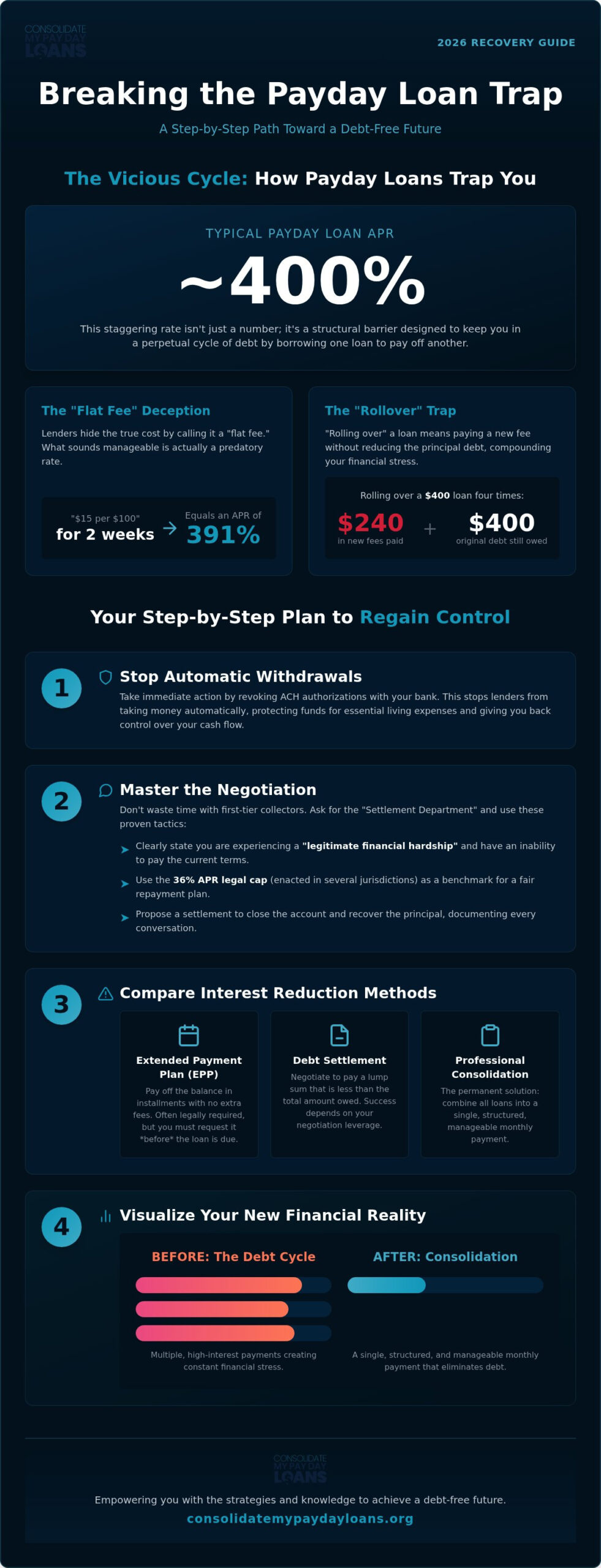
Did you know the national average interest rate for a typical payday loan is nearly 400% APR? This staggering figure isn’t just a number; it’s a structural barrier designed to keep you trapped in a cycle of borrowing one loan just to pay off another. It’s exhausting to watch your bank account dwindle from constant withdrawals while you search for ways to reduce payday loan interest rates. You deserve to regain control over your financial life without the constant fear of falling further behind.
The good news is that you don’t have to accept these predatory terms as a permanent reality. This 2026 recovery guide will teach you the specific strategies needed to negotiate with lenders effectively and break the debt cycle for good. We’ll walk you through the process of consolidating your debt into a single, manageable monthly payment and explain how to utilize new state-level rate caps. From understanding Extended Payment Plans to visualizing your recovery through structured relief, you’re about to discover a clear, step-by-step path toward a debt-free future.
Key Takeaways
- Understand the mechanics of the 400% APR trap and why these loans are structured to create a permanent cycle of debt.
- Master the specific communication tactics needed to reach settlement departments and successfully reduce payday loan interest rates through hardship programs.
- Take immediate action by revoking ACH authorizations to stop automatic bank withdrawals and protect your essential living expenses.
- Compare the success rates of Extended Payment Plans, debt settlements, and professional consolidation to find your most efficient path to recovery.
- Use a specialized consolidation calculator to visualize your savings and map out a single, manageable monthly payment that replaces multiple high-interest obligations.
Why Payday Loan Interest Rates Are So High (and How the Cycle Traps You)
To understand how to reduce payday loan interest rates, you first have to understand the mechanics of the trap. Most people start with a small, short-term loan to cover an emergency. However, what are payday loans exactly? They are high-cost, short-term obligations that typically require repayment within two weeks. When you can’t pay the full balance plus interest by your next payday, the lender offers an extension. This is where the cycle begins. You pay a fee to delay the principal, but the debt remains untouched.
The math is brutal. While 400% APR sounds like a theoretical number, its real-world impact is devastating. If you borrow $500 at this rate, you aren’t just paying back $500. Within a year, that single loan can cost you over $2,000 in interest and fees alone. Lenders rely on this “fee-only” payment model. They don’t want you to pay off the principal; they want you to pay the interest forever. You’ve reached a breaking point when your monthly interest payments exceed the original amount you borrowed.
The Difference Between Interest Rates and Finance Fees
Lenders often hide the true cost by calling it a “flat fee.” They might say it’s just $15 for every $100 you borrow. This sounds manageable until you realize that for a two-week loan, that “flat fee” translates to a 391% APR. In the context of 2026 regulations, predatory lending is defined as any credit product that uses deceptive fee structures and lack of “ability to repay” assessments to trap borrowers in a cycle of perpetual debt.
How Rollovers Compound Your Debt
Every time you “roll over” a loan, you pay a new fee without reducing the principal. It’s a hidden cost that compounds your financial stress. Many borrowers find themselves “stacking” loans, which means taking a second loan to pay the interest on the first. Consider a case where a borrower rolls over a $400 loan four times. Instead of paying $60 in fees once, they pay $240 in fees over eight weeks, yet they still owe the original $400. This is exactly why you need a structured plan to reduce payday loan interest rates before the total debt becomes mathematically impossible to manage.
Proven Strategies to Negotiate and Lower Your Payday Loan Interest
Negotiating with a lender feels intimidating, but you have more leverage than you think. Lenders know that if you default, they get nothing. By using a “hardship” approach, you shift the conversation from “I won’t pay” to “I cannot pay under these terms.” This isn’t just about asking for a favor; it’s about presenting a realistic plan to reduce payday loan interest rates so the lender actually recovers their principal rather than chasing a debt you can’t afford.
Don’t waste time with first-tier collectors. Their job is to follow a strict script and secure immediate payment. Instead, ask to be transferred to the “Settlement Department” or a manager with the authority to restructure debt. Once there, use the 36% APR benchmark. Across the United States, several jurisdictions have enacted laws that cap payday loan interest rates at approximately 36% APR, including fees. Use this as a “fairness” argument to show you’re aware of industry standards and consumer protections regarding payday loan costs and fees.
Requesting an Extended Payment Plan (EPP)
In many states, lenders are legally required to offer an Extended Payment Plan. This allows you to pay off the balance in several installments without additional interest or fees. The catch? You must request it before the loan is actually due. Some state regulations require lenders to offer a specific grace period if a borrower seeks credit counseling or demonstrates a legitimate inability to pay. Always confirm in writing that the EPP stops all further interest accrual to effectively reduce payday loan interest rates on your remaining balance.
The Negotiation Script: What to Say to Your Lender
When you call, stay calm but firm. Use specific phrases like: “I am experiencing a legitimate financial hardship and have an inability to pay the current terms.” Follow up with: “I am seeking debt relief and proposing a settlement to close this account.” Document the date, time, and name of every representative you speak with. If a lender refuses to negotiate or threatens legal action, it might be time to look into a payday loan relief program that can handle these professional negotiations on your behalf.
If you can scrape together a lump sum, offer it as a “final settlement” to eliminate all remaining interest. Aim for 50% of the total balance. It’s often better for the lender to take a guaranteed partial payment today than to risk a total loss tomorrow. This strategy is one of the most direct ways to settle your debt for less than the original balance plus fees.
Comparing Interest Reduction Methods: EPPs, Settlement, and Consolidation
Choosing the right strategy to reduce payday loan interest rates requires a clear understanding of your financial capacity and the specific tactics lenders use. DIY negotiation is an option if you have the time to call lenders repeatedly, but professional relief programs typically achieve more consistent results. This is because specialized advocates understand the internal thresholds lenders use to approve settlements. They know when a lender is likely to accept a lower amount to avoid a total loss on the account.
Taking a standard bank loan to pay off a payday lender sounds logical, but it often backfires. If your credit is already strained, you’ll likely only qualify for another high-interest product. You aren’t solving the problem; you’re just moving your debt from one expensive pocket to another. Debt settlement is another route that can lead to immediate savings, though it usually results in a temporary drop in your credit score as you stop payments to force a negotiation. Consolidation remains the most stable path for most borrowers because it merges multiple high-interest debts into one manageable monthly payment while focusing on long-term stability.
Why Rollovers Are Never the Answer
Rollovers are the primary way lenders keep you in debt. Consider the math over a six-month period. If you roll over a $500 loan every two weeks, you’ll pay thousands in fees without ever touching the original $500. You’re essentially treading water while the lender profits. In contrast, six months in a consolidation program means every dollar you pay goes toward reducing your actual balance. It’s the difference between financial stagnation and visible progress. You can use a Payday Loan Consolidation Calculator to see exactly how much you’re losing to the rollover cycle compared to a structured recovery plan.
The Role of Debt Consolidation in Interest Reduction
A professional consolidation program does more than just simplify your bills; it stops the daily interest clock. When you enter a program, negotiators work to align your payments with your actual budget. They use their knowledge of state payday loan regulations to push lenders toward a 0% or near-zero interest rate. Individual borrowers often lack the leverage to demand these terms. Experts, however, can often secure these concessions because they represent a large volume of cases. This creates a single, predictable monthly payment that allows you to breathe again while you effectively reduce payday loan interest rates to a level that makes repayment possible.
Stop the Cycle: Action Plan to Lower Payments
Regaining control over your finances requires more than just a desire to be debt-free; it demands a tactical, day-one action plan. The most immediate threat to your stability is the unrestricted access lenders have to your bank account. By taking specific legal steps, you can halt the drain on your resources and begin to reduce payday loan interest rates through structured negotiation. This process starts with reclaiming your agency over your own income.
Regaining Control of Your Bank Account
The first and most critical step is to revoke your ACH authorization. Many borrowers believe they’re stuck once they sign a loan agreement, but federal law provides you with the right to stop automatic withdrawals at any time. You must send a formal letter to your lender stating that you’re revoking their authorization to debit your account. Simultaneously, you must notify your bank. It’s vital to understand the difference between “stopping a payment” and “revoking authorization.” A stop-payment order often applies to a single transaction and carries a fee, whereas revoking authorization is a permanent legal withdrawal of the lender’s right to access your funds. This is the essential first step to ensure you have money for essentials like groceries and rent.
Organizing Your Debt for Maximum Leverage
Once your cash flow is protected, you must organize your debt to see the full picture. Create a “Lender List” that includes the current balance, the APR, and the date of your last payment for every loan. Identifying which loans are the most predatory allows you to prioritize your efforts. You should also prepare a simple financial statement that lists your monthly income and essential expenses. This document serves as proof of hardship when you notify your lenders in writing that you’re entering a hardship program. Use a consolidation calculator to aggregate your total debt and visualize how a single payment could replace the chaos of multiple lenders.
With your bank account secured and your debt organized, you can stop the cycle of paying only fees. Redirect the money you were previously losing to “interest-only” rollovers toward the principal balance of your smallest or most expensive loan. Finally, seek a unified exit strategy. Instead of fighting five different lenders, work toward closing all accounts simultaneously through a professional payday loan consolidation plan. This structured approach is the most effective way to permanently reduce payday loan interest rates and reclaim your financial peace.
Professional Payday Loan Consolidation: The Permanent Solution to High Interest
Many borrowers search for a traditional bank loan to solve their debt crisis, but this often leads to a dead end. Standard lenders usually require high credit scores and steady debt-to-income ratios that most people in the payday cycle simply don’t have. Professional payday loan relief programs offer a different path. Instead of adding new debt, these programs focus on restructuring what you already owe. By negotiating directly with your lenders, experts can often reduce payday loan interest rates to zero or near-zero, ensuring every dollar you pay actually shrinks your balance.
The core of a successful recovery is a unified exit strategy. Trying to pay off one lender while another drains your account is like trying to empty a sinking boat with a spoon. You need to address every account simultaneously to stop the cycle for good. This comprehensive approach prevents the “whack-a-mole” effect where one paid-off loan is immediately replaced by another emergency borrow. Once your accounts are consolidated into a single payment, the constant stress of daily collection calls and bank account monitoring finally disappears.
Why Consolidate My Payday Loans is the Right Choice
We understand the specific mechanics of predatory lending because we’ve been helping consumers navigate these traps for over two decades. Operating under Solid Ground Financial since 2004, our team specializes in the high-interest, unsecured debt that traditional consolidation companies often avoid. We don’t just see numbers on a spreadsheet; we see the human cost of 400% interest rates. Our approach is rooted in empathy and a non-judgmental environment, providing you with a stable anchor during financial turbulence. We act as your protective advocate, using our industry knowledge to reduce payday loan interest rates and demand fair treatment from lenders who thrive on your struggle.
Taking the First Step Toward Financial Freedom
Your recovery begins with a free, confidential debt analysis. During this consultation, we’ll review your “Lender List” and help you visualize a path out of the debt trap. In the first 30 days of a consolidation program, you’ll experience an immediate shift in momentum. We take over the communication with your lenders, giving you the psychological peace needed to focus on your future rather than your past due dates. It’s time to stop treading water and start moving forward toward the life you had before the debt cycle began. Start your path to financial peace today and reclaim your personal agency over your financial life.
Reclaiming Your Financial Agency
You’ve learned that the cycle of 400% interest isn’t a life sentence. By revoking ACH authorizations and utilizing state-level protections, you can stop the immediate drain on your bank account. Whether you choose to negotiate a hardship plan or pursue professional consolidation, the goal is to shift from treading water to making real progress. Reclaiming your financial life starts with the decision to stop paying fees and start paying down principal.
Since 2004, Solid Ground Financial has helped thousands of clients across the United States navigate these specific traps. Our specialized Payday Loan Hardship Programs are designed to reduce payday loan interest rates and provide a single, manageable path forward. You don’t have to face predatory lenders alone when you have a knowledgeable guide by your side. We remain a stable anchor for those seeking a supportive and non-judgmental environment to resolve their debt.
Take the first step toward psychological peace today. Estimate your savings with our Payday Loan Consolidation Calculator and see how quickly you can regain control. A debt-free future is within your reach, and the recovery begins now.
Frequently Asked Questions
Can I really lower my payday loan interest rate once I’ve signed the contract?
Yes, you can renegotiate the terms of your agreement even after the funds have been disbursed. Lenders are often willing to adjust the interest if they believe it is the only way to recover the principal balance. By presenting a documented financial crisis, you can often convince the lender to reduce payday loan interest rates. This proactive communication demonstrates your intent to pay while acknowledging that the current high-cost structure is no longer sustainable.
What happens if I stop paying my payday loans while negotiating?
Stopping payments typically triggers increased collection efforts and may lead to a temporary decline in your credit score. However, in many debt relief scenarios, this is a necessary step to demonstrate a legitimate inability to meet the original predatory terms. It signals to the lender that the account requires a specialist from the settlement department. During this period, it is vital to keep detailed records of all communication to protect yourself from aggressive collection tactics.
Is there a law that limits how much interest a payday lender can charge?
Interest caps vary significantly depending on where you live across the United States. As of 2026, 20 states and the District of Columbia have enacted legislation that limits interest to approximately 36% APR. Other jurisdictions require lenders to follow general consumer loan caps rather than specific payday provisions. If you reside in a state without these protections, you can still use these national benchmarks as a point of leverage to reduce payday loan interest rates during negotiations.
Will consolidating my payday loans hurt my credit score long-term?
Consolidation is generally beneficial for your long-term credit health because it replaces chaotic, missed payments with a single, consistent history. While settling an account for less than the full balance can cause a short-term dip, the alternative is often a series of defaults that cause much deeper damage. By resolving the debt and lowering your overall debt-to-income ratio, you build a stronger financial foundation that allows your score to recover and grow over time.
How can I stop a payday lender from taking money out of my bank account?
You have the legal right to stop automatic withdrawals by revoking your ACH authorization. To do this, you must notify the lender in writing and inform your bank that the authorization is no longer valid. This is a critical step in protecting your income for essential living expenses. Unlike a simple stop-payment request, revoking authorization is a permanent action that prevents the lender from attempting to debit your account for future installments or fees.
What is an Extended Payment Plan (EPP) and do I qualify?
An Extended Payment Plan is a structured repayment schedule that allows you to pay off your balance in smaller installments without incurring additional interest. Qualification often depends on state law and the timing of your request; most lenders require you to apply for an EPP before the loan’s original due date. It is a powerful tool for avoiding the rollover trap, but you must be proactive, as lenders rarely offer this option without a direct request.
Can I consolidate my payday loans and credit card debt at the same time?
Yes, professional relief programs can manage both payday loans and high-interest credit card debt simultaneously. Since both are forms of unsecured debt, they can be merged into a unified strategy that prioritizes interest reduction. This holistic approach simplifies your financial life by replacing multiple due dates with one monthly payment. It also gives your negotiators more leverage, as they are resolving your entire debt portfolio rather than a single isolated account.
How long does it take to see a reduction in my monthly payments?
Most borrowers see a significant reduction in their monthly out-of-pocket costs within the first 30 days of starting a program. Once the consolidation process begins and automatic withdrawals are halted, the immediate drain on your bank account stops. This shift provides instant relief to your cash flow. As negotiations proceed and interest rates are lowered or eliminated, your single monthly payment is calculated to fit realistically within your documented budget and essential living expenses.