
You’re sitting at your desk when your phone vibrates for the tenth time today. It isn’t a friend or family member; it’s a payday lender threatening to contact your employer or mentioning legal consequences that sound suspiciously like jail time. You need to know how to stop payday loan calls before the stress consumes your entire day. It’s exhausting to live under the constant shadow of a ringing phone and high-interest debt that never seems to shrink. You deserve to feel safe in your own home and focused at work without fearing the next notification.
We understand the weight of this pressure, and we’re here to help you regain control. This guide provides the immediate legal steps to silence the harassment using updated 2026 regulations and outlines the strategies to resolve the underlying debt for good. We will cover your rights under the Fair Debt Collection Practices Act (FDCPA), how to revoke consent under the latest TCPA rules, and why consolidation is the most effective path to permanent silence.
Key Takeaways
- Register for the National Do Not Call Registry and use the Opt-Out Prescreen to build a foundational defense against unwanted financial solicitations.
- Implement immediate legal strategies to stop payday loan calls by formally revoking your consent according to the latest 2026 consumer protection guidelines.
- Regain control of your checking account by revoking ACH authorizations; this step prevents lenders from using bank access as leverage for aggressive calling.
- Learn to spot the red flags of payday loan scams, such as threats of arrest or demands for untraceable payments, to ensure you only deal with licensed lenders.
- Discover how payday loan consolidation provides a permanent exit from the collection cycle by positioning a professional advocate between you and the lenders.
Why Payday Lenders Won’t Stop Calling You
The ringing doesn’t stop because you aren’t just dealing with a single lender. You’re caught in a high-speed digital auction where your personal information is the prize. To understand why the harassment is so persistent, it helps to look at what a payday loan is from the perspective of the industry. These lenders operate in a high-risk, high-reward environment. They know that if they aren’t the first ones to reach you, another company will be. This creates a desperate race to your phone that ignores your peace of mind.
The frequency of these attempts is fueled by the “debt trap” cycle. When a borrower is unable to repay a loan, they often seek another to cover the first. Lenders see this financial distress not as a reason to back off, but as a signal to increase their outreach. They want to ensure they’re at the front of the line for whatever funds you have left. This systemic pressure is why many people find it nearly impossible to stop payday loan calls without a professional intervention strategy.
The Role of Trigger Leads in Payday Lending
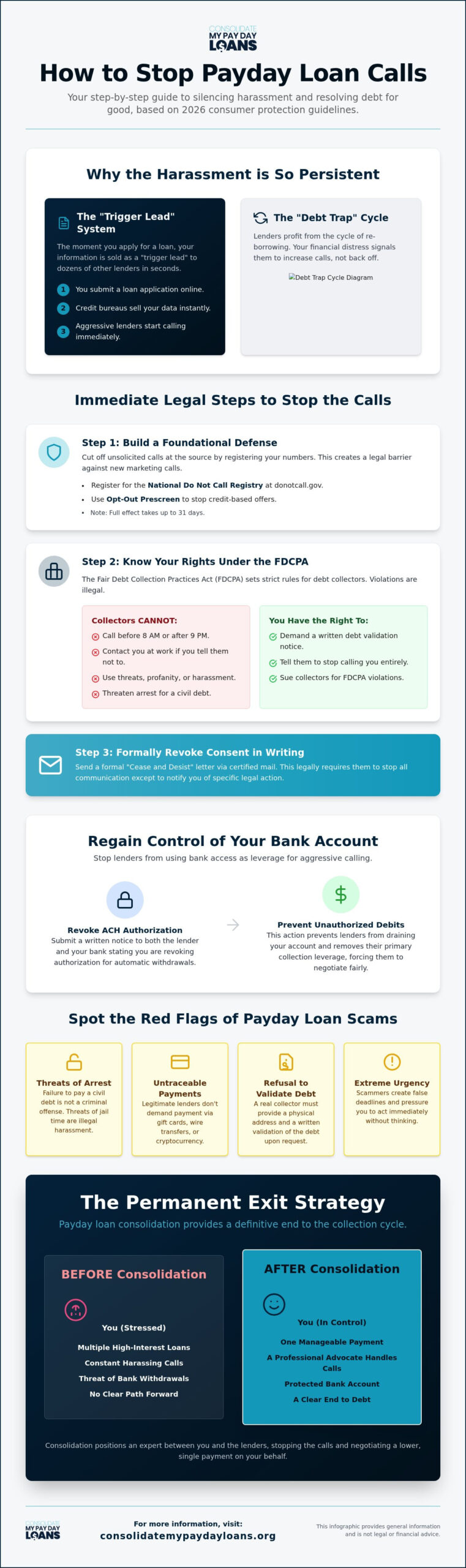
Your phone starts ringing the moment you submit an application because of “trigger leads.” When you apply for credit, the inquiry itself becomes a product. Credit bureaus and lead generators sell the fact that you’re looking for money to aggressive secondary lenders in real-time. Your contact information is sold in seconds. This is why you receive calls from companies you never contacted; they didn’t find you, they bought you. This predatory churn ensures that as long as you’re searching for relief, the calls will continue to multiply.
Collection Tactics vs. Predatory Harassment
There’s a clear line between legal debt collection and illegal harassment, though payday lenders frequently blur it. Legitimate collection involves identifying the debt and providing a path to repayment. Harassment starts when they use the “constant ring” tactic to disrupt your life. They might use auto-dialers to call you dozens of times a day or leave vague, threatening messages. Common red flags include:
- Threatening to contact your employer to “verify your income” as a way to shame you.
- Claiming you’ll face jail time or criminal fraud charges for a civil debt.
- Refusing to provide a physical address or a written validation of the debt.
These tactics are designed to create a sense of urgency through fear. They want you to feel that your only escape from the psychological weight of the noise is to pay immediately. Recognizing these as predatory maneuvers is the first step toward reclaiming your agency. You don’t have to live in fear of your phone. Learning the right legal and financial steps to stop payday loan calls will help you move from a state of panic to a state of resolution.
Immediate Legal Steps to Stop Payday Loan Calls
You have the power to silence the noise, even when it feels like the lenders hold all the cards. Asserting your legal rights is the most effective way to gain immediate relief. While these companies often act as though they’re above the law, specific federal protections exist to shield you from harassment. Understanding your rights when contacted by a debt collector is the first step toward regaining your peace of mind and learning how to stop payday loan calls for good.
How to Use the National DNC Registry Effectively
The National Do Not Call (DNC) Registry is a foundational defense. You can register your landline and mobile numbers for free at donotcall.gov. It’s a simple process, but it requires patience. It takes 31 days for your registration to become fully effective. While the DNC registry doesn’t stop collectors of legitimate existing debt, it is highly effective at cutting off the lead generators and data brokers who sell your information to secondary lenders. If you continue to receive marketing calls after the 31-day window, reporting these violations to the FTC helps build a necessary paper trail for your protection.
FDCPA Protections: What Collectors Can and Cannot Do
The Fair Debt Collection Practices Act (FDCPA) provides strict guidelines that third-party debt collectors must follow. If a caller violates these rules, they’re breaking federal law. Key protections include:
- Time Restrictions: Collectors cannot call you before 8 AM or after 9 PM in your local time zone.
- Workplace Privacy: If you inform a collector that your employer prohibits personal calls at work, they must stop calling you there immediately.
- Prohibited Language: Harassment, profanity, and abusive language are strictly forbidden. They also cannot lie about the amount you owe or threaten you with arrest.
Asserting these rights often forces collectors to change their tone. If the pressure remains too high, exploring payday loan relief can provide a professional buffer between you and these aggressive agencies.
Drafting a Limited Cease and Desist Letter
A “Limited Cease and Desist” letter is one of the most powerful tools in your arsenal. Unlike a full cease and desist, which stops all contact, a limited version requests that the lender or collector only communicate with you in writing. This stops the phone from ringing while ensuring you still receive important account updates. You should send this letter via certified mail with a return receipt requested. This provides legal proof that the lender received your request. If they continue to stop payday loan calls by ignoring your written demand, they may be liable for statutory damages under federal law.
How to Stop Payday Loan Automatic Withdrawals
Many borrowers don’t realize that their bank account is the primary tether allowing lenders to maintain pressure. When a payday lender loses the ability to dip into your checking account at will, they often pivot to aggressive phone tactics to scare you into making a manual payment. This shift is why you might see a spike in harassment after a failed withdrawal. Taking back control of your bank account is a necessary move to stop payday loan calls because it forces the lender to deal with you on your terms, not theirs.
There is a vital legal difference between a “Stop Payment” order and revoking authorization. A stop payment is a specific request to block one or more upcoming transactions. It often carries a fee from the bank and may only last for six months. In contrast, revoking authorization is a broader legal action. It officially cancels the lender’s right to access your account entirely. Lenders are legally required to honor this request under federal law, and ignoring it can lead to significant penalties for them.
Revoking Your ACH Authorization Legally
You can terminate a lender’s access to your funds by following two specific steps. First, notify the payday lender in writing that you are withdrawing your consent for any future electronic withdrawals. It’s best to send this via certified mail so you have proof of their receipt. Second, provide a copy of that notice to your bank or credit union. This puts the bank on notice that any future attempts by that lender are unauthorized. Revoking ACH authorization is a protected consumer right under the Electronic Fund Transfer Act.
Working with Your Bank to Block Predatory Debits
If a lender ignores your revocation and attempts to withdraw funds anyway, you must act quickly with your financial institution. You can issue a formal stop payment order on that specific lender to provide an extra layer of security. Some lenders attempt to bypass these blocks by changing their merchant ID or company name. If this happens, you might need to consider the “clean slate” approach. This involves closing your account entirely and opening a new one at a different bank. While this feels like a major hurdle, it provides immediate psychological relief and stops the financial bleeding. Understanding How to stop payday loan automatic withdrawals is a vital part of a broader plan to regain your agency and stop payday loan calls for good.
Identifying and Reporting Payday Loan Scams
When your phone rings incessantly, the line between a legitimate collector and a criminal scammer can feel dangerously thin. Scammers often purchase old lead data or stolen personal information to target individuals who have previously searched for financial help. This leads to the “phantom debt” phenomenon; callers demand payment for a loan you never actually received. Distinguishing between these threats is essential if you want to stop payday loan calls and protect your remaining assets from fraud.
Legitimate lenders must be licensed in your state to operate legally. You can verify a caller’s identity by asking for their license number or checking with your state consumer credit regulator. If they refuse to provide a physical business address or a written validation notice, you’re likely dealing with a fraudster. Real collectors may be aggressive, but they generally won’t risk their license by refusing to identify themselves or their company. Scammers rely on your desire to resolve the situation quickly to bypass these basic verification steps.
Red Flags of Collection Scams
Criminals use fear as a weapon to bypass your logical defenses. They create a false sense of urgency that makes you feel like you have no time to think. Be alert for these specific red flags:
- Threats of Arrest: They claim the sheriff is on the way or that you’ll be jailed for “check fraud.” In the United States, you cannot be jailed for failing to pay a civil debt.
- Untraceable Payment Methods: Scammers demand payment via gift cards, Zelle, or cryptocurrency. These methods are irreversible and nearly impossible for law enforcement to track.
- Refusal to Validate: If they cannot provide the original creditor’s name or the date of the alleged loan, hang up immediately.
Where to Report Harassment and Scams
Reporting these callers is the only way to trigger federal and state investigations. Your complaint adds to a database that helps authorities identify and shut down illegal call centers. Start by filing a report with the Consumer Financial Protection Bureau (CFPB). They track patterns of abuse and have the power to take legal action against predatory companies. You should also contact your State Attorney General’s office; they often have dedicated divisions for consumer protection and local lending laws.
For calls involving clear fraud or phantom debt, report the incident to the FBI’s Internet Crime Complaint Center (IC3). This is especially important if you’ve already shared sensitive banking information. If you’re overwhelmed by legitimate debts and cannot tell them apart from the scams, payday loan relief can help you organize your finances and provide a professional buffer against all unwanted callers. Taking these steps ensures you stop payday loan calls by attacking the problem from both a legal and a practical financial angle.
Ending the Call Cycle Through Payday Loan Consolidation
Blocking numbers and revoking authorizations provide immediate relief, but they don’t address the reason your phone is ringing in the first place. As long as the high-interest debt remains, legitimate lenders will continue their attempts to collect. Consolidation is the most effective way to stop payday loan calls because it replaces the chaos of multiple defaults with a structured, manageable plan. It transforms your financial situation from a defensive struggle into a proactive recovery.
The benefits of a single, manageable monthly payment extend far beyond your bank balance. When you aren’t juggling five or six different due dates, the psychological weight of the debt begins to lift. You gain the peace of mind that comes with knowing your debt is actually shrinking every month, rather than spinning out of control in a “rollover” trap. This stability is the foundation of long-term financial health and the only way to ensure the silence on your phone becomes permanent.
How Consolidation Stops the Harassment
When you enroll in Payday loan relief programs, you gain a professional advocate who acts as a buffer between you and the lenders. This is a critical shift in your recovery. Once a consolidation program is in place, the primary communication shifts from your personal phone to your representative. This transition naturally terminates the aggressive collection cycle because the lenders now have a clear point of contact and a defined path toward repayment. You no longer have to field threats or explain your situation to dozens of different callers every day.
Ending the cycle of defaults is what ultimately silences the lenders. Aggressive collection tactics are triggered by the uncertainty of repayment. By establishing a professional consolidation plan, you remove that uncertainty. The lenders stop their outreach because the debt is being handled systematically. You are no longer a target for harassment; you are a client in a structured resolution process. This is the most direct way to stop payday loan calls and reclaim your daily focus.
Calculating Your Path to Silence and Savings
Taking the first step toward a call-free future requires a clear understanding of your numbers. You can use a payday loan consolidation calculator to visualize how much you can save and how quickly you can achieve total resolution. Comparing the cost of “just stopping calls” through legal blocks against the long-term benefit of resolving the debt reveals the true value of consolidation. Legal blocks are a shield, but consolidation is the exit strategy.
Resolving the underlying debt restores your personal agency and allows you to focus on your future without the constant interruption of a ringing phone. You don’t have to carry the burden of predatory lending alone. By choosing a structured path to relief, you’re making a firm declaration that your financial life belongs to you, not the lenders. It is time to move past the noise and toward a stable, debt-free reality.
Take the First Step Toward a Quiet Phone and Financial Freedom
You don’t have to live in fear of your phone ringing. By asserting your legal rights and revoking ACH authorizations, you can gain immediate relief from the constant noise. These steps are vital, but they’re often temporary shields. To truly stop payday loan calls for good, you need a strategy that addresses the debt at its core. Consolidation provides that path, acting as a protective expert between you and aggressive lenders.
Since 2004, Solid Ground Financial has offered empathetic, non-judgmental advocacy for individuals facing financial turbulence. With over 20 years of experience managing high-interest predatory debt, we understand the mechanics of these traps and how to lead you toward a safer alternative. It’s time to regain your agency and silence the harassment for good. Calculate your savings and stop the calls with our Payday Loan Consolidation Tool. You deserve a future where your phone only rings when you want it to.
Frequently Asked Questions
Is it legal for payday lenders to call me at work?
Payday lenders can call you at your place of employment unless you specifically inform them that your employer doesn’t allow such calls. Under the Fair Debt Collection Practices Act (FDCPA), once you provide this notification, they’re legally barred from contacting you there. It’s best to provide this notice in writing to create a paper trail. If they continue to call after being told to stop, they’re violating federal law and could face penalties.
Can I go to jail for not paying back a payday loan?
No, you cannot go to jail for failing to repay a payday loan. Payday loans are civil debts, and the United States abolished debtors’ prisons long ago. If a collector threatens you with arrest or criminal charges, they’re using illegal tactics to scare you. These threats are common in “phantom debt” scams where callers try to collect on loans that don’t even exist. Always report these threats to the CFPB.
How do I write a cease and desist letter to a payday lender?
To write an effective cease and desist letter, clearly state that you’re revoking your consent to be contacted by phone. Include your full name, address, and account number for identification. Specify that all future communication must be in writing only. You don’t need complex legal jargon. Send the letter via certified mail with a return receipt requested to ensure you have proof that the lender received your request to stop payday loan calls.
What happens if I just block the numbers of payday loan collectors?
Blocking numbers provides immediate relief, but it’s rarely a permanent solution. Payday loan collectors and lead generators often use auto-dialers and “neighbor spoofing” to call from new, unrecognized numbers. While blocking helps manage the daily stress, it doesn’t address the underlying debt. The lenders will continue to sell your data to other agencies, which can lead to a fresh wave of calls from different companies and collection firms.
Does the Do Not Call Registry work for payday loan companies?
The National Do Not Call Registry is designed to stop unwanted telemarketing and sales calls, but it doesn’t apply to legitimate debt collection. If you have an existing business relationship with a lender, they’re allowed to contact you about your account. However, the registry is still useful because it helps stop the lead generators and data brokers who sell your information to secondary lenders, which can indirectly help you stop payday loan calls.
Can a payday lender call my family or friends about my debt?
A lender or collector is strictly limited in how they contact third parties. They can only call your family, friends, or neighbors once to ask for your contact information or location. They’re legally prohibited from disclosing that you owe a debt or discussing your financial situation with anyone other than you or your attorney. If they share your private debt information with others, they’re in direct violation of the federal FDCPA regulations.
How can payday loan consolidation stop the calls permanently?
Payday loan consolidation stops calls by resolving the underlying debt and establishing a professional buffer. When you enroll in a relief program, your consolidation advocate takes over communication with the lenders. This shift signals to the collectors that a structured repayment plan is in place, which naturally terminates the need for aggressive collection attempts. It replaces the cycle of defaults and harassment with a single, manageable path toward financial peace and total debt resolution.
What should I do if a caller threatens me with legal action?
If a caller threatens legal action, remain calm and ask for a written validation notice of the debt. Legitimate lenders must provide this within five days of their initial contact. Don’t provide any banking information or make a payment over the phone under pressure. Verify the caller’s identity and check if they’re a licensed lender in your state. Most threats of immediate lawsuits are empty tactics used to force a quick payment.