
Did you know the average payday loan carries a staggering 391% APR, often forcing borrowers to pay back triple what they originally borrowed? In some instances, these rates can even climb as high as 661%. It’s exhausting to watch your bank account drained by automatic withdrawals while aggressive debt collectors call your phone at all hours of the day. You’re likely feeling the weight of a system designed to keep you trapped in a cycle of endless rollovers and mounting fees. You aren’t alone in this struggle, and the pressure you’re feeling is a natural response to a predatory industry.
We understand the stress of facing financial turbulence, and we’re here to tell you that there’s a way out. By exploring your payday loan settlement options, you can stop the predatory cycle and regain control of your life. This guide will show you exactly how to negotiate with lenders to reduce the total amount you owe and consolidate your debt into one manageable payment. We’ll break down the mechanics of high-interest lending and provide a structured methodology to help you achieve the psychological peace and financial agency you deserve.
Key Takeaways
- Understand the mechanics of negotiating a lump-sum payment to resolve your debt for significantly less than the current balance.
- Compare payday loan settlement options against consolidation to determine which strategy offers the best protection for your credit score and long-term stability.
- Learn the essential first step of revoking ACH authorization to regain control over your bank account and stop automatic withdrawals.
- Identify the difference between settling the original principal and the predatory fees that often make these loans impossible to repay.
- Discover why professional advocacy can be more effective than DIY attempts when dealing with multiple high-interest lenders and aggressive collection tactics.
What is Payday Loan Settlement and How Does it Work?
A payday loan settlement is a formal agreement where a lender accepts a lump sum payment that is significantly lower than your current balance. It is a tactical exit strategy. To understand why this is necessary, it helps to first ask: What is a Payday Loan? These are short-term, high-cost obligations that frequently trap borrowers in a loop of rollovers. When you pursue payday loan settlement options, you are essentially asking the lender to forgive a portion of the debt in exchange for immediate cash.
The core of any negotiation involves distinguishing between the principal and the accrued fees. Payday lenders often charge fees ranging from $15 to $20 per $100 borrowed. Over time, these fees can eclipse the original amount you received. A successful settlement focuses on repaying the principal while convincing the lender to waive the predatory interest and late charges. Lenders often agree to these terms because they follow the principle that receiving something today is better than receiving nothing if you default entirely.
It’s also important to distinguish settlement from an Extended Payment Plan (EPP). An EPP merely stretches out the time you have to pay the full balance. It doesn’t reduce what you owe. Settlement, by contrast, is a permanent reduction in the total debt, providing a faster path to financial recovery.
The Role of Debt Forgiveness in Payday Loans
Payday lenders are notoriously more aggressive than credit card companies. They rely on direct access to your bank account and high-pressure collection tactics to secure payment. However, they also have internal thresholds for loss. They know that a borrower who has already paid back more in interest than the original loan value is a high risk for total default. Understanding this “insider knowledge” allows for better leverage during negotiations. Debt settlement is a strategic compromise between borrower and lender.
Common Settlement Triggers
Negotiations typically begin once a loan has entered default or when it becomes clear that the borrower can no longer sustain the payments. Your leverage often increases if the lender is charging rates that exceed state usury caps. With average APRs sitting at 391%, many lenders operate in a legal gray area. Enrolling in a payday loan relief program can act as a powerful trigger for these negotiations. It signals to the lender that you have professional advocacy and are serious about resolving the debt on your own terms rather than theirs.
Settlement vs. Consolidation: Choosing Your Exit Strategy
Deciding between settling your debt or consolidating it is a pivotal moment in your financial recovery. Both paths represent valid payday loan settlement options, but they serve different financial profiles and long-term goals. Settlement requires you to have a significant amount of cash on hand to offer a lump sum. In contrast, consolidation focuses on restructuring your debt into a sustainable monthly plan. While settlement might feel like a faster escape, it often requires you to fall behind on payments first, which can lead to aggressive collection calls and a temporary drop in your credit score.
The total cost analysis also reveals a stark difference. Settlement can reduce your total balance by 40% to 60%, but it leaves a “settled for less than full balance” mark on your credit report for seven years. Consolidation typically involves paying back the full principal, but at a fraction of the original interest rate. This method allows you to resolve the debt over several months without the sudden shock of a large lump-sum payment. Speed is the primary advantage of settlement; once the funds are transferred, the debt is legally extinguished. However, consolidation offers a more structured and predictable path to freedom.
Why Consolidation is Often the Safer Choice
Consolidation is generally the more stable route for those with a steady income. By choosing payday loan consolidation, you protect your banking relationship and avoid the risk of your account being closed due to repeated failed withdrawal attempts. It also helps you avoid the “taxable income” trap. When a lender forgives more than $600 of debt, the IRS often treats that amount as taxable income, meaning you could face an unexpected bill via Form 1099-C. A structured plan ensures you pay back your obligations without these hidden complications.
When Settlement Makes the Most Sense
Settlement becomes a viable option if you’ve already defaulted and have access to a lump sum of cash. It’s particularly effective for “zombie debt,” which refers to older loans that have been sold to third-party collectors. These agencies often buy debt for pennies on the dollar and are more willing to accept a fraction of the balance for a quick close. Before committing to this path, it’s wise to research payday loan alternatives to ensure you aren’t just trading one high-interest problem for another. If you’re unsure which path fits your current budget, you can check your eligibility for relief to see a clear comparison of your choices.
The Pros and Cons of Settling Payday Loan Debt
Settling your debt offers a path to freedom, but it’s a decision that requires careful weighing of immediate relief against long-term consequences. One of the most significant advantages of exploring payday loan settlement options is the immediate termination of the interest rate spiral. When you’re trapped in a cycle where fees reach $15 to $20 per $100 borrowed, a settlement stops the bleeding. You can significantly reduce the total amount paid back, often paying only a fraction of the original balance. This provides a clear end date to a struggle that might otherwise feel permanent.
However, you must prepare for the drawbacks. Your credit score will likely take a hit. Because settlement usually requires you to stop making payments to build a lump sum, your payment history suffers. Even after the settlement is finalized, the “settled for less than full balance” status remains on your report. This can make it difficult to obtain future credit, as lenders may see you as a higher risk. Additionally, during the negotiation phase, you might experience an uptick in aggressive collection calls. Lenders often use high-pressure tactics to try and secure a full payment before they agree to settle.
Credit Score Implications
A “settled” status is a permanent mark that tells future lenders you didn’t fulfill the original contract. While this is better than an open, unpaid debt, it’s less ideal than a full repayment. Credit recovery typically begins once the account shows a zero balance, but it can take 12 to 24 months of positive financial behavior to see a meaningful rebound. For those worried about long-term damage, choosing payday loan consolidation instead of bankruptcy is a preferred alternative for long-term credit health. It allows you to resolve the debt without the severe, decade-long impact of a bankruptcy filing.
Tax and Legal Risks
The IRS views forgiven debt as taxable income. If a lender forgives more than $600, you’ll likely receive a 1099-C form at the end of the year. You’ll need to report this amount on your tax return, which could result in a higher tax bill. There’s also the risk of legal action. If a lender feels they can collect the full amount through a court judgment, they may sue rather than settle. Professional negotiators can often mitigate these risks by using their industry relationships to secure a written agreement that protects you from future litigation.
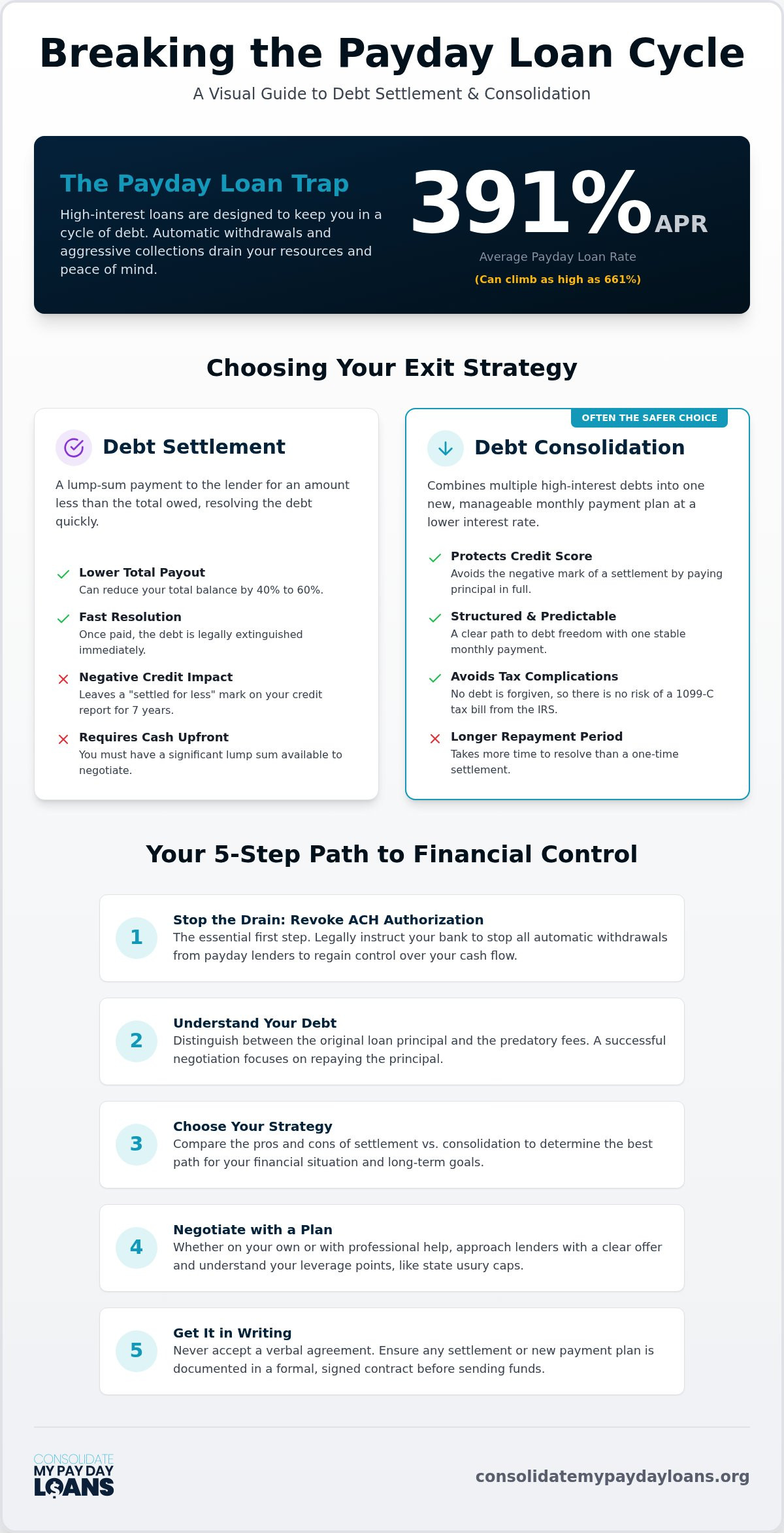
How to Negotiate a Payday Loan Settlement: 5 Steps
Negotiating with a high-interest lender requires a methodical approach that shifts the power balance back in your favor. You must move from a position of vulnerability to one of strategic control. To successfully navigate your payday loan settlement options, you need to follow a structured process that protects your assets while forcing the lender to the table. This isn’t about avoiding your obligations; it’s about finding a realistic resolution to a debt that has become mathematically impossible to repay.
The process involves five tactical stages. First, stop the automatic withdrawals by revoking your ACH authorization. Second, gather every record you have to calculate exactly how much principal you’ve paid versus interest. If you’ve already paid back the original loan amount in fees, you have significant leverage. Third, initiate all contact in writing to ensure a verifiable paper trail exists. Fourth, make a realistic lump sum offer, typically aiming for 40% to 60% of the current balance. Finally, never send a single cent until you have the final agreement signed by the lender in writing, explicitly stating that the debt is settled in full.
Revoking ACH Authorization Legally
Stopping the cycle begins with securing your bank account. There’s a vital difference between a “stop payment” order on a single check and “revoking authorization” for all future transfers. A stop payment is often temporary and carries bank fees. Revoking authorization is a legal demand that the lender stop accessing your account entirely. You should notify both your bank and the lender in writing at least three business days before the next scheduled withdrawal. This step is critical because it prevents the lender from draining your account, which forces them to negotiate rather than simply taking your funds.
The Art of the Settlement Offer
Your offer needs to be backed by a clear “Hardship Letter.” This document explains the specific financial circumstances, such as medical emergencies or loss of income, that prevent you from paying in full. It humanizes your situation while making it clear that a settlement is the lender’s best chance of recovering any funds. During this process, you can also negotiate for a “Pay-for-Delete” agreement. This is where the lender agrees to remove the negative mark from your credit report once the settlement is paid. If a lender refuses your first offer, remain firm. They may need to see that you’re committed to your resolution plan before they’re willing to compromise. If these steps feel overwhelming, you can get a professional evaluation of your debt to see how an advocate can handle these high-pressure negotiations for you.
Finding Professional Relief: Why Expert Help Matters
Attempting to navigate payday loan settlement options on your own can feel like facing a storm without a compass. This is especially true if you’re juggling three, four, or even five different lenders simultaneously. Each company has its own collection department and its own set of aggressive tactics. A DIY approach often leads to “settlement fatigue,” where a borrower gives in to a poor deal just to stop the phone from ringing. Professional advocates bring a level of firmness that individual borrowers often find difficult to maintain under high-pressure phone calls.
These experts understand the nuances of state usury laws and the shifting regulatory landscape. They know when a lender is operating outside legal boundaries, such as exceeding state-specific interest caps. This specialized knowledge transforms the negotiation from a plea for mercy into a demand for fairness. Before you speak to any lender, you can use a payday loan consolidation calculator to see exactly what your path to freedom looks like. It provides a data-driven preview of your potential savings, replacing fear with concrete numbers. This clarity is the essential first step in moving toward a structured payday loan hardship program.
The Consolidate My Payday Loans Advantage
Our primary objective is to stop the rollover trap immediately. We don’t just look at one loan in isolation; we create a unified strategy that can manage both payday loans and high-interest credit card debt. This holistic approach ensures you aren’t just fixing one leak while the ship is still taking on water. You gain the psychological peace that comes from knowing a professional team is handling the technicalities of your recovery. We act as a stable anchor, allowing you to focus on your daily life while we manage the lenders.
Your Next Steps to Financial Freedom
Taking action shouldn’t be another source of stress. You can start with a free consultation that requires no credit check, allowing you to explore your options without fear of further damaging your score. To make the most of this session, have your lender names, approximate balances, and a basic summary of your monthly income ready for your counselor. It’s time to stop the cycle of debt and start the process of recovery. You’ve carried this burden long enough, and taking that first step today is the most important move you’ll make toward regaining your financial agency.
Take Control of Your Financial Future Today
Breaking the cycle of high-interest debt requires a shift from reactive stress to proactive strategy. You’ve learned that resolving these obligations starts with securing your bank account and evaluating the best payday loan settlement options for your unique budget. Whether you choose a lump-sum settlement to extinguish debt quickly or a structured consolidation to protect your long-term credit health, the goal remains the same: regaining your personal agency. You’ve already done the hard work of educating yourself on the process; now it’s time to put that knowledge into action.
Since 2004, our empathetic and non-judgmental financial experts have specialized in managing high-interest debt and stopping predatory lending cycles for good. We provide the stable anchor you need during financial turbulence, offering specialized consolidation programs that simplify multiple lender deadlines into one manageable path. You don’t have to face aggressive collectors alone. Take the first step toward psychological peace and tangible financial recovery by speaking with a dedicated advocate who understands the industry’s pitfalls. Get Your Free Payday Loan Relief Quote Today. Your journey toward a debt-free life is possible, and it begins with the decision to move forward today.
Frequently Asked Questions
Can I settle a payday loan for less than I owe?
Yes, you can settle a payday loan for less than the total balance by negotiating a lump-sum payment. Lenders often agree to these terms because they’d rather recover a portion of the debt than risk a total default. This strategy is a primary component of many payday loan settlement options, allowing you to discharge the debt for a fraction of what you originally borrowed.
What happens if I stop paying my payday loans to force a settlement?
Stopping payments will likely trigger aggressive collection efforts and a temporary drop in your credit score. Lenders may call you frequently or attempt multiple bank withdrawals. However, this period of delinquency often makes the lender more willing to negotiate. They realize that a borrower who has stopped paying is a high risk for never paying at all, which creates a window for compromise.
How much should I offer for a payday loan settlement?
You should generally start your offer at 30% to 40% of the current balance, with the goal of settling around 50%. It’s helpful to remind the lender of how much you’ve already paid in interest and fees. When exploring payday loan settlement options, using your payment history as leverage can justify a lower offer, especially if you’ve already repaid the original principal amount.
Will settling a payday loan stop the lender from calling my work?
Yes, once a settlement agreement is finalized and paid, the lender must cease all collection activities immediately. This includes calls to your workplace and your personal phone. Under the Fair Debt Collection Practices Act, you can also send a written request for them to stop calling your place of employment even before you reach a final settlement. Professional advocates can help enforce these boundaries.
Does a payday loan settlement stay on my credit report?
A settled payday loan will typically remain on your credit report for seven years from the date of the first delinquency. It will be marked as “Settled for less than full balance.” While this is a negative mark, it’s generally considered less damaging than an active, unpaid collection account. It shows future lenders that the obligation has been legally resolved and the balance is zero.
What is the difference between an Extended Payment Plan and a settlement?
An Extended Payment Plan (EPP) allows you more time to pay the full balance without additional fees, while a settlement reduces the total amount you owe. An EPP is a state-mandated option in many jurisdictions that pauses the interest cycle. A settlement is a negotiated compromise where the lender agrees to forgive a specific portion of your debt entirely in exchange for a quicker payment.
Can a payday lender sue me if I try to negotiate a settlement?
Yes, a lender has the legal right to sue you for the full balance if you’re in default. However, lawsuits are expensive and time-consuming for lenders. Most prefer to reach a settlement agreement rather than paying legal fees to chase a borrower who may not have seizable assets. Negotiating in good faith often prevents litigation from ever reaching a courtroom floor.
How do I stop a payday lender from taking money out of my bank account?
You must revoke your ACH authorization by notifying both the lender and your bank in writing. Simply asking your bank to “stop payment” isn’t enough, as lenders may attempt withdrawals for different amounts. A formal revocation of authorization is a legal requirement that forces the lender to stop accessing your account. This step is vital to regain control over your monthly budget.