
Could paying off payday loans with a credit card be the lifeline you need, or are you simply trading one predatory cycle for another? When you’re facing a 391% average APR and the constant fear of unauthorized ACH withdrawals, the urge to find any exit strategy is overwhelming. You want the daily interest to stop accruing and the lender harassment to end immediately. It’s completely understandable to look at a credit card with an average 21% interest rate as a sanctuary compared to the triple-digit rates of short-term lenders.
We’re here to help you determine if this strategy is a viable move for your specific situation or a dangerous debt trap. This 2026 guide explores the mechanics of shifting debt and, more importantly, introduces professional consolidation alternatives designed to break the cycle for good. You’ll discover how to lower your effective APR and combine multiple stressful payments into one manageable monthly obligation. It’s time to regain your agency and find a path toward lasting psychological peace.
Key Takeaways
- Explore the critical differences between using a high-fee cash advance and a 0% introductory balance transfer to settle outstanding debt.
- Understand the long-term financial implications of paying off payday loans with a credit card to determine if you’re solving the problem or just moving it.
- Compare the impact on your credit score when adding new revolving debt versus entering a structured consolidation program that reduces your total balance.
- Learn how to conduct a 2026 debt audit to assess your debt-to-income ratio and identify the most cost-effective path toward financial recovery.
- Discover how specialized negotiation strategies can stop the predatory rollover cycle and provide a permanent exit from high-interest lending.
The Risks and Rewards of Paying Off Payday Loans with a Credit Card
When you’re trapped in a cycle of high-interest borrowing, a credit card can feel like a life raft. The pressure of a 391% APR is exhausting. It’s constant. Moving that debt to a major bank feels like a victory because the psychological relief of escaping a predatory lender is tangible. You’re no longer dealing with aggressive storefront tactics or the fear of immediate bank account seizures. Instead, you’re back in the world of traditional finance. However, it’s vital to recognize the difference between a debt swap and a true debt solution. To navigate this safely, you must first clarify what is a payday loan? and why it creates such a heavy burden compared to other forms of credit.
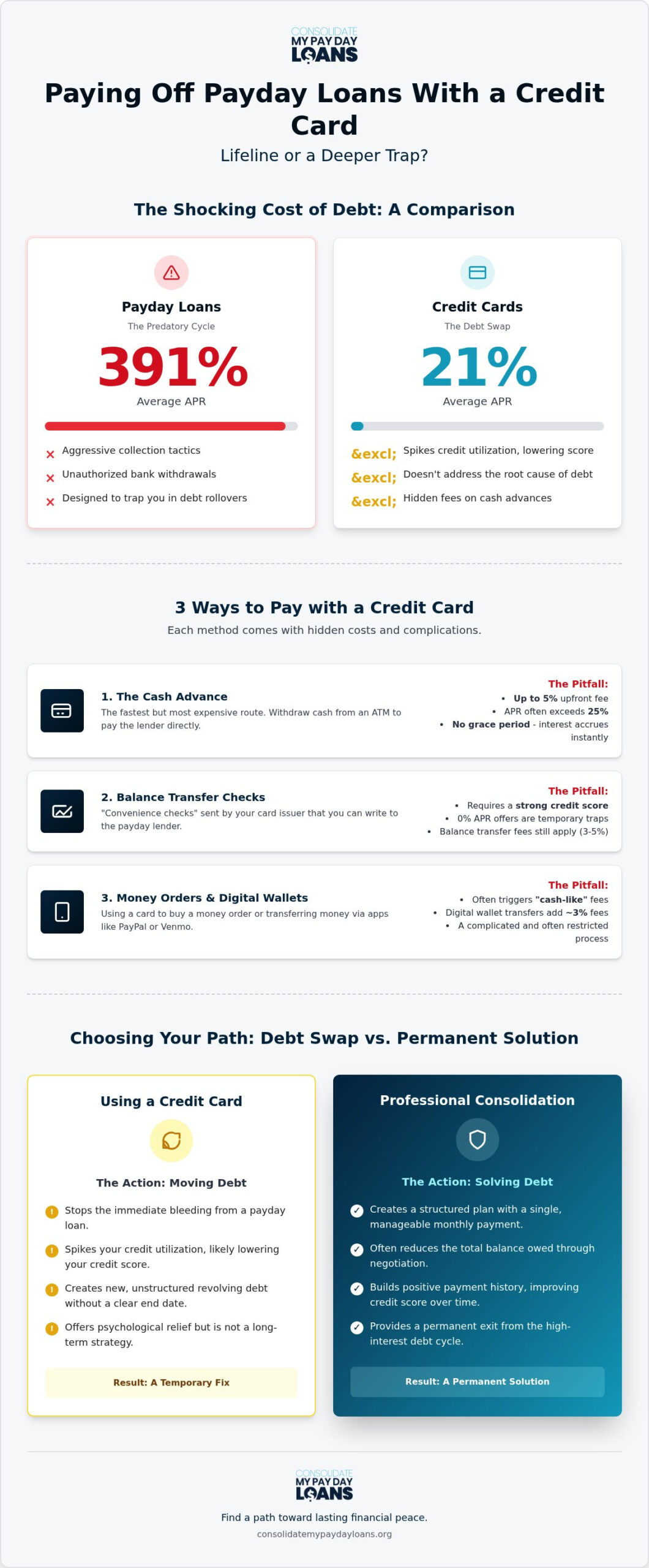
Paying off payday loans with a credit card might stop the immediate bleeding, but it doesn’t always heal the wound. You’re essentially using one line of credit to satisfy another. While the lower interest rate of a credit card, which averages around 21% in 2026, is objectively better, your credit utilization will spike. This can lead to a sudden drop in your credit score. This dip makes future financial recovery more difficult if you don’t have a plan to pay down the new card balance quickly. You’ve moved the debt, but you haven’t managed it yet.
Can You Directly Pay a Payday Lender with a Card?
Most lenders realize that credit card payments are easy for consumers to dispute. Because of this, they rarely accept them directly. To bypass this, borrowers often turn to cash advances or money orders. This adds layers of complexity and cost. Understanding what happens if you don’t pay back a payday loan reveals why borrowers are so desperate to switch to a card; payday lenders are often far more aggressive than traditional credit card collections teams. They may attempt multiple bank withdrawals, leading to cascading overdraft fees that a credit card company simply wouldn’t trigger.
The Hidden Costs of Credit Card Cash Advances
If you choose this path, be prepared for the cash advance trap. In 2026, most banks charge a fee of 3% to 5% just to access the funds. This happens the moment you withdraw the money. Unlike a standard purchase, cash advances usually have a much higher APR than your normal card rate. There is also no grace period. Interest starts accruing the second the transaction is processed. You aren’t just paying off payday loans with a credit card; you’re creating a new, expensive obligation that requires a strict repayment plan. Without professional guidance, this “life raft” can quickly become another anchor.
3 Ways to Pay Payday Debt with a Credit Card & Pitfalls
If you’ve decided that paying off payday loans with a credit card is your next move, you need to understand the logistics. Lenders don’t make this easy. They want you trapped in their specific ecosystem, not moving your debt to a regulated bank with lower rates. Because most payday storefronts refuse to swipe a card at the counter, the mechanics of paying off payday loans with a credit card involve more than just a simple transaction. You’re forced to use workarounds that come with their own set of financial hurdles.
- Method 1: The Cash Advance. This is the fastest route but also the most expensive. You withdraw cash from an ATM using your credit card and pay the lender in person. In 2026, you’ll likely face a 5% upfront fee, and interest starts accruing immediately at a rate often exceeding 25%.
- Method 2: Balance Transfer Checks. If you have a strong credit score, your card issuer might send you “convenience checks.” You can write these directly to the payday lender. This is often a component of broader debt consolidation strategies designed to lower your monthly overhead.
- Method 3: Funding a Money Order. You can use your card to purchase a money order at select retailers, though many have restricted this practice. It’s a complicated process that usually triggers “cash-like transaction” fees from your bank.
A growing trend in 2026 involves digital wallet workarounds. Borrowers use apps like Venmo or PayPal to send money to a trusted friend using a credit card, who then transfers the cash back to the borrower’s bank account. While clever, this maneuver typically costs 3% in transaction fees on top of your card’s standard interest rate. It’s a high price for a temporary fix.
The Balance Transfer Trap
A 0% APR offer looks like a miracle, but it can be dangerous. If you don’t clear the full payday balance before the promotional period ends, which usually lasts 18 to 21 months, the interest rate can spike to 23% or higher. For those struggling with lower scores, credit card consolidation for bad credit requires more than just shifting balances; it requires a structured repayment plan. There’s also the risk of “re-loading.” Once you clear the card to pay the payday loan, the temptation to use that newly available credit for daily expenses can lead to a double debt burden that’s nearly impossible to manage alone.
Regaining Control: The ACH Revocation Step
Before you move a single dollar, you must stop the bleeding. Payday lenders rely on automatic bank withdrawals to keep you in their cycle. Under the Electronic Fund Transfer Act in 2026, you have the legal right to revoke this access. You must notify your bank and the lender in writing that you’re stopping the authorization. This prevents the unauthorized withdrawal attempts that lead to cascading overdraft fees. It’s the first step in any successful recovery. If you’re unsure how these savings add up, using a payday loan consolidation calculator can help you visualize the difference between credit card interest and a professional relief program.
Credit Card vs. Professional Consolidation: A 2026 Comparison
Deciding between these two paths requires looking past the immediate relief of a zero balance on your payday portal. While paying off payday loans with a credit card might stop the lender’s phone calls today, it sets a new timer on your financial health. The primary danger of the credit card route is the “perpetual minimum payment.” If you only pay the minimum on a card balance, you could remain in debt for years. Professional consolidation is designed with a fixed end date, ensuring you actually reach a zero balance rather than just treading water.
The interest rate gap is significant. Even with credit card rates averaging 21% in 2026, they are a fraction of the typical payday loan costs. However, a credit card is still a form of high-interest revolving debt. Professional consolidation programs often negotiate to lower or waive the fees that make payday loans so toxic. This reduces the total amount you owe rather than just shifting the balance to a new creditor. You’re seeking a solution that addresses the principal balance, not just the interest.
Credit score impact is another critical factor to weigh. When you use a card, your credit utilization ratio, which is the amount of credit you use versus your total limit, will likely skyrocket. This often triggers a sharp drop in your score. In contrast, consolidation focuses on debt reduction. As your total debt decreases through a structured program, your score typically begins a steady recovery. You aren’t just paying off payday loans with a credit card; you’re choosing whether to mask the debt or eliminate it entirely.
When the Credit Card is a Viable Temporary Fix
This strategy is only effective under very specific conditions. You need a high credit limit, low current utilization, and ideally, a 0% introductory APR offer. It also requires a level of repayment discipline that can be hard to maintain when you’re already under financial stress. If you’re dealing with just one small loan and have a guaranteed way to pay the card back within a few months, it might work as a short-term bridge. For most people, however, it’s a gamble that leads to maxed-out cards and even less financial flexibility.
Why Professional Relief is the Sustainable Path
Most borrowers aren’t juggling just one lender. They have multiple loans with different due dates and aggressive collection tactics. Understanding unsecured debt consolidation is vital because it shows how a professional advocate can bundle these various debts into one manageable monthly payment. These programs use specialized negotiation to stop the rollover cycle and waive accumulated late fees. Before committing to a new credit card balance, use a payday loan consolidation calculator to see how much you could save through a professional program versus the long-term cost of credit card interest.
Buying Guide: Choosing a Consolidation Strategy in 2026
Choosing between a self-managed debt swap and professional intervention requires an objective look at your numbers. While paying off payday loans with a credit card offers immediate relief from aggressive lenders, it only works if you have the capacity to handle a new revolving balance. In 2026, a successful recovery starts with a methodical four-step audit of your financial standing. You need to move beyond survival mode and start looking at the long-term cost of your debt.
- Step 1: Audit your total debt. Create a comprehensive list of every payday loan, installment loan, and existing credit card balance. You must see the full scope of the “mountain” before you can decide on the best climbing gear.
- Step 2: Check your 2026 debt-to-income (DTI) ratio. Calculate how much of your monthly gross income goes toward debt. If this number exceeds 40%, you’re in a high-risk zone where a credit card might lead to a total default on other obligations.
- Step 3: Evaluate provider legitimacy. Scrutinize any company you consider for help. Look for specific industry certifications and a transparent fee structure that aligns with federal consumer protection laws.
- Step 4: Compare total repayment amounts. Don’t just look at the monthly payment. Calculate the total interest you’ll pay on a credit card over several years versus the fixed, total cost of a professional consolidation plan.
Vetting Your Debt Relief Partner
Trust is the most valuable currency when you’re facing financial turbulence. A legitimate consolidation provider will never ask for money upfront. Under federal regulations, fees are only earned after a debt is successfully negotiated and a payment is made. You should verify that the company is a member of the American Fair Credit Council (AFCC). This membership ensures they adhere to strict ethical standards and provide essential consumer protections. Always clarify if the program focuses on settlement, which actually reduces the principal you owe, or simple consolidation, which just combines your payments into one monthly bill.
Evaluating the “Hardship” Path
If your income has dropped or your expenses have spiked, you might qualify for a payday loan hardship program. These specialized tracks are distinct from standard credit card relief because they account for the unique, high-velocity nature of payday lending. Ask potential partners if they have specific negotiation scripts for the lenders you’re currently facing. Because payday lenders operate outside the norms of big banks, your advocate needs “insider knowledge” of their specific collection tactics. If you’re ready to stop the cycle and regain your agency, you can start your free debt analysis today to see which strategy fits your 2026 budget.
Consolidate My Payday Loans: A Specialized Exit Strategy
Predatory lenders rely on your isolation. They assume you don’t have an advocate to challenge their high-velocity interest rates and aggressive collection tactics. At Consolidate My Payday Loans, we bridge the gap between the chaotic world of short-term lending and the stability you deserve. While paying off payday loans with a credit card might lower your APR, it doesn’t necessarily address the systemic rollover cycle that keeps you trapped. Our strategy is built on professional advocacy. We step between you and the lender to negotiate a resolution that focuses on principal reduction and fee waivers.
The “Single Payment” advantage is a cornerstone of our program. Instead of tracking multiple due dates and fearing unauthorized bank drafts, you move toward one predictable monthly bill. This simplification provides immediate psychological relief. It allows you to stop reacting to financial emergencies and start managing your recovery. We don’t just move your debt from one high-interest bucket to another. We create a structured path toward financial peace that prioritizes your agency over the lender’s profit margins.
- Direct Negotiation: We use specialized scripts to stop the interest accrual and rollover fees that typical credit cards can’t touch.
- Predictability: You’ll know exactly when your debt will be settled, unlike the open-ended nature of credit card minimum payments.
- Protection: Our team works to stop the harassment, giving you the space to breathe and rebuild.
Our 2026 Debt Relief Methodology
Success begins with a “Deep Dive” into your specific lender contracts. We identify the legal leverage points that allow us to negotiate more effectively. Once you enter the program, we establish a protective barrier to redirect collection efforts away from your daily life. For many, choosing payday loan consolidation instead of bankruptcy is the most strategic move for their long-term credit health. It allows for a dignified exit from debt without the decade-long shadow of a bankruptcy filing.
Take the First Step Toward Recovery
You can start visualizing your future right now by using our payday loan consolidation calculator to estimate your potential savings. Within your first 24 hours in the program, you’ll feel the weight begin to lift as our team takes over the communication with your lenders. This is about more than just paying off payday loans with a credit card; it’s about reclaiming your life. Your debt does not define your future, and with the right advocate, you can break the cycle for good.
Your Path to Financial Agency in 2026
You’ve explored the mechanics of shifting debt and the risks inherent in the credit card “life raft.” Moving a balance doesn’t eliminate the underlying burden. True recovery happens when you stop the rollover cycle and negotiate with lenders directly to reduce what you actually owe. While paying off payday loans with a credit card can provide a temporary reprieve from triple-digit interest, it often lacks the structured principal reduction provided by a professional program.
Our specialized payday loan relief experts have spent over 18 years advocating for national debt relief. We utilize proven negotiation strategies to stop rollovers and waive predatory fees that keep you trapped. You can start visualizing your recovery right now. See how much you can save with our 2026 Payday Loan Consolidation Calculator and take back control of your financial life. You don’t have to navigate this turbulence alone. A stable, debt-free future is within your reach, and it starts with a single, informed decision today.
Frequently Asked Questions
Can I pay off a payday loan with a credit card directly?
Most payday lenders refuse direct credit card payments because they want to avoid the risk of consumers disputing the transactions. You typically have to use a workaround like a cash advance or a balance transfer check to access the funds. These methods allow you to pay the lender in cash or via a bank draft, though they trigger immediate interest charges from your card issuer.
Is it better to use a credit card cash advance or a consolidation program?
A professional consolidation program is almost always the safer choice for long-term recovery. While a cash advance provides immediate liquidity, it carries high fees and interest rates that start the moment you withdraw the money. Consolidation focuses on negotiating with lenders to reduce your total principal and waive rollovers, providing a structured path to becoming debt-free rather than just shifting the balance.
Will using a credit card to pay a payday loan hurt my credit score?
Using a card can negatively impact your score if it causes your credit utilization ratio to spike. If you use a large portion of your available limit to settle a loan, your score will likely drop. Professional relief programs focus on total debt reduction, which typically leads to a steady score recovery as you pay down the negotiated balances and improve your debt-to-income ratio.
How do I stop payday lenders from withdrawing money from my bank account?
You can stop automatic withdrawals by revoking your ACH authorization in writing to both the lender and your bank. Under the Electronic Fund Transfer Act, you have the legal right to stop these recurring payments. It is best to provide this notice at least three business days before your next scheduled payment to ensure your bank has sufficient time to process the stop-payment request.
Can I consolidate credit card debt and payday loans together?
Yes, many specialized relief programs allow you to merge both revolving credit card balances and short-term loans into a single monthly payment. This is a highly effective method of paying off payday loans with a credit card debt simultaneously. By bundling these high-interest obligations, you simplify your monthly budget and ensure that a larger portion of your payment goes toward the principal balance instead of interest.
What is a payday loan hardship program and how do I qualify?
A hardship program is a specialized repayment track for borrowers who can prove they are experiencing significant financial distress. You typically qualify if your income has decreased or you’ve faced unexpected medical expenses. These programs are designed to break the rollover cycle by freezing interest and extending the repayment term, allowing you to settle the debt without the pressure of triple-digit APRs.
How much can I save by consolidating my high-interest debt in 2026?
Savings depend on your total balance, but moving from a 391% average payday APR to a negotiated settlement can save you thousands of dollars in interest alone. Professional advocates also work to waive late fees and accumulated rollovers that lenders often tack on. Using a 2026 savings calculator is the best way to visualize how much of your hard-earned money will stay in your pocket.
What happens if I use a balance transfer card to pay a payday loan?
You essentially trade a predatory loan for a credit card balance that may offer a 0% introductory APR for 18 to 21 months. This is a common tactic for paying off payday loans with a credit card, but it requires extreme discipline. If you don’t clear the balance before the promotional period ends, the interest rate will spike to an average of 21%, potentially leaving you in another cycle of debt.