
What if the reason you can’t pay off your debt isn’t the size of your paycheck, but a system specifically designed to keep you trapped? It’s exhausting to watch every cent of your income disappear into a black hole of 400% interest rates and aggressive bank withdrawals. You’re likely feeling the weight of constant financial stress, yet you’re not alone in this struggle. This is why exploring payday loan consolidation for low income has become a vital lifeline for those seeking a real recovery in 2026.
We know the fear of a total financial collapse is real when lenders are constantly pulling from your account. You deserve a strategy that respects your tight budget and offers a way to stop taking new loans just to cover old ones. This guide provides actionable strategies to break the payday loan cycle and eliminate debt quickly, even when money is scarce. We’ll preview a step-by-step exit plan that prioritizes your psychological peace and outlines a clear methodology to reclaim your financial agency.
Key Takeaways
- Learn the immediate “Stop the Bleed” protocol to legally revoke ACH authorizations and protect your bank account from aggressive lender withdrawals.
- Discover how to adapt the Debt Snowball and Avalanche methods specifically for high-interest short-term loans to gain mental and financial momentum.
- Understand the mechanics of payday loan consolidation for low income and how it creates a single, manageable monthly payment without requiring a traditional bank loan.
- Use specialized tools like a debt-free date calculator to visualize your path to recovery and find a relief plan that fits your current budget.
Understanding the Low-Income Debt Trap & Why Speed Matters
Traditional financial advice often feels like a slap in the face when you’re drowning in high-interest debt. Telling someone to skip a daily latte is useless when a single $500 loan has ballooned into $2,000 in just a few months. This isn’t a failure of willpower; it’s the result of a mathematical trap designed to exploit tight budgets. While “good debt” like a mortgage or a student loan might help you build a future, predatory debt is designed to consume your present. To understand the systemic nature of these traps, one should first ask: What is a payday loan? It’s a short-term, high-cost debt that relies on your next paycheck as collateral, often creating a permanent deficit in your bank account.
The rollover cycle creates a constant state of fight-or-flight. You take a new loan to pay the old one, but the fees grow faster than you can work. This cycle doesn’t just drain your wallet; it takes a massive toll on your mental health. Breaking free requires a specific approach, such as payday loan consolidation for low income, which focuses on stopping the interest bleed rather than just cutting small expenses. Speed is your greatest ally here. The longer you stay in the cycle, the harder it becomes to escape without professional intervention.
The Velocity of High-Interest Debt
High-interest debt moves with terrifying speed because of how daily interest accrues. If you carry a $1,000 balance on a high-interest credit card at 30% APR, you’ll owe about $75 in interest after 90 days. In contrast, a payday loan with a 400% APR will cost you nearly $1,000 in interest alone over that same period. You effectively pay for the loan twice without ever touching the principal balance. The tipping point arrives when your monthly interest obligations exceed your surplus income after rent and food. At that stage, the debt becomes mathematically impossible to pay off through traditional budgeting alone because the balance grows faster than you can pay it down.
- Daily interest accrual that compounds faster than most people can earn.
- Rollover fees that add hundreds of dollars to the principal balance every few weeks.
- Automatic bank withdrawals that trigger cascading overdraft fees and financial instability.
The Myth of the “Minimum Payment”
Lenders often present a “minimum payment” or a “rollover fee” as a helpful way to stay current. In reality, this is a trap that ensures you never make progress. When you pay $100 toward a typical payday loan, it’s common for $80 or more to go toward interest and service fees. This leaves only a tiny fraction to reduce the actual debt. If your payment doesn’t cover the principal, you’re stuck in a “forever loan” that keeps you tethered to the lender indefinitely. Predatory lending is defined by loan terms that are intentionally exploitative, typically featuring interest rates between 300% and 500% APR.
Immediate Steps to Protect Your Cash Flow & Stop the Cycle
When you’re trapped in a cycle of high-interest borrowing, your first priority is regaining control of your own cash flow. The panic of seeing your bank account hit zero before you’ve even bought groceries is overwhelming. You need to act now to protect what’s left of your paycheck. While you work toward a long-term solution like payday loan consolidation for low income, these immediate steps will help you keep your lights on. You have legal rights that can help you avoid the high costs and risks of further financial damage, but you must be proactive in exercising them.
The “Stop the Bleed” protocol consists of three actions you must take in the next 24 hours. First, you must secure your bank account. Second, you must redefine your budget to prioritize survival. Third, you must inform your lenders that you are in a hardship situation. Taking these steps doesn’t make you a “bad” borrower; it makes you a person who is taking responsibility for their survival.
Revoking Your ACH Authorization Legally
Many lenders rely on the fact that you don’t know you can stop them from automatically withdrawing funds. You have the legal right to revoke your ACH authorization at any time. This is different from a “stop payment” on a single check; it’s a total cancellation of the lender’s permission to touch your account. To do this, you should notify the lender in writing and then contact your bank to ensure they block any future attempts. For a step-by-step guide and specific scripts, you can follow this resource on how to stop payday loan automatic withdrawals legally. Stopping these withdrawals prevents cascading overdraft fees and gives you the breathing room to evaluate payday loan relief options that actually fit your budget.
Prioritizing Your Four Walls
When money is scarce, you must adopt a “Debt-First” budget that prioritizes your “Four Walls” before any predatory collector. These walls are food, utilities, shelter, and transportation. Payday lenders often use aggressive threats to jump to the front of the line, but they are unsecured creditors. They cannot take your home or your groceries. If a collector calls, stay calm and firm. Use a simple script: “I am currently in a hardship situation and cannot make this payment while meeting my basic survival needs.” By securing your four walls first, you regain the psychological peace needed to plan a permanent exit from debt.
- Food: Ensure your family is fed before sending a cent to a high-interest lender.
- Shelter: Rent or mortgage payments are non-negotiable foundations for your recovery.
- Utilities: Keep the lights, water, and heat running to maintain a stable environment.
- Transportation: You need to get to work to maintain the income that will eventually fund your debt-free life.
Proven Debt Payoff Strategies Tailored for Limited Budgets
Paying off debt on a limited income requires a tactical shift. Traditional advice often assumes you have hundreds of dollars in extra cash each month, but when you’re managing small-dollar, high-interest loans, every single dollar must be weaponized. The goal is to move from a defensive posture to an offensive one. By using payday loan consolidation for low income strategies, you can begin to systematically dismantle your balances without needing a perfect credit score or a high-end salary. It’s about finding the small leaks and redirecting them toward the principal balance.
Finding “hidden” cash for a 30-day sprint is often the first step to gaining momentum. This doesn’t mean skipping coffee; it means looking at micro-budgeting opportunities or temporary side income. Whether it’s selling unused household items or picking up a few hours of gig work, that initial injection of cash can be used for the “Power Payoff” method. This involves taking every extra $5 or $10 you find and applying it directly to the principal of your highest-priority loan. This prevents interest from eating your progress before it starts. While the “Debt Avalanche” modified approach focuses on the loan with the highest daily fee first, the primary objective is to stop the cycle of taking new loans to pay old ones.
The Micro-Snowball Method
Small wins are the fuel of financial recovery. When your income is tight, listing your debts by the “Total Payoff Amount” rather than the monthly payment allows you to see which debt can be eliminated the fastest. Killing a small $200 loan entirely provides a massive psychological boost and frees up that monthly payment to attack the next balance. You can use this payday loan consolidation calculator to visualize your debts and identify which one to kill first based on the actual savings you’ll realize.
Negotiating a Hardship Plan
You don’t always have to fight this battle alone. Many states legally require lenders to offer an “Extended Payment Plan” (EPP) if you request it before your due date. An EPP allows you to pay off the balance over a longer period without additional interest or fees. It’s a powerful tool for those who don’t qualify for traditional bank loans but need immediate relief. If you’re unsure how to start these conversations, exploring a payday loan hardship program can provide the structured guidance and scripts needed to manage these requests effectively.
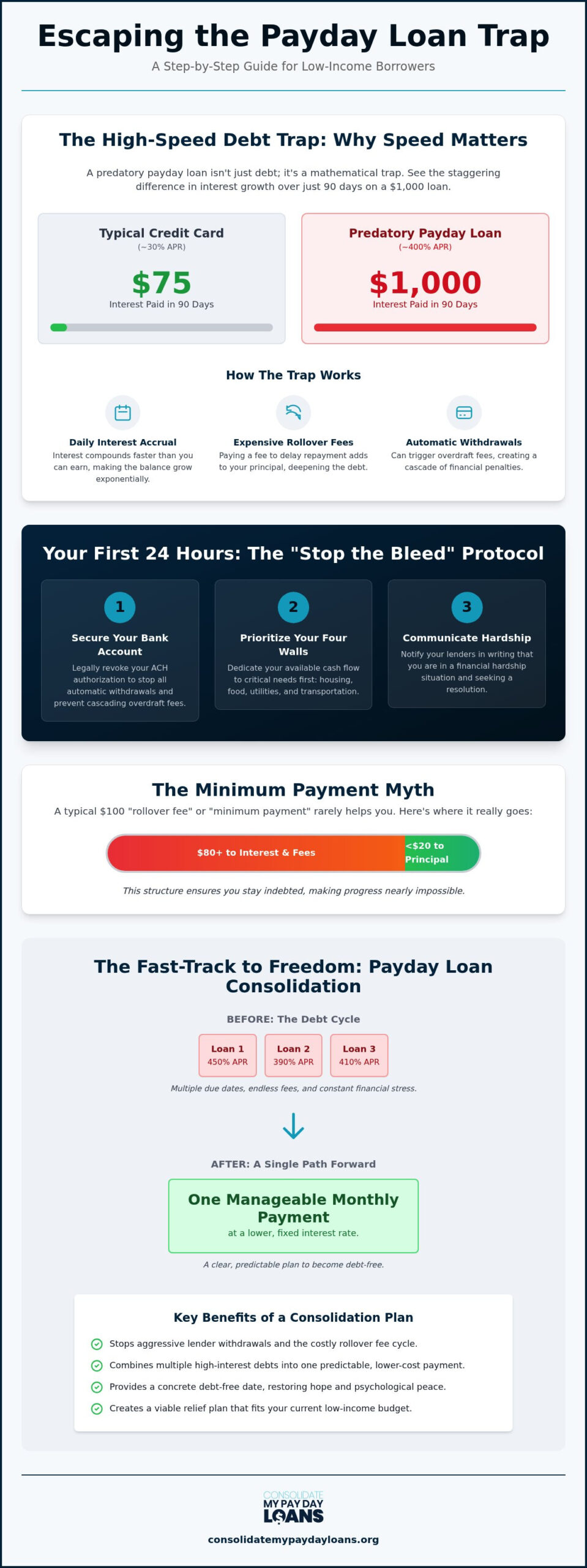
Payday Loan Consolidation: The Fast-Track for Low-Income Borrowers
Most financial experts suggest taking out a personal loan to pay off high-interest debt. For those with a low income and damaged credit, this advice is often impossible to follow. Banks typically require high credit scores and stable, high-level earnings that many payday loan users simply don’t have. This is where specialized payday loan consolidation for low income becomes a necessary alternative. Instead of relying on a new lender to approve you, a consolidation program works by restructuring your existing debt into a single, affordable payment that fits your actual budget.
A professional consolidation company acts as your advocate and a stable anchor during financial turbulence. They step between you and the lenders who are draining your bank account every payday. These experts negotiate directly with your creditors to reduce interest rates and waive late fees that have been piling up. This process stops the cycle of taking out new loans to cover the old ones. It provides a path to recovery that is based on your actual ability to pay, rather than a lender’s aggressive and predatory collection tactics.
Consolidation Loans vs. Consolidation Programs
Understanding the difference between a loan and a program is critical for your financial safety. A consolidation loan is a new piece of debt used to pay off others. If your credit is poor, these loans often come with interest rates nearly as high as the payday loans you’re trying to escape. In contrast, a relief program doesn’t involve borrowing more money. It focuses on managing the debt you already have through negotiation and structured payments. This distinction is vital for anyone who cannot qualify for traditional bank products but needs an immediate exit plan.
- Credit Requirements: Consolidation loans require a hard credit check and high scores. Programs are often accessible even with a history of defaults or low scores.
- Interest Rates: New loans for bad credit may still carry 36% APR or higher. Programs aim to lower or stop interest accrual entirely through professional negotiation.
- Monthly Impact: Relief programs are specifically designed to fit a low-income budget, whereas loan payments are set by the lender’s rigid terms.
For a more detailed breakdown of how these systems work to protect your income, you can read our payday loan consolidation guide. If you are ready to see how a professional program can lower your monthly obligations, you can explore your payday loan relief options today.
Avoiding Consolidation Scams
The debt relief industry has its share of bad actors who target people in distress. In 2026, you must remain vigilant against companies that make unrealistic promises. A legitimate service will never ask for large upfront fees before they have provided any help. If a company guarantees they can wipe out your debt for pennies on the dollar without any impact on your financial standing, be cautious. These are often “too good to be true” claims designed to exploit your stress.
Look for red flags like being told to stop all communication with your bank or being pressured into a contract you don’t understand. Always verify a company’s reputation by checking recent 2026 consumer reviews and their Better Business Bureau ratings. A trustworthy partner will be transparent about their process and provide you with a clear timeline for your recovery. You deserve a guide who is tough on the systemic problem of predatory lending but compassionate toward your individual situation.
Navigating Your Path to Financial Peace with Professional Support
Reaching the end of this guide is a significant first step toward reclaiming your life. You’ve identified the trap, secured your bank account, and explored tactical payoff methods. Now, you need a way to bring it all together into a sustainable plan. Professional support through payday loan consolidation for low income provides the structure you need to stop guessing and start making progress. By moving from multiple high-interest debts to a single monthly payment, you gain the clarity required to manage your household budget without the constant threat of financial collapse. This simplification is often the missing piece in a successful recovery strategy.
The most powerful tool at your disposal is the Consolidate My Payday Loans calculator. This tool allows you to input your current balances and see an estimated “Debt-Free Date.” Seeing a concrete end point changes your perspective from one of survival to one of goal-setting. When you have a predictable, lower monthly payment that actually fits your low-income budget, you can finally breathe. You no longer have to decide which bill to skip or which lender to appease; instead, you follow a methodical path that leads directly to financial agency.
Life after debt is about more than just a zero balance. It is about building a foundation that prevents future crises. Once your payday loans are under control, your immediate focus should shift to building a $500 emergency fund. While this amount may seem small, it is a critical buffer against the unexpected car repairs or medical bills that often drive people back to predatory lenders. Your income does not define your financial future; your strategy does. By choosing a path of structured recovery, you are ensuring that your hard-earned money stays in your pocket where it belongs.
Taking the First Step: The Savings Estimate
To begin your recovery, gather your latest statements for a quick 5-minute audit. Knowing exactly what you owe is the only way to determine how much you can save. Professional negotiation can often slash the total amount owed by waiving fees and reducing interest rates that have been compounding daily. If you are ready to move from planning to action, review our guide on how to get out of high interest payday loans for the next tactical steps in your journey.
A Unified Strategy for Credit Cards and Loans
Many borrowers find that their financial stress isn’t limited to just one type of debt. Consolidating credit cards along with payday loans creates a much stronger financial foundation. Addressing all high-interest obligations at once prevents one debt from undermining the progress you make on another. For more information on multi-debt strategies, see our credit card and payday loan consolidation guide. When you are ready to see what is possible for your specific situation, get your free payday loan consolidation estimate today and take the first real step toward peace.
Reclaim Your Financial Agency and Peace of Mind
Breaking the cycle of high-interest debt requires more than just a strict budget; it requires a strategic exit plan. You now have the tools to stop the immediate financial bleed by revoking ACH authorizations and prioritizing your survival needs above predatory collectors. The trap ends here. By understanding the mechanics of your debt, you can move from a state of constant panic to a structured path of recovery. For many individuals, payday loan consolidation for low income serves as the critical turning point that finally makes debt elimination possible on a tight budget.
Our team has over 18 years of expertise in specialized payday loan relief, focusing exclusively on the unique challenges of predatory lending. We provide a no-cost savings estimation tool to offer you total transparency regarding your recovery options. You deserve a partner who understands these systemic traps. Calculate your potential payday loan savings now and see how quickly you can reach your debt-free date. Your current income does not dictate your future. With the right strategy and professional support, financial peace is closer than you think.
Frequently Asked Questions
Can I consolidate payday loans if I have a very low income?
Yes, you can. Specialized payday loan consolidation for low income is specifically designed for borrowers who don’t qualify for traditional bank loans due to limited earnings. Unlike a personal loan, these programs focus on restructuring your existing debt rather than checking for high income. This approach ensures your new, single payment is calculated based on what you can actually afford after meeting your basic survival needs and household expenses.
Will consolidating my payday loans hurt my credit score?
Any debt management strategy can have a temporary impact on your credit score, but the long-term benefit of stopping defaults is far greater. If you choose a relief program over a new loan, you may see a short-term dip as accounts are restructured. However, this is often a necessary trade-off for regaining control. It’s much better for your credit health to resolve the debt through a structured plan than to face a total financial collapse.
How much can I actually save with a payday loan relief program?
Savings vary based on your specific lenders and the total number of loans you carry. Most participants see a significant reduction in their monthly obligations because professional negotiators work to waive predatory late fees and slash triple-digit interest rates. By stopping the daily accrual of interest, more of your payment goes toward the principal balance. This acceleration allows you to reach a debt-free date much faster than paying minimum fees.
Is it better to consolidate or file for bankruptcy on a low income?
Consolidation is generally considered a safer first step for payday debt before considering bankruptcy. Bankruptcy is a legal process with long-lasting consequences that can stay on your record for up to ten years. A relief program offers a way to manage your obligations without the severe legal and credit repercussions of a court filing. It provides a structured path to recovery that protects your financial future while resolving your current crisis.
What happens if a payday lender tries to sue me for a small amount?
It’s uncommon for lenders to sue over small amounts because the legal costs often exceed the debt itself. However, they may use the threat of legal action to pressure you into making payments you can’t afford. You have rights under consumer protection laws that limit how collectors can contact you. If you enter a professional relief program, your negotiators handle the communication, which often stops the aggressive threats and legal posturing.
How long does the payday loan consolidation process typically take?
You’ll often feel the relief in your cash flow within the first 30 days as automatic withdrawals are stopped and payments are restructured. The total time to become completely debt-free depends on your total balance and your budget. Most programs are designed to reach a resolution within 6 to 18 months. This timeline provides a predictable and steady path toward recovery, ensuring you don’t feel overwhelmed by the process.
Can I still use my bank account after I revoke ACH authorization?
Yes, you can still use your bank account normally after revoking authorization. In fact, your account is much safer once you’ve stopped lenders from making unauthorized or predatory withdrawals. It’s important to monitor your statements closely after notifying your bank to ensure the block is effective. This step protects your income for essentials like rent and food, allowing you to manage your finances without the fear of sudden account depletion.
Do I need a new loan to consolidate my existing payday debt?
No, you don’t need a new loan. While some companies suggest taking out a new personal loan to consolidate, many low-income borrowers don’t qualify for these products. Professional relief programs offer a non-loan alternative that restructures your existing debt into one manageable payment. This method avoids the trap of taking on new debt to pay off the old ones, which is a key component of successful payday loan consolidation for low income.