
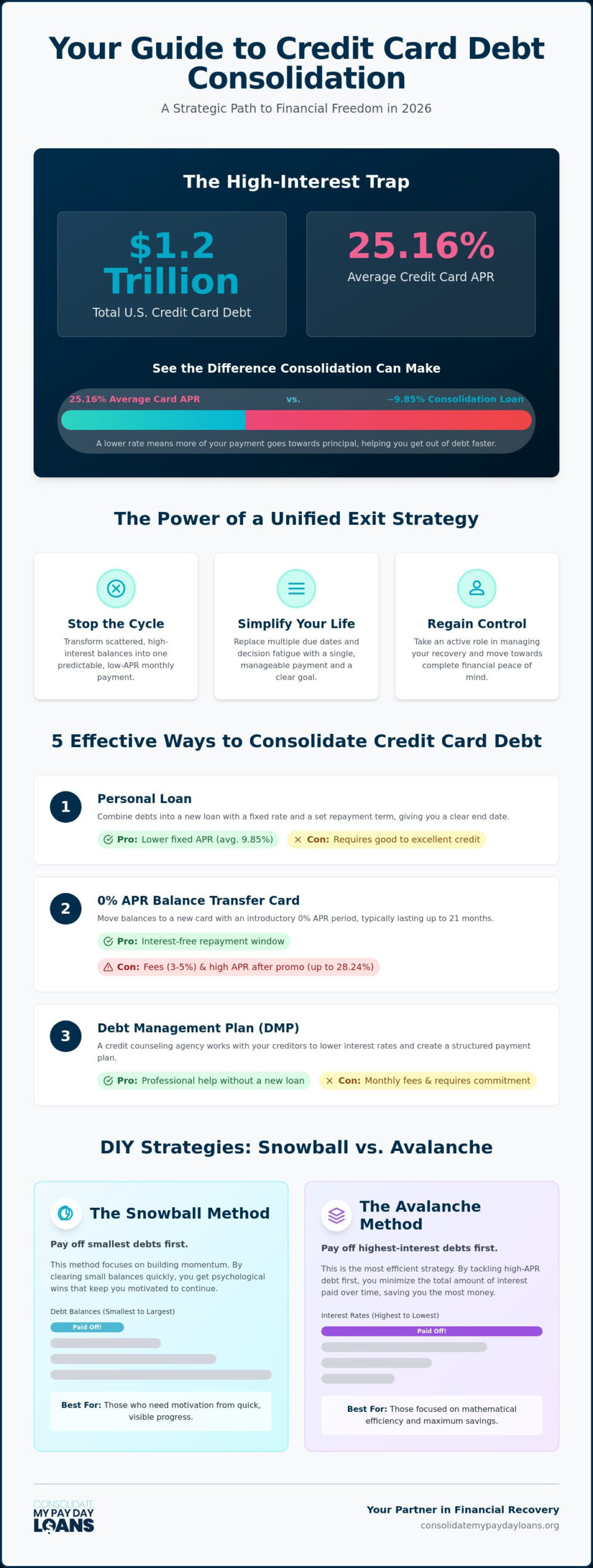
With Americans now carrying over $1.2 trillion in credit card debt and average interest rates hitting a staggering 25.16% this July, the weight of minimum payments can feel like a permanent anchor. You’re likely tired of the constant anxiety that comes with juggling multiple due dates and watching your hard-earned money disappear into high-interest charges. It’s exhausting to feel like you’re running in place while your credit score hangs in the balance. You deserve a strategy that actually moves the needle. Finding the best way to consolidate credit card debt isn’t just about moving numbers around. It’s about regaining your agency and establishing a clear, predictable path to zero.
In this guide, we’ll break down the most effective strategies for 2026, from 0% APR balance transfers to structured personal loans, to help you secure a lower monthly payment and a single, manageable due date. We’ll show you how to find the light at the end of the tunnel and calculate exactly when you’ll reach it. It’s time to stop the cycle of high-cost debt and start your recovery with a plan that puts you back in control of your financial future.
Key Takeaways
- Stop the cycle of high-interest minimum payments by transforming scattered balances into one predictable, low-APR monthly obligation.
- Evaluate five distinct methods, including personal loans and balance transfers, to determine the best way to consolidate credit card debt for your unique financial situation.
- Master DIY repayment frameworks like the Snowball and Avalanche methods to gain momentum and clear balances without external financing.
- Learn to recognize predatory “consolidation scams” and protect yourself by identifying the hallmarks of legitimate, consumer-focused relief organizations.
- Explore the power of a Unified Exit Strategy to simultaneously tackle credit card balances and high-interest payday loans for complete financial peace.
Understanding Credit Card Consolidation in 2026: More Than Just a Math Problem
At its core, What is debt consolidation? It’s the strategic process of combining multiple high-interest balances into a single, structured payment with a lower interest rate. In July 2026, this isn’t just a helpful financial tip; it’s a necessary survival tactic. With Americans carrying over $1.2 trillion in credit card debt and average interest rates sitting at a record 25.16%, the traditional method of paying only the minimums has become a losing game. High-interest lenders rely on you staying in this cycle, where your monthly efforts barely touch the principal balance. Choosing the best way to consolidate credit card debt means breaking that cycle and reclaiming your financial agency.
Many people mistake consolidation for simply “shifting debt.” Opening a new card to move a balance around without a clear repayment plan is just a temporary fix. True relief comes from “solving debt” through a structured strategy that reduces the total cost of borrowing. This shift in perspective transforms you from a passive payer into an active manager of your own recovery. It’s about moving away from the chaos of predatory rates and toward a stable, predictable exit strategy.
The Psychology of the Debt Trap
Living with debt is mentally exhausting. When you’re managing five or six different due dates, you experience “decision fatigue.” This mental drain makes it easier to miss a payment or lose track of your progress, leading to more fees and higher stress. The emotional burden of seeing your balances stay flat despite your hard work can lead to a sense of hopelessness. A single monthly payment acts as a stable anchor. It provides immediate psychological relief, replacing a scattered mess of obligations with one clear goal and a visible “light at the end of the tunnel” date.
Key Financial Terms You Must Know
- APR vs. Effective Interest Rate: Your APR is the stated yearly rate, but the effective rate accounts for how often interest compounds. If you don’t consolidate, you’re likely paying much more than the sticker price.
- Credit Utilization Ratio: This is the amount of credit you’re using compared to your limits. Moving debt into a consolidation loan can lower this ratio on your cards, which often leads to a significant boost in your FICO score.
- ACH Authorization: Most modern consolidation plans use Automated Clearing House (ACH) transfers. This ensures your payment is always on time, protecting your credit score from the damage of accidental late fees.
Finding the best way to consolidate credit card debt requires you to look beyond the numbers and address the systemic reasons you’re feeling trapped. By simplifying your obligations, you’re not just fixing a spreadsheet; you’re taking back control of your life.
A Roundup of the 5 Best Ways to Consolidate Credit Card Debt
Finding the best way to consolidate credit card debt requires a cold, hard look at your credit score and your total balance. In July 2026, the financial landscape offers diverse paths ranging from simple bank products to intensive professional intervention. Your goal isn’t just to move money around; it’s to move from high-interest chaos to a single, manageable stream. Not every solution fits every budget, so you must choose the one that aligns with your specific recovery goals.
Option 1 & 2: Personal Loans and Balance Transfers
For those with solid credit, a personal debt consolidation loan is often the cleanest choice. Borrowers with excellent credit can currently secure rates around 9.85%, which is a massive drop from the 25.16% average credit card APR reported this month. These loans provide a fixed interest rate and a specific “End Date,” giving you a clear timeline for freedom. Balance transfer cards are another popular tool, offering 0% introductory periods for up to 21 months. However, you must calculate the “Transfer Fee” math. Most cards charge between 3% and 5% of the total amount just to move the debt. If you don’t pay the full balance before the promo ends, you’ll face variable APRs that can climb as high as 28.24%.
Option 3 & 4: Debt Management and Home Equity
If your credit score makes a new loan difficult to obtain, a Debt Management Plan serves as a middle ground. These programs don’t involve a new loan. Instead, a professional agency negotiates lower interest rates with your existing creditors on your behalf. It’s a structured path that simplifies your life into one payment without the “trap” of taking on new credit. On the other hand, we generally caution against using Home Equity Lines of Credit (HELOC). While the rates might look lower, you’re turning unsecured credit card debt into secured debt. This means you’re putting your home at risk for a credit card balance. The Consumer Financial Protection Bureau guide highlights these risks, reminding borrowers to be wary of any plan that trades housing security for temporary relief.
Option 5: Specialized Debt Relief Programs
Determining the best way to consolidate credit card debt for your specific profile might lead you toward professional debt relief, especially if your debt-to-income ratio is too high for traditional banking. These programs focus on negotiating with lenders to reduce the actual principal you owe. It’s a powerful option for those feeling trapped by a cycle of minimum payments they can no longer sustain. This approach requires an advocate who understands the nuances of the lending industry and can protect you from predatory practices. If you’re dealing with a complex mix of obligations, including high-interest short-term loans, using a specialized consolidation approach can provide the comprehensive relief you need to finally breathe again.
Snowball vs. Avalanche: The DIY Strategies for Debt Mastery
Not everyone is ready to jump into a formal financial program or apply for a new loan immediately. If you’re thinking “I can’t afford to consolidate right now,” you aren’t alone. Many people feel that their monthly cash flow is too tight to even begin the process. However, staying paralyzed is the most expensive choice you can make. You need a way to organize the chaos while you evaluate should i consolidate my credit card debt or pursue a self-managed path. The best way to consolidate credit card debt for your specific situation might actually start with a behavioral framework that requires zero upfront fees and 100% discipline.
The Debt Snowball: Momentum Through Small Wins
The Snowball method is designed for the human brain, not a calculator. You list all your debts from the smallest balance to the largest, regardless of interest rates. You pay the minimum on every account except for the smallest one, where you throw every extra cent you can find. When you see a balance disappear completely, it creates a psychological “dopamine hit” that fuels your commitment to the next goal. This method is exceptionally effective for those who feel unmotivated or drowned by the sheer number of different accounts they have to track.
The Snowball Method is a behavioral strategy prioritising psychological momentum over interest math.
The Debt Avalanche: The Mathematical Path to Savings
If you’re driven by logic and want to pay the least amount of interest possible, the Avalanche is your tool. You target the card with the highest interest rate first. Since the average credit card APR has climbed to 25.16% as of July 2026, knocking out these high-cost balances first can save you thousands of dollars over the life of your debt. It requires more patience than the Snowball because your highest-interest card might also have a large balance, meaning it could take months before you experience the satisfaction of closing an account.
These DIY methods don’t have to exist in a vacuum. You can use an Avalanche approach to clear your most toxic balances while preparing your credit score for a more formal solution. Finding the best way to consolidate credit card debt often involves a hybrid approach, using DIY discipline to stabilize your finances before bringing in a professional advocate to handle the heavy lifting. By shifting your behavior now, you’re setting the foundation for a permanent recovery rather than a temporary fix.
How to Choose the Right Consolidation Path for Your Profile
Selecting the best way to consolidate credit card debt isn’t just about finding the lowest interest rate. It’s about matching a strategy to your specific credit score, total debt load, and monthly cash flow. In the 2026 market, where rates for fair credit can hover around 18.60%, choosing the wrong path can lead to more frustration. You need a clear framework to move from feeling trapped to feeling empowered. Finding the best way to consolidate credit card debt requires you to be honest about your current standing so you can choose a path that actually leads to zero.
The Credit Score Decision Matrix
- Excellent Credit (720+): You have the most leverage. Look for 0% APR balance transfer offers that last up to 21 months. This allows you to pay down the principal directly without interest interference.
- Fair Credit (620-719): A fixed-rate personal loan is often your strongest ally. While you might not get the 9.85% rate reserved for top-tier borrowers, you can still find options significantly lower than the 25.16% credit card average.
- Poor Credit (<620): Traditional loans may be out of reach or come with predatory rates near 30%. In this bracket, specialized debt relief and principal negotiation become the most effective tools for recovery. Understanding the key differences in credit card consolidation vs debt settlement is especially critical at this credit level, where choosing the wrong path can have lasting consequences for your financial future.
As you evaluate your options, keep a sharp eye out for red flags. Legitimate providers won’t demand massive upfront fees before helping you. Be cautious of “guaranteed” results that sound too good to be true. A trustworthy partner focuses on consumer protection and stopping the cycle of high-interest debt rather than just selling you another financial product. Look for companies with established histories, like those founded around 2007, that prioritize your long-term stability over short-term gains.
The “Unified Exit” Consideration
If your financial turbulence involves more than just plastic, you must consider credit card and payday loan consolidation as a single, cohesive strategy. Consolidating your credit cards while leaving high-interest payday loans active is like trying to bail out a boat with a hole in the bottom. You need a “Unified Exit Strategy” that addresses every predatory obligation at once. Before starting any new plan, it’s vital to revoke your ACH authorizations with current high-interest lenders. This stops the automatic drain on your bank account and gives you the breathing room to execute your new recovery plan. If you’re ready to see how a structured approach can simplify your life, you can start your recovery today by exploring a plan tailored to your specific debt mix.
It’s natural to feel anxious about what happens after you commit to a path. The transition from managing multiple crises to following one structured plan can feel strange at first. However, this shift is what restores your agency. By improving your credit utilization ratio, you aren’t just paying off old debt; you’re rebuilding your future buying power and securing long-term psychological peace. The fear of the unknown is temporary, but the relief of a single due date is permanent.
Beyond the Cards: Why a Unified Strategy Wins
Most financial guides treat credit card debt as an isolated issue, but the reality for many Americans in 2026 is far more complex. It’s common to find yourself caught in a crossfire between high-interest plastic and even more predatory short-term loans. When you’re facing this “worst-case” scenario, the best way to consolidate credit card debt is through a unified strategy that addresses every toxic obligation at once. Tackling one while ignoring the other is like patching a tire while the engine is failing. You need a comprehensive plan that stops the bleeding across your entire portfolio.
Consolidating payday loans and credit cards together provides the ultimate relief because it resets your entire financial foundation. Instead of being drained by multiple lenders with varying predatory tactics, you move into a single, structured environment. This approach is designed to close the debt cycle for good rather than just delaying the inevitable. To understand the impact this can have on your monthly budget, you should use the payday loan consolidation calculator. Seeing the potential savings in black and white can replace your current anxiety with a sense of focused momentum.
Managing Life After Consolidation
Once you’ve secured a plan, a common question arises: can i still use my credit card after debt consolidation? While the goal is to break the cycle of high-interest borrowing, you don’t necessarily have to cut up every card. However, your focus must shift toward building an emergency fund. This fund is your only real “insurance” against falling back into the debt trap when life’s unexpected costs arrive. In the months following your consolidation, you’ll likely see your credit score begin to recover as your utilization ratio drops. Monitoring this progress provides the encouragement needed to stay the course.
Your First Step Toward Financial Peace
The best way to consolidate credit card debt is the one you actually start today. Waiting for the “perfect moment” or for interest rates to drop further only gives lenders more time to collect your hard-earned money. Taking action now is a declaration of your financial agency. A free consultation can provide the clarity you’ve been missing, helping you separate the noise of the industry from the facts of your situation. You are a partner in this recovery process, not just a number on a spreadsheet. By choosing an advocate who understands the systemic traps of the lending world, you’re ensuring that this is the last time you’ll ever have to search for a way out of debt. Peace of mind is available; you simply have to reach for it.
Take the Final Step Toward Lasting Financial Peace
Breaking the cycle of high-interest debt requires more than just a change in math; it requires a change in strategy. You’ve learned that the best way to consolidate credit card debt is to align your specific financial profile with a plan that prioritizes your long-term recovery over a lender’s profit. Whether you choose a behavioral DIY approach or a professionally negotiated Unified Exit Strategy, the goal remains the same. You deserve a life free from the anxiety of multiple due dates and the weight of interest rates that never seem to drop.
With over 18 years of expertise as a national advocate for consumer financial rights, we specialize in merging complex payday and credit card obligations into one manageable path. You don’t have to navigate these predatory lending traps alone. A single, lower monthly payment is within reach, and it starts with a conversation. Get a Free Debt Consolidation Quote and Start Your Recovery Today. You’ve carried this burden long enough. It’s time to reclaim your agency and look forward to a future where you are finally debt-free.
Frequently Asked Questions
Is it a good idea to consolidate my credit card debt in 2026?
Yes, consolidation is a powerful tool in 2026 because it stops the bleeding from record-high interest rates. With average credit card APRs sitting at 25.16%, moving that debt into a structured loan or relief program is often the best way to consolidate credit card debt. It simplifies your life into one payment and ensures more of your money goes toward the principal instead of endless interest charges.
Will consolidating my credit cards hurt my credit score?
You might see a small, temporary dip in your score due to a hard credit inquiry or the closing of old accounts. However, the long-term impact is usually very positive. By paying off your revolving balances, you significantly lower your credit utilization ratio. This factor alone often leads to a substantial score increase within the first three to six months of your new plan.
How much can I actually save by consolidating my credit cards?
Your total savings depend on the gap between your current rates and your new consolidated rate. For example, moving a balance from a 25.16% APR card to a consolidation loan with a 12% rate can save you thousands of dollars in interest over the life of the debt. Using a calculator helps you visualize these savings and see exactly how much faster you’ll reach a zero balance.
Can I consolidate my credit cards if I also have payday loans?
Absolutely, and addressing both is vital for a full recovery. Many people find that a unified approach is the best way to consolidate credit card debt when they are also trapped by payday loans. By merging these different types of high-interest debt into one Unified Exit Strategy, you stop the predatory cycle and ensure that one monthly payment covers all your unsecured obligations.
What is the difference between debt consolidation and debt settlement?
Consolidation replaces multiple high-interest debts with a single, lower-interest payment that eventually pays the full principal balance. Debt settlement, on the other hand, involves negotiating with creditors to accept a lump sum that is less than what you actually owe. While settlement can reduce the total amount paid, it typically has a more negative and lasting impact on your credit report than consolidation does. For a deeper look at how these two approaches compare in today’s market, see our full breakdown of credit card consolidation vs debt settlement to determine which path best fits your financial situation.
Can I still use my credit cards once they are consolidated into a new loan?
Technically you can, but it isn’t recommended. To break the debt cycle, you should focus on using cash or debit while your consolidation plan clears your existing balances. Adding new charges while trying to pay off the consolidation loan creates a double debt situation that can quickly become unmanageable. Focus on building an emergency fund so you don’t have to rely on plastic for unexpected costs.
How long does the credit card consolidation process typically take?
The speed of the process depends on the path you choose. A personal consolidation loan can often be approved and funded within a few business days. If you’re working with a professional relief program to negotiate rates or principal, it might take two to four weeks to fully organize your accounts and finalize the new payment structure. The key is starting the process as soon as possible to stop interest accrual.
What happens if I can’t afford the new consolidated monthly payment?
If your financial situation changes, you must communicate with your advocate or lender immediately. Legitimate consolidation providers are partners in your recovery and prefer to work out a solution rather than see you default. They can often review your plan or offer hardship options to keep you on track. Proactive communication is the best way to protect the progress you’ve already made toward becoming debt-free.