
What if the constant ringing of your phone finally stopped and you could actually keep your next paycheck? If you are currently trapped in a cycle of high interest debt, you are likely asking yourself what happens if you don’t pay back a payday loan. It is a terrifying question, especially when you are facing aggressive collection calls and the threat of your bank account being emptied by automatic withdrawals. You aren’t alone in this struggle, as millions of Americans are currently navigating APRs that average 391 percent in 2026. The fear of legal action or wage garnishment is real, but the reality of how these lenders operate is often different than the threats they make over the phone.
We understand the weight of this stress and the feeling that there is no way out. This guide provides a clear, authoritative look at the real world consequences of default and, more importantly, a strategic path toward financial recovery that avoids the long term damage of bankruptcy. You will discover how to protect your bank account, stop the cycle of predatory rollovers, and find a manageable monthly payment that actually reduces your balance. By the end of this article, you will have the insider knowledge needed to reclaim your agency and move toward a future of psychological peace and financial stability.
Key Takeaways
- Understand the immediate financial triggers, such as bank NSF fees and aggressive internal collection efforts, that occur within the first 48 hours of a missed payment.
- Learn the truth about what happens if you don’t pay back a payday loan, including how long a default impacts your credit report and the actual legal risks involved.
- Debunk common myths regarding high-interest debt, such as the fear of jail time or the false hope that debt will simply vanish after seven years of silence.
- Discover how specialized payday loan consolidation can immediately stop collection calls and negotiate predatory interest rates down to manageable levels.
- Identify the specific steps required to transition from the exhaustion of debt rollovers to a single, predictable monthly payment plan that restores your financial agency.
What Happens Immediately After a Missed Payday Loan Payment?
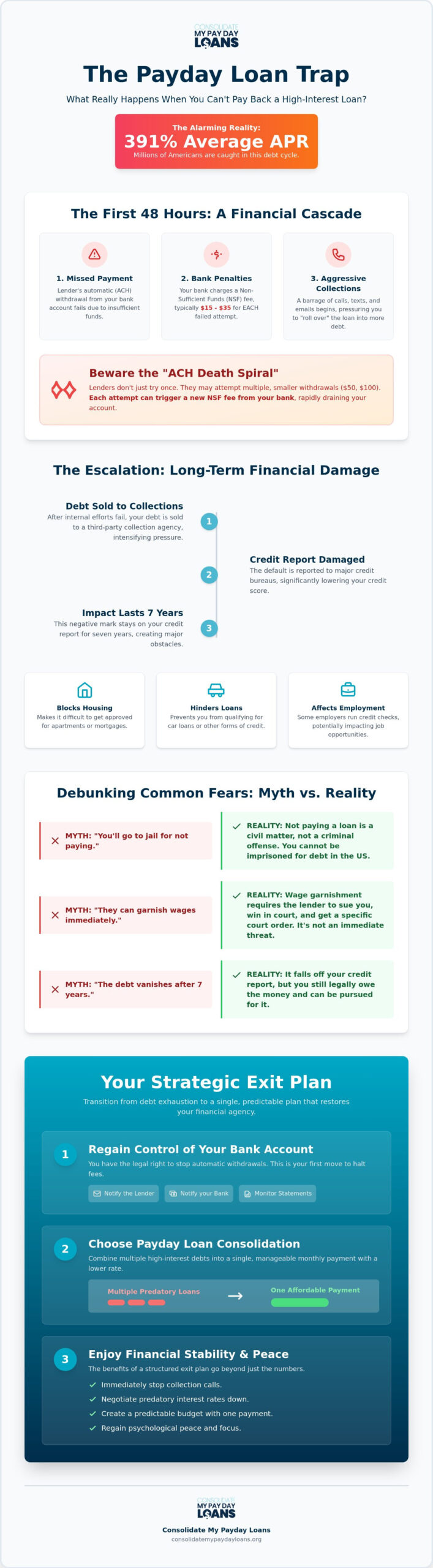
The silence of a missed deadline is quickly broken by the chime of bank alerts. If you are wondering what happens if you don’t pay back a payday loan, the first impact is almost always felt in your bank balance rather than your mailbox. Most lenders use the Automated Clearing House (ACH) system to withdraw funds directly on your scheduled payday. When those funds aren’t available, your bank will likely trigger a Non-Sufficient Funds (NSF) fee. These fees typically range from $15 to $35 per attempt, and they add up with terrifying speed.
Lenders rarely stop after one failed attempt. They often engage in what is known as the ACH “death spiral.” Instead of trying to pull the full amount again, they may break the total debt into smaller, multiple withdrawal attempts of $50 or $100. Each of these attempts can trigger a fresh NSF fee from your bank. Within a single afternoon, a borrower can find their account hundreds of dollars overdrawn solely due to bank penalties. For a comprehensive overview of payday loans and how these payment structures are designed, it is helpful to understand that these products prioritize lender access to your cash above all else.
Within the first 48 hours, the internal collection efforts begin. You can expect a barrage of phone calls, text messages, and emails. These representatives are trained to be firm and persistent. Their primary goal is to convince you to “roll over” the loan. They might present this as a helpful favor, but it is a strategic trap. By paying only the interest or a small fee to extend the due date, you aren’t reducing the principal balance. You are simply buying a few weeks of silence at an incredibly high price.
Regaining Control: Revoking Your ACH Authorization
You have the legal right to stop a lender from reaching into your bank account. Many people confuse a “stop payment” order with revoking authorization, but they are very different tools. A stop payment is often temporary and applies to a specific check or transfer. To truly protect your account, you must revoke your ACH authorization entirely. This is a multi step process that requires direct action:
- Notify the lender: Send a formal letter via email and certified mail stating that you are revoking their authorization to withdraw funds from your account.
- Notify your bank: Provide your financial institution with a copy of the revocation letter. Under federal law, banks must honor your request to stop these automatic transfers once you have notified them.
- Monitor your statements: Check your account daily to ensure no unauthorized “micro-withdrawals” occur after the revocation.
The Reality of Late Fees and Interest Accumulation
The math of a defaulted payday loan is designed to be overwhelming. While an origination fee is a one time charge to set up the loan, default fees are recurring penalties for missing your date. When you stop paying, the interest doesn’t just sit still. In many states, a $500 loan can balloon to $1,500 in as little as 60 days through a combination of late fees and soaring interest rates. Default interest is a predatory mechanism for debt inflation. These costs are often buried in the fine print of your contract, creating a mountain of debt that feels impossible to climb without a structured intervention plan.
The Escalation: Collections, Credit Damage, and Legal Risks
When the initial flurry of phone calls from the lender fails to produce a payment, the debt typically transitions into the hands of a third party collection agency. This shift marks a significant escalation in the recovery process. If you are wondering what happens if you don’t pay back a payday loan over the long term, this is the stage where your financial reputation begins to suffer. Unlike the original lender, collection agencies often report the default to the major credit bureaus. This creates a negative entry that remains on your credit report for seven years. This isn’t just a number; it’s a hurdle that can block you from securing housing, obtaining a car loan, or even passing a background check for a new job.
Many borrowers live in constant fear of the “Garnishment Myth.” It’s common for collectors to imply they will seize your next paycheck immediately. However, under federal law, a debt collector cannot garnish your wages or levy your bank account without first obtaining a court order. You are protected by the Fair Debt Collection Practices Act (FDCPA). This law prohibits collectors from using deceptive threats, calling you at unreasonable hours, or contacting your employer about the debt. Knowing your rights is the first step in regaining your composure during this turbulent time.
The Lawsuit Timeline: From Summons to Judgment
The legal path from a missed payment to a judgment follows a specific timeline. If a lender or collection agency decides to sue, you will receive a formal court summons. Ignoring this document is the most dangerous mistake you can make. When you fail to appear or respond, the court usually grants a default judgment to the creditor. In 2026, this judgment gives the lender the legal power to freeze your bank account or garnish a percentage of your earnings until the debt, plus legal fees, is satisfied. Proactive management is always a more stable choice than silence.
Credit Score Consequences: Beyond the Three Digits
The damage extends far beyond the immediate debt. A public judgment or a collection account on your record makes it incredibly difficult to qualify for traditional financial tools, such as credit card consolidation for bad credit. Waiting seven years for a default to “fall off” your report is rarely a viable strategy. During that time, the interest continues to accrue, and the risk of a lawsuit remains high. Instead of waiting for the situation to deteriorate further, you can use a Payday Loan Consolidation Calculator to help you visualize a structured path out of the trap before the legal system gets involved.
Case Study: How Sarah Found Her Escape from the Payday Loan Trap
Sarah’s journey into high interest debt began with a single, common emergency: a blown transmission. To keep her job, she needed her car. To fix her car, she took out a $500 payday loan. When the two week deadline arrived, she couldn’t pay the full balance plus interest, so she took out a second loan from a different lender to cover the first. Within three months, Sarah was juggling four concurrent payday loans. She spent every waking hour wondering what happens if you don’t pay back a payday loan, paralyzed by the fear that one missed payment would lead to an immediate lawsuit or the loss of her home.
The breaking point arrived when Sarah realized that 70 percent of her bi-weekly paycheck was going toward interest rollovers. She was working forty hours a week just to keep the lenders from calling her. There was no money left for groceries, utilities, or the very car repairs that started the cycle. Instead of waiting for the inevitable default and the aggressive collections process described earlier, Sarah sought professional help. She chose a structured consolidation program, which immediately shifted her status from a harassed debtor to a protected client with a clear recovery plan.
Analyzing the ‘Sarah’ Scenario: The Math of the Trap
The math of Sarah’s situation was designed to ensure she never finished paying. Every two weeks, she paid nearly $600 in fees across her four loans, yet her total principal balance of $2,000 never moved. This cycle is the core of the payday lending business model. The psychological shift occurred when she stopped viewing her situation as a personal failure and started seeing it as a systemic trap. The cloud of uncertainty began to lift the moment Sarah used a payday loan consolidation calculator to see her actual exit date. For the first time in months, she saw a path to zero debt that didn’t involve taking out more loans.
Lessons Learned: Why Sarah Didn’t Choose Bankruptcy
While Sarah felt desperate, she recognized that the long term stigma of bankruptcy would haunt her for a decade. She wanted to protect her remaining credit score and maintain her ability to rent an apartment in the future. Choosing payday loan consolidation instead of bankruptcy was her most strategic move. It allowed her to pay back the principal she owed under fair terms without the public record of a court filing. By consolidating, she stopped the collection calls and replaced four chaotic due dates with one manageable monthly payment, successfully escaping the trap before the legal escalations of default could begin.
Common Misconceptions About Defaulting on High-Interest Debt
Lenders often rely on a borrower’s lack of legal knowledge to maintain control over the repayment process. The most pervasive lie told to individuals in financial distress is that they will face criminal charges or jail time for a missed payment. In the United States, defaulting on a loan is a civil matter, not a criminal one. Unless you committed intentional fraud during the application process, you cannot be arrested for being unable to pay. Understanding the clear distinction between civil debt and criminal activity is essential for anyone wondering what happens if you don’t pay back a payday loan.
Another dangerous misconception is the idea that debt simply vanishes after seven years. While negative marks eventually age off your credit report, the legal obligation to pay doesn’t automatically expire. Some original lenders might not report to the major bureaus, but third party collectors almost certainly will. Ignoring the debt won’t make it disappear. It only allows interest to compound and increases the likelihood of a lawsuit. Online lenders also use their location to create a sense of untouchability. You might hear that a lender based out-of-state cannot sue you in your local court. This is false. Most large online lenders have legal networks that allow them to file for judgments in your home county. Digital borders provide no protection against a determined creditor.
Tribal Lenders and State Laws: Clearing the Confusion
Tribal lenders often claim sovereign immunity to bypass state interest rate caps. However, the legal landscape in 2026 has shifted significantly toward consumer protection. Many states now require all lenders, including those online or based on tribal land, to be licensed within the state where the borrower resides. If a lender isn’t licensed in your state, their ability to legally collect or sue you may be severely limited or entirely void. Always check your state’s 2026 consumer protection statutes to see if your loan meets local legal requirements before you assume you are powerless.
The Danger of the ‘New Loan’ Solution
The “new loan” solution is perhaps the most destructive path a borrower can take. Taking a new high interest loan to pay off an old one only accelerates your financial ruin. This is not debt relief; it is debt relocation. Some borrowers also consider paying off payday loans with a credit card as a potential escape route, but this strategy carries its own risks and must be carefully evaluated before acting. A true consolidation program focuses on reducing interest and principal through negotiation, whereas a consolidation loan is simply more debt at a different price point. If you have ever asked yourself how does unsecured debt consolidation work as a legitimate alternative to taking on new loans, the answer lies in professional negotiation that reduces your existing balances rather than replacing them. Be wary of any “relief” company that demands large upfront fees before providing services. If you are ready to stop the cycle without taking on more debt, you can explore professional payday loan relief options that prioritize your recovery over lender profits.
Strategic Relief: Choosing Consolidation as Your Exit Plan
Understanding what happens if you don’t pay back a payday loan is a necessary reality check, but it shouldn’t be the end of your story. While the consequences of default are designed to keep you in a state of perpetual anxiety, specialized payday loan consolidation offers a structured and legal methodology for reclaiming your financial life. This process works by placing a professional advocate between you and the lenders. This immediate intervention stops the aggressive collection calls and text messages, providing the psychological breathing room you need to focus on recovery rather than survival.
The core benefit of this strategy lies in aggressive negotiation. Professional programs work to reduce predatory interest rates, which average 391 percent in 2026, down to zero or low single digits. Instead of your payments being swallowed by recurring fees and rollovers, every dollar you pay begins to reduce the actual principal balance. By merging multiple high interest obligations into a single, easy to track monthly payment, the chaos of managing several due dates disappears. This simplification isn’t just about convenience; it’s a strategic move to prevent the missed payments that trigger the legal escalations discussed in previous sections.
Steps to Start Your Consolidation Journey
Regaining control requires a methodical approach. Your first step is to gather all current loan agreements and your most recent balance statements to see the full scope of the debt. Many borrowers find that using a specialized debt calculator is the most effective way to visualize the difference between their current situation and a consolidated plan. This tool helps determine a new, lower monthly obligation that fits within your actual budget. Finally, consulting with a relief specialist allows you to verify which of your loans are eligible for a program, ensuring you aren’t paying a penny more than necessary to resolve the debt.
Life After Payday Loans: Building a Safety Net
The ultimate goal of consolidation is to move beyond the debt trap entirely. Once the interest rates are slashed, the money that used to vanish into lender fees can be redirected toward building a genuine emergency fund. For those facing multiple types of high cost debt, a credit card and payday loan consolidation plan can serve as a unified exit strategy. This comprehensive approach cleans up all unsecured debt simultaneously, preventing one financial leak from sinking your entire recovery. The emotional freedom of being debt trap free in 2026 is tangible. It means keeping your paycheck, protecting your bank account, and finally sleeping through the night without the fear of a ringing phone.
Take Control of Your Financial Future Today
You now understand that what happens if you don’t pay back a payday loan is a cycle of escalation that won’t resolve itself through silence. From the immediate sting of bank fees to the long term threat of legal judgments, the payday lending system is designed to keep you trapped. However, you have the power to break this cycle. By revoking bank authorizations and choosing professional consolidation, you can stop the predatory fees and replace financial chaos with a single, manageable monthly payment.
Our team brings decades of experience in debt relief to every negotiation. We work as your dedicated advocate to stop aggressive collections and reduce interest rates to levels you can actually afford. You don’t have to face these lenders alone. Estimate your savings and start your escape with our Payday Loan Consolidation Calculator. Peace of mind is within reach, and we are ready to help you reclaim your personal agency and rebuild your financial life.
Frequently Asked Questions
Can a payday lender garnish my bank account without a court order?
No, a payday lender cannot garnish your bank account or wages without first suing you and winning a court judgment. A judgment is required. While they may attempt to withdraw funds using your ACH authorization, a formal garnishment requires a judge’s order. If you revoke your ACH authorization as discussed earlier, they must rely on the legal system to access your funds involuntarily.
What is the statute of limitations on payday loan debt in 2026?
The statute of limitations for payday loan debt in 2026 varies significantly by state, typically ranging from three to six years. Once this period expires, a lender loses the legal right to sue you for the balance. However, debt collectors may still attempt to contact you. The negative entry will also remain on your credit report for a full seven years from the date of default.
Will defaulting on a payday loan affect my ability to get a job?
Defaulting on a payday loan can affect your employment prospects if your prospective employer conducts a credit check. Many companies in the financial or government sectors view a public judgment or a history of defaults as a risk factor. Proactively managing what happens if you don’t pay back a payday loan through consolidation can prevent the public records that most often trigger red flags during background checks.
Is it possible to settle a payday loan for less than I owe?
Yes, it’s often possible to settle a payday loan for less than the full balance through professional negotiation. Lenders may accept a lump sum settlement or a reduced total if they believe it’s the only way to recover any funds. This is a core component of many relief programs. It requires firm communication and a deep understanding of lender policies to achieve a successful settlement.
How do I stop a payday lender from calling my employer?
You can stop a lender from calling your workplace by clearly notifying them that your employer prohibits such calls. Under the Fair Debt Collection Practices Act (FDCPA), once you inform a collector that you aren’t allowed to receive personal calls at work, they must stop immediately. Sending this request in writing via certified mail provides you with a legal paper trail if they continue the harassment.
What happens if I can’t pay back a payday loan due to a medical emergency?
A medical emergency doesn’t legally cancel your debt, but it may qualify you for an internal hardship program or an extended payment plan. Most lenders are more willing to negotiate when you provide documentation of your situation. If you are struggling with what happens if you don’t pay back a payday loan due to unexpected health costs, consolidation can help by lowering your monthly payments to a manageable level.
Does payday loan consolidation hurt my credit score like a default does?
Payday loan consolidation is significantly less damaging to your credit score than a default or bankruptcy. While your score may experience a minor, temporary dip when you first enroll, it prevents the long term devastation of a public judgment. By ensuring your payments are made on time and in full, consolidation helps you rebuild your financial reputation far faster than waiting out a seven year default.
Can I be arrested for a ‘bad check’ if my payday loan payment bounces?
You cannot be arrested for a bounced payday loan payment or a “bad check” in 2026. This is a common threat used by aggressive collectors to incite fear. Failing to pay a civil debt is not a criminal act. Unless there is evidence of deliberate fraud, the legal system treats these disputes as civil matters that are resolved through settlements or judgments rather than jail time.