
Reviewed by Nela Diaz — Negotiations Manager, Solid Ground Financial. [Last reviewed: July 26, 2026]
You aren’t a criminal for falling behind on a high-interest debt, even if the aggressive collection calls make you feel like one. It’s exhausting to watch your bank account dwindle from automatic withdrawals while wondering if your next paycheck will even make it home. You are likely wondering what happens if you don’t pay back a payday loan when interest rates are hovering near the national average of 400%. The fear of wage garnishment or legal action is heavy; however, the truth is often more manageable than the threats from collectors suggest.
We understand the stress of this situation and are here to offer a stable anchor during this financial turbulence. This 2026 guide provides a clear roadmap to help you navigate the immediate and long-term consequences of default without losing your personal agency. We will explore your legal rights, including how to revoke ACH authorizations to protect your bank account from being emptied. You’ll also learn the steps to stop collection harassment and discover structured paths like payday loan consolidation to settle your debt once and for all.
Key Takeaways
- Separate the “debtor’s prison” myth from reality to find immediate psychological peace regarding your legal standing.
- Understand what happens if you don’t pay back a payday loan regarding your credit standing and specialized reporting agencies like Teletrack.
- Learn the specific legal steps to revoke ACH authorization, preventing lenders from repeatedly attempting to empty your bank account.
- Identify the difference between aggressive collection threats and the actual legal process required for a lender to pursue wage garnishment.
- Discover how professional payday loan consolidation offers a structured, manageable alternative to the predatory cycle of 400% APR debt.
Immediate Consequences: The First 48 Hours of Default
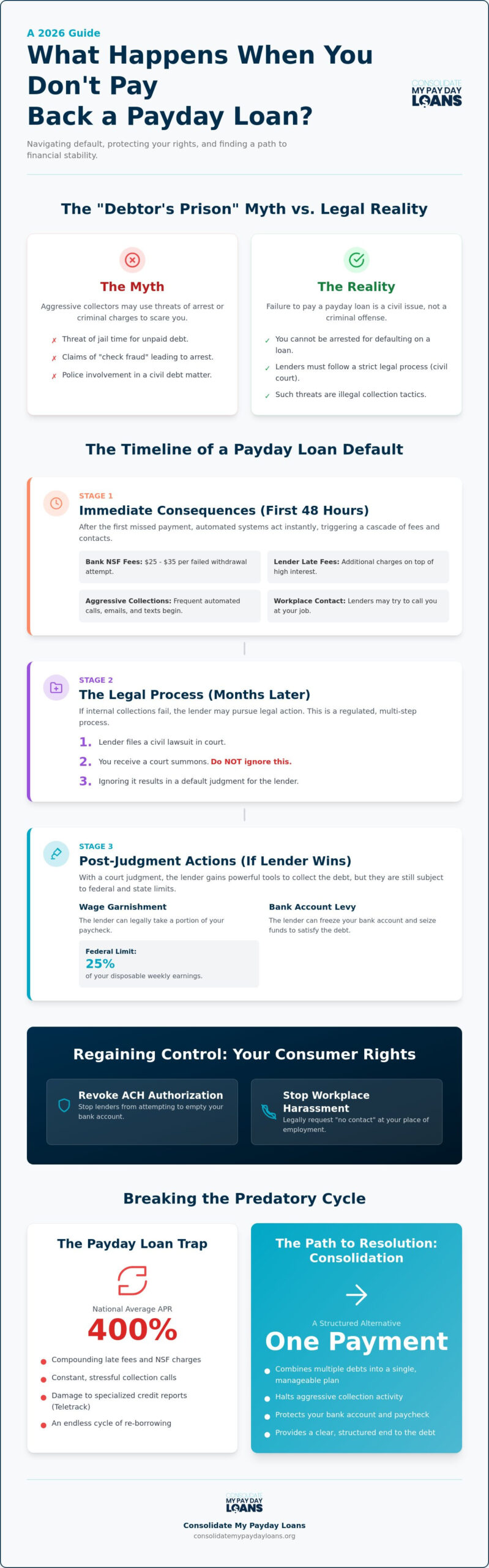
The first 48 hours after a missed payment are often the most jarring. Within minutes of a failed withdrawal, the automated systems of both your bank and the lender begin to communicate through penalties. Understanding what happens if you don’t pay back a payday loan starts with recognizing that these lenders don’t wait for a phone call. They act immediately. Even a small loan can trigger a rapid decline in your bank account stability as fees pile up faster than the original debt grew. The clock starts the moment your balance fails to cover the requested amount.
The NSF Fee Loop: How Banks and Lenders Collide
When you first agreed to the terms, you likely signed an ACH authorization. This gives the lender permission to pull funds directly from your account. If the money isn’t there, your bank will charge a Non-Sufficient Funds (NSF) fee, which often ranges from $25 to $35 per attempt. Lenders often try to withdraw the full amount multiple times or break the total into smaller, separate requests. To understand the mechanics of these high-interest products, it helps to review what a payday loan is and how its structure prioritizes lender recovery over borrower stability. The NSF loop is a primary driver of account closures because it can drain a balance into the negative within hours.
Lender-imposed late fees are another immediate burden. These charges are frequently flat fees added on top of the already high interest. In some cases, a single late fee can exceed the interest you would have paid over the entire original two-week term. This compounding effect is why many people find it impossible to catch up once the first payment is missed.
Aggressive Internal Collections Tactics
While the bank handles the fees, the lender’s in-house recovery team begins their outreach. You can expect frequent automated calls, sometimes starting as early as 8:00 AM. These initial contacts are designed to create a sense of urgency and fear. However, you have rights. If you don’t pay back a payday loan, you can still protect your peace of mind. Internal collections teams typically follow a specific pattern during the first 48 hours:
- Frequent automated calls: High-volume dialing to your primary and secondary numbers.
- Digital pressure: Rapid-fire emails and text messages detailing mounting late fees.
- Workplace outreach: Attempts to reach you at your place of employment to verify your status.
Under federal guidelines, you have the right to request “no contact” at your workplace. Simply stating that your employer does not allow personal calls is often enough to stop that specific channel of harassment. You are in a difficult spot, but you are not without options or legal protections.
The Legal Reality: Lawsuits, Garnishment, and the Jail Myth
One of the most persistent and predatory myths in the lending industry is the threat of arrest. You cannot be sent to jail for failing to pay back a payday loan. This is a civil debt, not a criminal offense. While aggressive collectors might imply that “check fraud” or “malicious intent” could lead to police involvement, these are often illegal collection tactics designed to exploit your fear. If you are worried about what happens if you don’t pay back a payday loan, remember that the legal path for a lender is much slower and strictly regulated than they want you to believe.
The transition from default to a courtroom usually takes several months. First, the lender will attempt internal collections. If that fails, they may file a formal civil lawsuit. If you receive a court summons, you must not ignore it. Ignoring a summons guarantees a default judgment for the lender, which gives them the legal power they didn’t have before. When a judge rules against you, the lender gains access to tools like wage garnishment or bank account levies. Facing this process alone is daunting, but you can fight back with the right information.
Understanding Wage and Bank Garnishment
A lender cannot simply call your boss and demand your paycheck. They must win a lawsuit first. Even with a judgment, federal law limits how much can be taken from your earnings. Typically, garnishment is capped at 25% of your disposable weekly earnings or the amount by which your weekly income exceeds 30 times the federal minimum wage. Some states offer even stronger protections, completely prohibiting wage garnishment for certain types of consumer debt. Understanding these boundaries is the first step toward finding payday loan relief that fits your actual budget.
Dealing with Third-Party Debt Collectors
If the original lender cannot collect, they often sell your debt to a third-party agency. These agencies buy small payday loans for pennies on the dollar. Once this happens, your rights are protected by the Fair Debt Collection Practices Act (FDCPA). This law prohibits collectors from calling before 8 AM or after 9 PM, using profane language, or contacting your neighbors. Interestingly, because the agency bought your debt so cheaply, they are often more willing to settle for a fraction of the original balance. Selling debt often makes it eligible for negotiation, providing a window of opportunity to resolve the matter for less than you owe.
The Long-Term Impact on Your Financial Future
The consequences of a missed payment extend far beyond the initial flurry of collection calls. While the immediate financial shock is painful, the systemic barriers that arise later can be even more restrictive. When considering what happens if you don’t pay back a payday loan, it’s vital to look past next week’s budget and toward your ability to rent an apartment or secure a job years from now. These loans are often marketed as quick fixes for minor emergencies, but they can become permanent anchors that weigh down your financial mobility. The burden is both financial and psychological, often keeping individuals in a state of perpetual survival mode.
Credit Score Damage and Recovery
Most payday lenders don’t report your positive payment history to the three major credit bureaus. However, they are very quick to report a default once the debt is sold to a collection agency. This creates a one-sided system where you get no credit for paying on time but suffer a significant hit to your FICO score for falling behind. A collection account remains on your credit history for seven years, making it much harder to qualify for traditional credit cards or auto loans. If you are currently facing this, learning how to get out of high interest payday loans is the first step toward rebuilding that foundation. Recovery is possible, but it requires a methodical approach to stop the damage from spreading and eventually disappearing from your record.
The ‘Invisible’ Specialty Credit Reports
Even if a default hasn’t hit your main credit report yet, it is likely documented in specialized databases. Companies like Teletrack, Clarity, and DataX track subprime lending activity specifically. Other subprime lenders check these reports before approving even small payday loans or app-based cash advances. A single default in these databases can flag you as high-risk across the entire alternative lending industry. This “invisible” history can also affect your ability to set up utilities without a massive deposit or even pass a background check for certain employment positions. Clearing your name from these specialized databases is a critical, though often overlooked, part of regaining your financial agency. It ensures that one difficult period doesn’t dictate your access to essential services for years to come.
The long-term reality of what happens if you don’t pay back a payday loan often involves a loss of options. When your credit is compromised, you are forced into even higher-cost financial products, deepening the cycle. Breaking this pattern requires more than just a one-time payment; it requires a structured strategy to resolve the debt and protect your future self from the same traps. Reclaiming your financial life is a marathon, but with a clear understanding of these reports, you can start making the right moves today.
Regaining Control: ACH Revocation and Your Consumer Rights
One of the most frightening aspects of falling behind is the loss of control over your own bank account. You might feel helpless as a lender makes repeated attempts to withdraw funds, but you have the legal power to stop it. Federal law provides you with the right to revoke your authorization for automatic payments at any time. This is a critical step in managing what happens if you don’t pay back a payday loan because it prevents the “NSF loop” from draining your remaining balance. Taking this action doesn’t erase the debt, but it does put you back in the driver’s seat of your financial life.
How to Revoke ACH Authorization Legally
Stopping automatic withdrawals requires a methodical approach to ensure the lender and the bank both respect your request. You should follow these three steps immediately:
- Step 1: Send a formal written notice to the payday lender. While an email is a good start, a certified letter provides a verifiable paper trail. State clearly that you are revoking authorization for all future electronic transfers from your account.
- Step 2: Notify your bank or credit union. Give them a copy of the notice you sent to the lender. You can typically place a “stop payment” order on these specific transfers, which prevents the lender from successfully pulling funds.
- Step 3: Monitor your account for “re-presentment.” Some lenders attempt to bypass stop-payment orders by changing the transaction name or amount slightly. If you see an unauthorized “bank ping,” dispute the charge immediately with your financial institution.
Identifying Predatory Lending Violations
As you regain control of your account, it’s time to evaluate if the loan itself is even legal. If you are an active-duty service member or a dependent, the Military Lending Act (MLA) caps interest rates at 36%. Many payday lenders ignore this, which could make your loan unenforceable. Furthermore, state-specific regulations offer strong protections. For example, Ohio caps interest at 28% APR and bans traditional two-week loans, while California limits the maximum loan amount to $300. If your lender has exceeded these caps or ignored mandatory cooling-off periods, you may have significant legal leverage. Keep a detailed log of every interaction and document every call you receive from the lender or their collectors.
Closing your bank account is often suggested as a quick fix, but it should be your last resort. Doing so can damage your banking history and make it difficult to open a new account in the future. Instead, use your legal rights to freeze the withdrawals and then seek payday loan relief to handle the debt on your own terms. Reclaiming your bank account is the first step toward reclaiming your peace of mind.
Breaking the Cycle Through Professional Consolidation
Traditional bank loans are often a closed door for those stuck in the high-interest debt cycle. Most conventional lenders require a credit score that has already been bruised by the very loans you are trying to escape. This creates a frustrating paradox where the help you need is gated behind the financial stability you lack. When you are assessing what happens if you don’t pay back a payday loan, the answer doesn’t have to be a choice between total default or endless interest. Professional consolidation acts as a shield. It stands between you and the lender, replacing the chaos of multiple high-interest obligations with a single, structured plan that actually respects your monthly budget.
The primary benefit of this approach is the immediate reduction in pressure. Instead of balancing five different due dates and 400% APR rates, you move toward a single payment aligned with your actual income. This shift is essential for regaining your agency. You stop reacting to emergencies and start following a methodical path toward zero balance. Professional advocacy ensures that you are no longer a lone individual fighting a systemic trap; you have an expert partner who understands the industry’s pitfalls and how to navigate them safely.
The Mechanics of a Relief Program
Expert negotiators don’t just ask for lower payments. They work directly with lenders to waive accumulated late fees and reduce the principal balance whenever possible. This process is the key to moving from survival mode to a structured repayment plan. By addressing the debt at its source, these programs stop the compounding interest that makes payday loans so dangerous. You can find a deeper breakdown of this process in our payday loan consolidation pillar. This methodology ensures that every dollar you pay actually goes toward clearing your debt rather than just feeding the lender’s profit margins.
Choosing a Path to Financial Peace
Deciding between debt settlement and consolidation depends on your specific goals. Settlement involves negotiating a lump-sum payment for less than you owe, while consolidation focuses on restructuring the debt into a manageable timeline. Both options offer significant emotional relief because they involve a professional handling the collection calls on your behalf. You no longer have to dread the phone ringing or wonder what happens if you don’t pay back a payday loan on time. The harassment stops so that your recovery can begin. You deserve a stable anchor in this turbulence. Take the first step toward relief with our consolidation calculator.
Reclaim Your Financial Freedom Today
The cycle of high-interest debt is designed to feel inescapable, but you now have the tools to break through the noise. You know that jail is a myth and that you possess the legal right to stop automatic bank withdrawals through ACH revocation. While the fear of what happens if you don’t pay back a payday loan can be paralyzing, the reality is that you have significant legal rights and professional resources at your disposal. You don’t have to face aggressive collectors alone or watch your bank account dwindle from predatory fees.
We are here to serve as your stable anchor. As an A+ rated debt management advocacy with over 18 years of experience in debt relief, we provide the expert negotiators you need to handle lenders on your behalf. We focus on reducing your burden and simplifying your path to recovery. You can transition from survival mode to a structured, manageable future starting right now.
Stop the cycle today; estimate your savings with our Payday Loan Consolidation Calculator. Taking this step is the first move toward regaining your personal agency and finding the psychological peace you deserve. Your financial recovery is within reach, and we are ready to help you secure it.
Frequently Asked Questions
Can a payday lender take me to court for a small amount?
Yes, lenders can sue for any amount, though they usually wait until the debt justifies the legal fees. A lawsuit is the only way they can legally garnish your wages or levy your bank account. If you receive a summons, you must respond to prevent a default judgment. Ignoring the court only gives the lender more power to take your money involuntarily.
Is it possible to go to jail for not paying back a payday loan?
You cannot go to jail for failing to pay a payday loan. Defaulting on a civil debt is not a criminal offense. Any lender or collector threatening you with arrest is violating federal law. These threats are common scare tactics used to exploit your anxiety, but they have no legal standing. You are protected by the law, and your debt is a civil matter, not a police issue.
What happens to my credit score if I default on a payday loan?
Understanding what happens if you don’t pay back a payday loan involves knowing that while lenders don’t report to the Big Three immediately, the debt eventually surfaces. Once the debt is sold to a collection agency, it will likely appear on your major credit reports for seven years. It also shows up on specialty reports like Teletrack instantly, which can block you from getting other short term credit.
How can I stop a payday lender from taking money out of my bank account?
You stop withdrawals by revoking your ACH authorization in writing to both the lender and your bank. This is a legal right under federal law. Tell your bank you are revoking the authorization for that specific lender to prevent future pings that cause overdraft fees. This action puts you back in control of your bank account while you work on a resolution.
Can payday lenders garnish my Social Security benefits?
No, payday lenders cannot garnish Social Security benefits for civil debts. Federal law protects these funds from most private creditors. If a lender attempts to freeze an account containing only Social Security income, you can file an exemption with the court to protect your money. It’s important to keep your benefits in a separate account to make this protection easier to prove and maintain.
What should I do if a debt collector threatens me with arrest?
Document the time, date, and name of the person threatening you, then report them to the Consumer Financial Protection Bureau. Threatening arrest for a civil debt is a violation of the Fair Debt Collection Practices Act. You should also state clearly that you know your rights and won’t be intimidated. Keeping a log of these illegal threats provides you with leverage if the case goes to court.
How long can a payday lender try to collect a debt?
The time a lender has to sue you is determined by your state’s statute of limitations, which usually ranges from three to six years. However, debt collectors can technically try to contact you indefinitely unless you send a formal cease and desist letter. Once the statute of limitations passes, they lose the legal right to sue you, though the debt may still exist on your record.
Will a payday loan default affect my ability to get a job?
A default can affect your job search if the employer runs a credit check, which is common in banking or government roles. While most employers won’t check your credit for entry level positions, roles involving financial responsibility often require it. Knowing what happens if you don’t pay back a payday loan allows you to address these marks on your report proactively during the interview process.