
Hidden debt damages trust through both the money concealed and the sense that the relationship’s shared reality wasn’t what you believed. Learning how to rebuild financial trust after hidden debt starts with full, honest disclosure, ending any ongoing secrecy, and making financial decisions together. Trust won’t return through promises alone; it needs visible, consistent accountability over time.
It’s understandable to feel hurt, unsettled, or unsure what to believe. This guide explains financial infidelity, how hidden debt can affect a relationship, and practical steps both partners can take to restore openness. Regular money check-ins, such as weekly or monthly conversations about bills, spending, and goals, can also create a dependable routine for addressing concerns before they grow.
Key Takeaways
- Rebuild trust with complete disclosure of accounts, debts, income, and obligations, then end any ongoing financial secrecy.
- Agree on clear spending and credit rules together so both partners know when purchases or borrowing need discussion.
- Use regular money check-ins to review bills, upcoming expenses, concerns, and shared goals before problems grow.
- Make accountability visible through consistent follow-through, while giving the hurt partner time and space to process the betrayal.
- If hidden high-interest debt is difficult to manage, explore whether payday loan consolidation or credit card consolidation could help organize repayment.
1. Accountability and understanding the reasons for deception
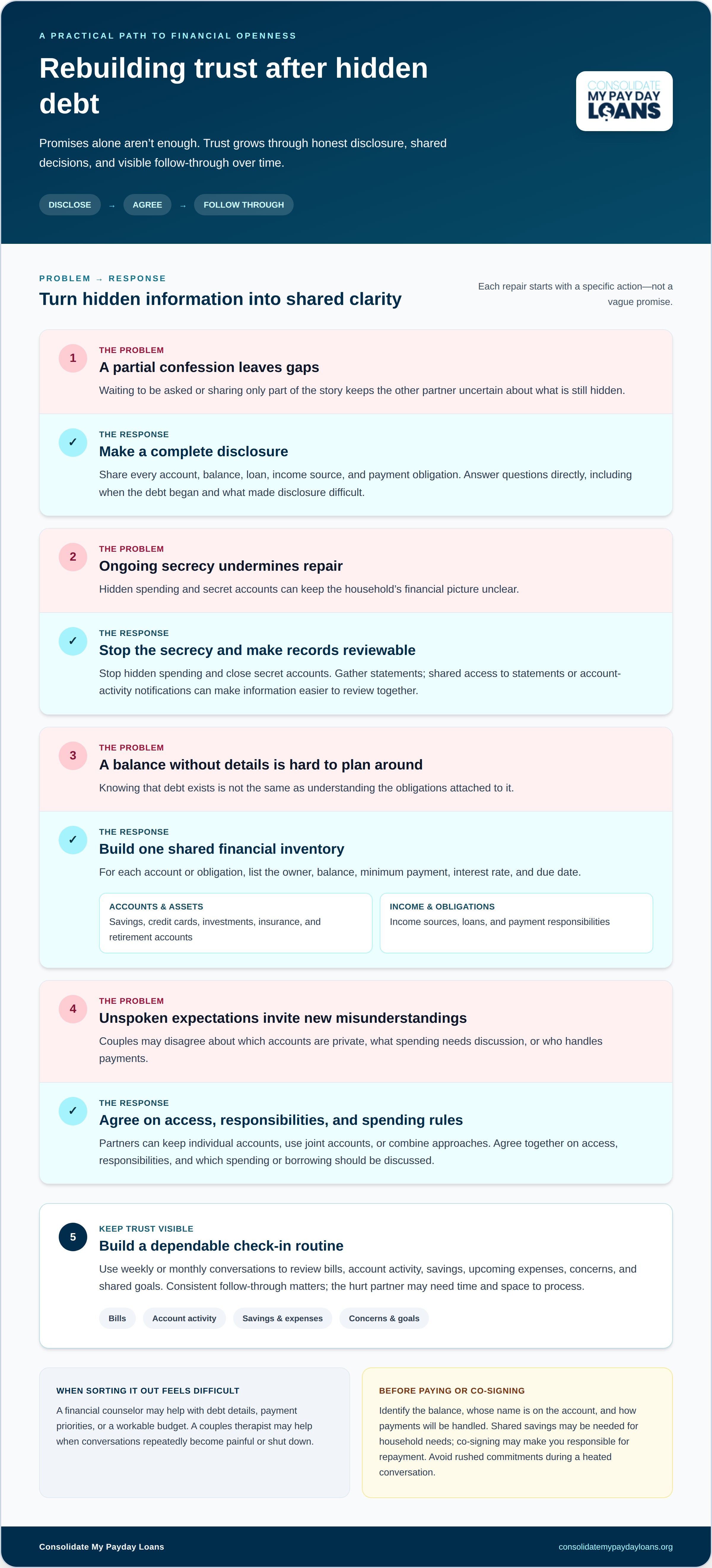
Start with a complete account of what happened, not a partial confession. The partner who hid debt should disclose every account, balance, loan, income source, and payment obligation without waiting to be asked. They should stop hidden spending and close secret accounts. Then they should answer questions directly, including when the debt began and what made disclosure difficult. Understanding the reason can guide prevention, but it doesn’t excuse the deception.
Make the disclosure concrete. Gather statements and list each account’s owner, balance, minimum payment, interest rate, and due date. Include savings, credit cards, investments, insurance, retirement accounts, and income. Both partners should know which accounts exist and the obligations attached to them. Shared access to statements or account-activity notifications can make the information easier to review together.
Should couples separate or combine finances after financial deception? There’s no single arrangement that suits every couple. Partners can keep individual accounts, use joint accounts, or combine approaches, as long as they agree on access, responsibilities, and which spending to discuss. A weekly meeting can cover bills, account activity, and savings without requiring every account to be joint.
What legal responsibilities do spouses have for each other’s debt in community property states? The answer depends on state rules and the details of the debt, so don’t assume marriage automatically makes every debt shared or solely individual. Identify whose name is attached to each obligation, and get state-specific legal guidance before making decisions about responsibility.
When should couples seek financial counseling or couples therapy? Consider a financial counselor when debt details, payment priorities, or a workable budget are difficult to sort out together. A couples therapist may help when conversations repeatedly become painful or shut down. Either partner can also seek individual emotional support while processing betrayal.
What are the risks of paying a partner’s hidden debt or co-signing loans? Using shared savings can reduce the money available for household needs, while co-signing may make you responsible for repayment. Before agreeing, identify the balance, whose name is on the account, and how payments will be handled. Don’t make a rushed commitment during a heated conversation.
How can you check credit reports and identify undisclosed debt in the United States? Each person can request their own credit reports through AnnualCreditReport.com, the federally authorized source for free reports. Review your report for accounts or obligations you don’t recognize, and ask your partner to review theirs. Don’t access a partner’s individual report without permission.
2. What Is Financial Infidelity?
Financial infidelity happens when someone intentionally hides money-related behavior that violates a couple’s expectations or agreements. The key issue isn’t whether an account is individual or joint. For example, a separate savings account isn’t dishonest if both partners know about it and agree to keep some finances separate. Secretly opening an account after agreeing to disclose all credit cards is different.
Financial infidelity can involve more than hidden debt. A partner might conceal purchases, leave a loan off the household budget, understate income, or transfer shared savings without discussion. Imagine one person saying the bills are current while quietly making minimum payments on an undisclosed credit card. The debt matters, but so does the false picture of the household’s finances.
Common examples include secret credit cards, undisclosed personal loans, hidden cash, and purchases concealed through another account. Some people hide gambling losses or spending they fear their partner will challenge. Others conceal financial help given to relatives or a change in income. These examples share a pattern: someone hides a choice despite an expectation or agreement to discuss it.
The reasons vary by situation. Someone may fear conflict, feel ashamed about debt, or want to avoid judgment over spending. Compulsive spending or gambling can also contribute to secrecy and may require appropriate treatment. Understanding the reason can help partners identify what needs to change, but it doesn’t erase the effects of concealment or make the behavior acceptable.
Context matters. If a couple has agreed that purchases above a certain limit require discussion, deliberately hiding one may break that agreement. If no such rule exists, the couple may need to clarify expectations before calling the purchase financial infidelity. A direct conversation about what each person considers private, shared, or reportable can prevent assumptions from becoming another source of mistrust.
Hidden debt isn’t automatically financial abuse. But controlling a partner’s access to money, withholding funds for basic needs, opening accounts in their name, or using money to threaten or isolate them may signal abuse. In that situation, prioritize personal safety and qualified legal or advocacy support before attempting joint budgeting. For disclosed credit card balances that are difficult to manage, credit card debt consolidation may be worth exploring as a separate repayment option.
3. Emotional and relationship effects of hidden debt
A hidden credit card balance can hurt twice: through the debt itself and through the lie. The partner who discovers it may question past conversations, shared plans, or what household income could safely cover. For example, finding out that savings went toward undisclosed payments can make earlier budget decisions feel unreliable. The emotional impact may include anger, fear, embarrassment, or numbness. These reactions can come together, not in a neat order.
Uncertainty can affect everyday behavior, too. A partner might feel anxious when bills arrive, hesitate before using shared savings, or repeatedly check account activity. The person who hid the debt may feel ashamed and avoid discussing income or purchases, deepening the distance. Naming a specific concern, such as “I’m worried another account will surface,” gives the couple a clearer starting point than arguing over blame.
Trust can weaken beyond money. One partner may wonder whether other important information was withheld, while the other may interpret questions as punishment. A conversation about a routine purchase can turn into a dispute about honesty. Both partners can slow this cycle by discussing one issue at a time, listening without interruption, and taking a break if either feels overwhelmed.
Repair requires emotional accountability as well as financial facts. The partner who concealed debt can listen to the hurt without defending the behavior or rushing forgiveness. The hurt partner can ask direct questions and set boundaries for future decisions. If a therapist is involved, couples can use sessions to discuss recurring arguments, fear, and ways to make conversations safer. Individual emotional support can also help someone process betrayal without relying only on their partner.
Look closely at the behavior surrounding money. Hidden debt alone isn’t automatically financial abuse, but control may be present if one partner withholds funds for basic needs, restricts access to money, opens accounts in the other person’s name, or uses finances to threaten or isolate them. In that situation, prioritize personal safety and qualified legal or advocacy support before joint budgeting. A shared financial meeting isn’t safe when one person is being controlled.
Some couples may consider separation or divorce if deception continues despite treatment and meaningful repair efforts. That decision should take ongoing behavior, emotional safety, and each person’s needs into account, rather than pressure to forgive quickly. If both partners choose to work on the relationship, agree on a next step, such as a therapist appointment or a calm conversation about one unresolved concern. Consistent honesty over time matters more than a single apology.
4. Preventing future financial secrecy
Turn vague promises into written agreements about what each partner will disclose. Record household income, shared expenses, savings goals, and debts in one inventory. For each account or obligation, include its balance, interest rate, minimum payment, due date, and the name legally attached to it. Update the inventory when an account changes or a new obligation arises. This record gives both partners the same reference point during difficult conversations.
Set a spending boundary before the next purchase creates tension. For example, partners might agree to discuss any purchase above $200 in advance. They can also agree how to handle credit cards, lines of credit, and buy-now, pay-later plans. The threshold should fit their budget and apply clearly to both people. Write down exceptions, such as routine household bills, so a shared rule doesn’t become another source of confusion.
Build transparency into everyday spending. Partners can agree to share relevant account statements or activity notifications while deciding together which accounts remain individual. A separate account isn’t automatically a secret; the risk grows when it conceals spending or breaks an agreement. If new credit could put shared finances at risk, partners may consider freezing accounts or removing authorization for new credit.
How can you set boundaries and rebuild emotional trust after hidden debt? Agree on specific rules for disclosure, spending, and credit, then follow them consistently. Pair those boundaries with calm conversations, honest answers, and space for the hurt partner to express concerns without pressure to forgive.
Make the household budget realistic enough to follow. Include seasonal changes, school breaks, holidays, and periods when income may be lower. Agree how to handle unexpected costs, such as car repairs or school expenses, before they arise. Partners can write down shared goals, such as paying off debt or building savings, and review whether planned spending supports them.
Use a weekly conversation to catch small problems before they become concealed obligations. Each partner can raise a concern gently, listen without interrupting, and take a break if the discussion becomes overwhelming. For example, “I’m worried our current plan leaves no room for school costs” invites problem-solving more than blame. Follow through on agreed changes, then revisit them when circumstances shift.
Following through on spending and saving agreements is a suggested way for the partner who broke trust to rebuild safety. Couples can set clear spending limits before checking in with each other, and can agree on limits around credit cards, lines of credit, or buy-now, pay-later plans. Making those boundaries clear in advance gives both partners a shared understanding of what has been agreed. Budget transparency means both partners know what money is coming in, what money is going out, and what agreements they have made together.
Couples may also consider maintaining an emergency fund to reduce financial stress and the temptation to hide problems. Both partners can understand its purpose and agree on how to use it. When a money conversation gets heated, a gentle opening, listening without interruption, and taking breaks when overwhelmed can help calm things down. These practices can help partners return to difficult topics ready to hear concerns and focus on the agreements they’re trying to honor.
5. Scheduling regular financial check-ins
Promises after betrayal matter less than consistent, observable follow-through. Set a recurring money meeting so couples can review current facts before worry turns into hiding or accusation. A weekly check-in lasting 30 minutes can focus on recent transactions, upcoming bills, and questions about credit cards. Keep the meeting at a predictable time, such as after dinner on the same day each week. A reliable routine makes it easier to raise concerns while they’re still manageable.
Give each meeting a simple agenda. First, review bills due before the next check-in. Then look at account activity, debt payments, and income changes. Finish by naming one decision that needs both partners’ input, such as adjusting a savings contribution. If a transaction is unclear, note the question and agree on who will explain it. This keeps the conversation focused on facts instead of turning every budgeting discussion into a replay of the betrayal.
Monthly conversations can take a wider view. Couples can discuss upcoming expenses, savings progress, and whether the household plan still fits their priorities. For example, if a car repair changes the month’s budget, agree on which expense or goal will shift. Quarterly planning sessions can revisit shared goals and longer-term decisions. An annual relationship check-in can make space to discuss what feels safer, what remains difficult, and whether the meeting routine needs adjusting.
Use the same rules for both partners. Each person should have time to speak, ask questions, and raise concerns without interruption. If one partner becomes overwhelmed, pause and set a specific time to continue. End each meeting by writing down decisions, who will handle each task, and when you’ll review it. Revisit those commitments at the next check-in. Repeated follow-through makes accountability practical without demanding instant forgiveness.
Once a year, review household accounts and assets together, including balances and outstanding obligations. An annual review with a financial advisor can also help partners assess their plans and progress. These reviews complement, rather than replace, regular conversations. If credit card balances are making repayment discussions hard to organize, explore credit card consolidation as a possible way to address that debt. Keep the check-in focused on shared understanding, not pressure to choose a particular solution.
Consolidate My Payday Loans
Consolidate My Payday Loans can help when hidden debt includes payday loans or credit card balances that are difficult to manage. Payday loan consolidation combines multiple high-interest payday loans into a single payment, while credit card consolidation addresses eligible card debt. Its calculator can help estimate potential savings and debt reduction, and payday loan relief programs are designed to help borrowers address the cycle of debt and lower monthly payments. These options can support a clearer repayment plan, but they don’t replace honest conversations or shared financial check-ins. Discuss the disclosed balances and repayment responsibilities together before deciding what fits your household. If you’re ready to explore support for managing debt, contact Consolidate My Payday Loans.
Build the Next Chapter Together
The next step is to turn accountability into a shared direction. Choose one financial goal that matters to both of you, then decide how to track progress and make decisions together. A modest, clearly defined goal can give future money conversations a purpose beyond revisiting what went wrong. Allow for changing circumstances, and treat questions as a chance to clarify the plan, not as proof that repair has failed.
Rebuilding financial trust after hidden debt takes patience from both partners. The person who concealed the debt can keep showing up with honest answers; the hurt partner can set boundaries and decide what progress feels safe. You don’t have to resolve every concern in one conversation. Focus on the next honest step, then keep building from there.
If debt is making it harder to move forward, contact Consolidate My Payday Loans to explore support. A clearer plan can help you approach the next conversation with greater confidence.
Frequently Asked Questions
What Is Financial Infidelity?
Financial infidelity is deliberate money-related behavior that breaks an agreement or expectation between partners. The same action can mean different things in different relationships: keeping a private account may be acceptable if both partners agreed, while concealing it after agreeing to disclose accounts may violate trust. A useful test is whether the person hid the behavior because they knew it crossed a shared boundary.
What’s the first step to take when you discover your partner has been lying about money?
Pause before making major financial decisions, then establish what needs attention first. Ask whether a payment is due soon, whether a shared bill is at risk, and whether new borrowing or spending is continuing. Set a time to talk when neither person is in a rush. If you feel unsafe or financially controlled, prioritize personal safety and seek qualified support before attempting joint money planning.
What steps help rebuild trust after a partner hides debt?
A practical way to rebuild financial trust after hidden debt is to turn promises into small, observable commitments. Agree on one action, such as sharing a statement before the next money conversation, and set a time to review whether it happened. The partner who concealed debt should answer follow-up questions without defensiveness. The hurt partner can decide which boundaries should stay in place as trust develops.
How should you disclose and document all debts and financial accounts?
Gather current statements and loan records, then sort them into individual, joint, and unclear obligations. Note when each record was reviewed and flag missing or disputed details instead of guessing. Keep copies somewhere both partners can access them, with appropriate account security. A credit report can help identify accounts in the report holder’s name, but it may not include every household obligation or private agreement.
What financial transparency rules help prevent hidden debt in the future?
Write down rules that answer practical questions: which credit applications require advance discussion, which purchases need notice, and how partners will report changes to income or bills. Decide together whether account alerts or shared statement access will help, while respecting agreed privacy boundaries. Review the rules after a major change, such as a new job or an unexpected expense, so outdated expectations don’t create new misunderstandings.