
A payday loan default is not a financial dead end. In fact, it’s often the necessary catalyst that allows you to move from a predatory cycle to professional debt management. When you’re actively searching for payday loan default help, you’re likely facing a storm of aggressive collection calls and the constant fear of bank account “sweeps” that disappear your paycheck before you can buy groceries. It’s exhausting to watch your balances balloon with fees while you’re simply trying to survive.
You deserve to have a stable anchor in this financial turbulence. We understand that the high-interest lending system is designed to keep you trapped, but you have more power than you realize. This guide will show you how to stop unauthorized ACH withdrawals, end the harassment from collectors, and secure your bank account. We’ll also provide a clear roadmap for consolidating multiple high-cost loans into one affordable payment that actually fits your budget. By the end of this article, you’ll have a methodical plan to regain your personal agency and find the psychological peace that comes with a permanent path to debt relief.
Key Takeaways
- Safeguard your finances by taking immediate steps to stop unauthorized bank account “sweeps” and predatory ACH withdrawals.
- Gain clarity on the collections timeline and learn why high-interest rollovers are a trap designed to keep your balance ballooning.
- Use federal and state consumer protections as a shield against harassment and to identify when payday loan default help can render certain debts unenforceable.
- Evaluate the differences between consolidation and settlement to find the most effective “safe exit” from the debt cycle.
- Discover how professional relief programs act as your advocate, merging multiple obligations into a single, affordable monthly payment.
Immediate Steps for Payday Loan Default Help: Stopping the Bleeding
Facing a default feels like a sudden emergency. Your first instinct might be to panic as you watch your bank balance dwindle, but the most effective payday loan default help begins with a shift in perspective. You aren’t just a debtor; you’re a consumer with specific legal protections that remain active even when you can’t make a payment. In 2026, the regulatory environment continues to evolve. While the CFPB reviews specific enforcement provisions, your fundamental right to control your own bank account remains your most powerful tool for financial recovery.
Many borrowers try to do the right thing by calling their lender to ask for an extension. Unfortunately, this is often a tactical error. Lenders frequently use these calls to push for rollovers, which simply stack more fees onto a balance that’s already impossible to manage. Understanding what a payday loan is reveals a product designed for short-term use. When these loans aren’t settled immediately, the interest and fees can quickly exceed the original principal. Instead of asking for permission to pay later, you must take proactive steps to protect your remaining assets.
How to Revoke ACH Authorization Legally
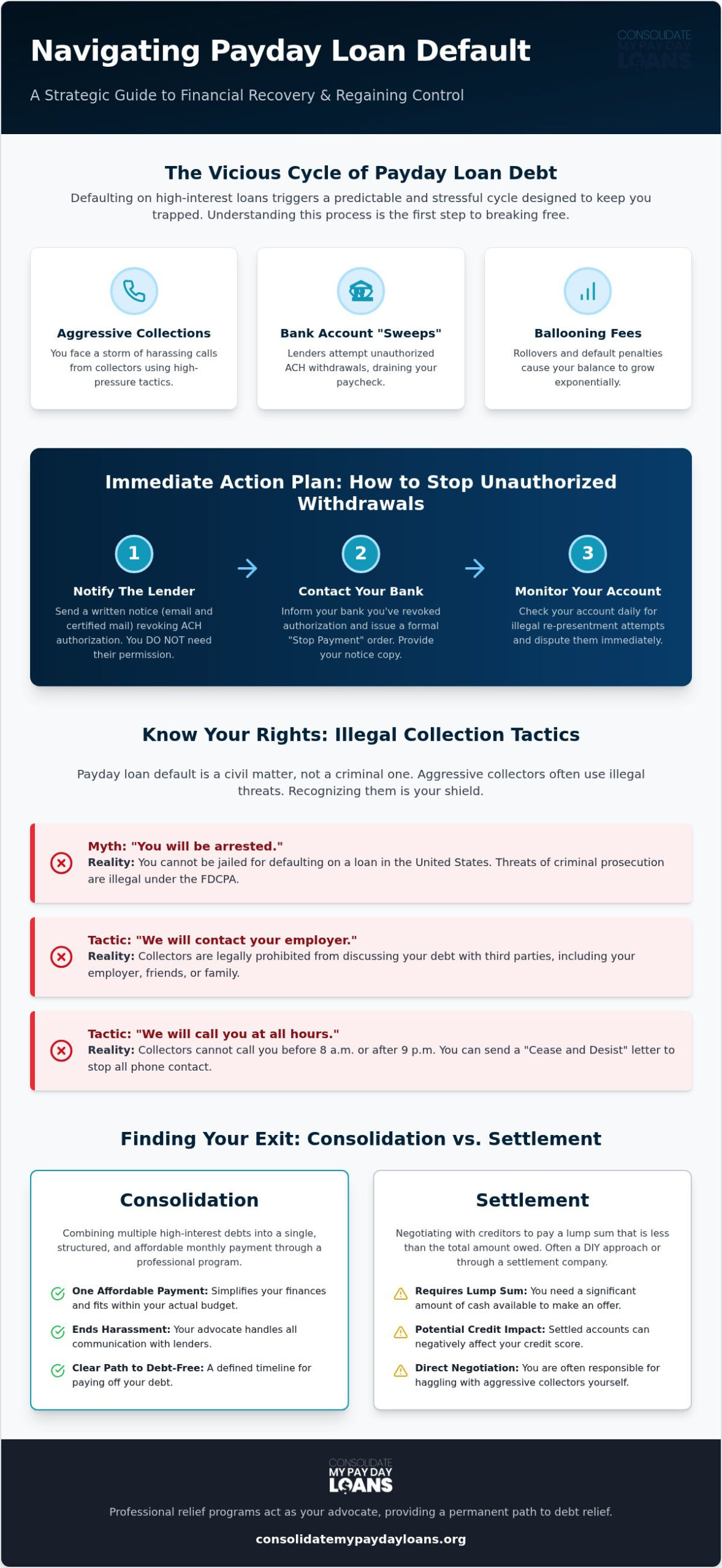
The most urgent task is stopping “sweeps,” where lenders attempt to withdraw funds automatically from your paycheck. You can reclaim control through a methodical three-step process.
- Step 1: Notify the lender. Send a written notice via email and certified mail stating that you’re revoking your authorization for ACH transfers. You don’t need the lender’s permission to do this.
- Step 2: Contact your bank. Inform your financial institution that you’ve revoked authorization and issue a formal “Stop Payment” order. Provide them with a copy of your notice to the lender to ensure they have documentation on file.
- Step 3: Monitor for re-presentment. Some lenders try to bypass stop-payment orders by changing the transaction amount or the company name. Check your account daily to catch and dispute these attempts immediately.
Communicating with Lenders Post-Default
It’s time to stop taking phone calls. Debt collectors are trained to use high-pressure tactics to trigger an emotional response. Move all communication to written formats like email or physical mail. This creates a permanent paper trail that protects you if the lender violates consumer laws.
Be aware that threats of jail time or criminal prosecution are almost always false and illegal. Defaulting on a loan is a civil matter, not a criminal one. If a collector harasses you at your workplace or calls at unreasonable hours, send a formal “Cease and Desist” letter. This legally requires them to stop phone contact, forcing them to communicate only through the mail or through your professional debt advocate.
What Happens When You Default? Understanding the Reality
Defaulting on a high-interest loan triggers a chain reaction that feels overwhelming, but understanding the mechanics of this process helps you stay in control. The first blow is almost always financial. When a lender attempts to withdraw funds from an empty account, your bank may charge Non-Sufficient Funds (NSF) fees for every failed attempt. Simultaneously, the lender tacks on their own internal default fees, causing the balance to balloon overnight. Recent data shows that personal loan delinquency rates rose to 4% in late 2025, which means you aren’t alone in facing these consequences of payday loan default. It’s a stressful start, but it isn’t the end of your financial life.
One of the most persistent myths used by aggressive collectors is the threat of jail time. It’s vital to remember that there is no such thing as debtor’s prison in the United States. Payday loan default is a civil matter, not a criminal one. Any collector who suggests you could face arrest is likely violating federal law. While you won’t face criminal charges, you can be sued in civil court. If a lender wins a judgment, they may eventually be able to garnish wages or levy bank accounts, though this is a lengthy legal process that requires a court order. Addressing the issue early through professional payday loan default help can often prevent the situation from ever reaching a courtroom.
The Escalation of Collection Tactics
Lenders typically move from standard “customer service” reminders to aggressive third-party agencies within 30 to 60 days of your first missed payment. These agencies often use social pressure as a weapon, calling your workplace or personal references under the guise of “verifying contact information.” While they aren’t allowed to disclose your debt to third parties, the mere frequency of the calls constitutes harassment. In 2026, modern consumer protections have tightened, and any agency calling more than seven times in a seven-day period is generally considered to be in violation of federal standards.
Impact on Your Financial Future
A default doesn’t just disappear. It can remain on your traditional credit report for seven years, making it difficult to secure car loans or favorable insurance rates. Beyond the big three credit bureaus, payday lenders also use specialized reporting agencies like Clarity and FactorTrust. These bureaus track your history with high-cost lending specifically. In 2026, these specialized reports are increasingly used by subprime lenders and even some landlords to assess your reliability as a tenant. Protecting your future borrowing capacity requires a proactive strategy to manage the debt rather than letting it sit in a permanent state of default.
Knowing Your Rights: Consumer Protection in 2026
Knowledge is your primary defense against aggressive collectors. While the weight of debt feels personal, the rules governing how that debt is collected are strictly professional and legally binding. The Fair Debt Collection Practices Act (FDCPA) serves as your shield. It ensures that even in default, you’re treated with a baseline of human dignity. In 2026, the Consumer Financial Protection Bureau (CFPB) continues to refine its regulatory agenda, focusing on how lenders manage penalty fees and automated communications. Understanding these protections is the first step toward effective payday loan default help, as it allows you to identify when a lender has crossed the line from collection to harassment.
Leverage in negotiations often comes from identifying predatory markers in your original loan agreement. For instance, many lenders still attempt to bypass state-specific interest rate caps. In states like Colorado, the law strictly limits finance charges to an annual percentage rate (APR) of 36%. If you’re being charged more, the loan may be legally unenforceable. Furthermore, if you reside in one of the 17 states where payday lending is prohibited, such as New York, Pennsylvania, or North Carolina, any lender attempting to collect on a high-interest short-term loan may be operating outside the law. Recognizing these violations provides you with the agency needed to challenge unfair terms rather than simply accepting them.
The FDCPA and You: What Collectors Cannot Do
Collectors often rely on your lack of knowledge to exert pressure. The law is very specific about their boundaries. They cannot call you before 8 AM or after 9 PM in your local time zone. You also have the absolute right to demand a “Validation of Debt” in writing. Once you request this, the collector must pause all collection activities until they provide proof that you actually owe the debt and that they have the legal right to collect it. If they call your workplace, a simple statement that your employer prohibits such communications legally bars them from calling that number again. Documentation is key; keep a log of every violation to use as leverage later.
Challenging Unfair Loan Terms
Predatory lending is often buried in the fine print. Review your original agreement for “unconscionable” terms that exceed state caps or include illegal “waivers” of your consumer rights. Since the “ability-to-repay” provisions were rescinded years ago, many lenders have become reckless in their underwriting. If a lender issued you a loan they knew you couldn’t afford based on your income, this can be reported to the CFPB for federal oversight. Reporting violations doesn’t just help your case. It alerts regulators to systemic abuses, often leading to broader relief for consumers in similar situations.
Consolidation vs. Settlement: Finding Your Best Exit Strategy
Choosing between consolidation and settlement is a pivotal moment in your financial recovery. These two paths offer different mechanisms for relief, and the right choice depends on your current cash flow and your long term credit goals. Consolidation merges multiple high interest obligations into a single, structured payment plan. This approach focuses on lowering interest rates and halting the fee cycle while you repay the principal. Settlement, by contrast, involves negotiating with the lender to pay a lump sum that’s less than the total balance. While both provide payday loan default help, they have vastly different impacts on your financial health.
A common mistake many borrowers make is falling into the “New Loan” trap. This happens when you try to take out a traditional personal loan to pay off your payday debts. If you’ve already defaulted, your credit score may be too low for a low interest bank loan. You might end up with a high cost installment loan instead, effectively trading one predatory fire for another. True relief focuses on managing the debt you already have rather than adding new liabilities to your name. We recommend that you first explore payday loan consolidation as a way to simplify your life without the risks of new high interest borrowing.
When to Choose Payday Loan Consolidation
Consolidation is the ideal strategy if you’re juggling multiple lenders and high monthly outlays. It stops the “rollover” cycle immediately. By working with a professional advocate, you move from a chaotic struggle to a methodical repayment plan. Professional management is almost always superior to DIY negotiation. Experts understand the specific leverage points that force lenders to waive predatory fees and accept lower interest. This path allows you to maintain a more consistent credit history while proving you’re committed to resolving your obligations in a structured way.
The Pros and Cons of Debt Settlement
Settlement can offer significant principal reduction, sometimes cutting the total balance by half. However, it’s a more aggressive approach with higher risks. During the “saving” phase, where you stop payments to build a settlement fund, lenders may become more hostile or even file a civil lawsuit. There are also tax implications to consider. The IRS generally views forgiven debt as taxable income. If a lender forgives more than $600, you’ll likely receive a 1099-C form, which could increase your tax bill at the end of the year. While settlement provides a “hard reset,” the potential for litigation and tax debt makes it a heavier burden for many families.
Professional Payday Loan Relief: Reclaiming Financial Agency
Regaining control after a default requires more than just a desire to pay; it requires a strategic buffer between you and the aggressive tactics of lenders. Professional relief programs provide this essential layer of protection. When you attempt to negotiate on your own, lenders often ignore your requests or try to steer you back into high-interest rollovers. However, an expert advocate carries the “insider knowledge” of the industry. They understand the systemic pitfalls and know exactly which legal levers to pull to stop the harassment. This transition allows you to stop being a target and start being a partner in your own financial recovery.
The journey toward a debt-free 2026 is methodical and designed to build your confidence at every step. By shifting the burden of communication to professionals, you instantly eliminate the stress of answering collection calls. This isn’t just about money; it’s about the psychological peace that comes from knowing someone is in your corner. Seeking payday loan default help through a structured program ensures that your path forward is predictable and sustainable. You move from the chaos of multiple due dates to the clarity of a single, managed objective.
How Consolidation Programs Work
The process is straightforward and transparent. It begins with a clear assessment of your current obligations to ensure the solution fits your specific needs.
- Step 1: Analyze your debt. Use a payday loan consolidation calculator to estimate your potential savings and see a realistic path to relief.
- Step 2: Professional enrollment. Once you join a program, your advocate takes over all lender communications. You no longer have to talk to collectors; your program handles the negotiations for you.
- Step 3: Simplify your life. Instead of managing 5 to 10 separate lenders with varying interest rates, you make one affordable monthly payment directly to the program.
The Path to Financial Peace
Consistency is the key to rebuilding your financial reputation. As you make managed payments, you establish a new history of reliability. This steady progress is the foundation for a better credit score and future access to fair lending. Beyond the numbers, the relief of ending the daily “phone tag” with collectors is immeasurable. If your situation is particularly severe, a specialized payday loan hardship program can offer a fresh start without the long-term stigma of bankruptcy. You don’t have to face this storm alone. Expert payday loan default help is available to guide you back to solid ground. Start your recovery today with a free debt analysis and take the first step toward reclaiming your agency.
Reclaiming Your Financial Future in 2026
A payday loan default doesn’t have to define your financial story. By revoking ACH authorizations and asserting your rights under modern consumer protection laws, you’ve already taken the first steps toward stopping the bleeding. You now understand that professional consolidation offers a structured, safe exit from the predatory cycle of rollovers and ballooning fees. Finding effective payday loan default help is about more than just managing numbers; it’s about reclaiming the psychological peace you deserve.
Consolidate My Payday Loans has provided A+ rated debt management support since 2004. With over 20 years of experience in high-interest debt relief, we offer specialized tools like our 2026 savings calculator to help you visualize a life without the burden of payday loans. Our team acts as your dedicated advocate, negotiating with lenders so you don’t have to face the harassment alone. You have the power to replace financial chaos with a single, affordable monthly payment. Take Control of Your Debt – Get a Free Payday Loan Relief Consultation. Your journey to recovery starts with a single decision. We’re ready to help you build a stable foundation for the years ahead.
Frequently Asked Questions
Can I go to jail for defaulting on a payday loan?
No, you cannot go to jail for defaulting on a payday loan. Payday loan debt is a civil matter, not a criminal one. Under the Fair Debt Collection Practices Act (FDCPA), it’s actually illegal for a collector to threaten you with arrest or jail time to coerce a payment. While a lender can sue you in civil court, this process involves financial judgments rather than criminal penalties. You aren’t a criminal for facing financial hardship.
How do I stop a payday lender from calling my job?
You can stop a lender from calling your workplace by clearly stating that your employer doesn’t permit personal calls. Once you provide this notification, the FDCPA legally bars the collector from contacting you at that number again. It’s best to follow up this verbal request with a written “Cease and Desist” letter sent via certified mail. This creates a documented paper trail that protects your rights if the harassment continues at your place of employment.
Is it possible to consolidate payday loans with bad credit?
Yes, it’s absolutely possible to find payday loan default help and consolidate your debt even with a poor credit score. Unlike traditional bank loans, professional consolidation programs focus on your current ability to pay rather than your past credit history. These programs work by negotiating with your existing lenders to lower interest rates and stop fees. This allows you to manage your debt through a single, affordable monthly payment that fits your actual budget.
What is a payday loan extended payment plan (EPP)?
An Extended Payment Plan (EPP) is a provision that allows you to repay your loan in smaller installments over a longer period without incurring additional interest or fees. Many states require lenders who are members of the Community Financial Services Association of America (CFSA) to offer this option to borrowers who can’t pay on time. You must typically request an EPP before the close of business on the day before your loan is due to qualify for this benefit.
How much does a payday loan relief program cost?
The cost of a relief program varies based on the total amount of debt you’re consolidating and the specific terms negotiated with your lenders. Most reputable programs don’t require high upfront fees. Instead, the administrative costs are typically factored into your new, lower monthly payment. This ensures the program remains accessible while focusing on reducing your overall debt burden. Always ask for a clear breakdown of how your payments are distributed during your initial consultation to ensure transparency.
Will defaulting on a payday loan ruin my credit forever?
Defaulting on a loan won’t ruin your credit forever, though it will have a significant impact in the short term. A default typically stays on your credit report for seven years from the date of the first delinquency. However, its influence on your score decreases over time as you establish new, positive payment habits. By using a structured plan for payday loan default help, you can begin rebuilding your credit immediately by proving a history of consistent, managed payments.
Can a payday lender garnish my wages without a court order?
No, a private payday lender cannot garnish your wages without first obtaining a court judgment against you. They must file a civil lawsuit, prove the debt is valid, and win the case before they can request a garnishment order from the court. Some borrowers confuse this with “voluntary wage assignments,” which are clauses in some loan contracts. You can typically revoke a voluntary wage assignment at any time by notifying both the lender and your employer in writing.
What should I do if a lender threatens me with fraud charges?
If a lender threatens you with fraud charges, you should document the conversation and report the incident to the Consumer Financial Protection Bureau (CFPB). Lenders often use the threat of “check fraud” or “malicious intent” as a scare tactic to force a payment. Unless you intentionally took out the loan using false information or with a closed bank account, defaulting is not a crime. These threats are often a violation of federal debt collection laws and should be reported immediately.