
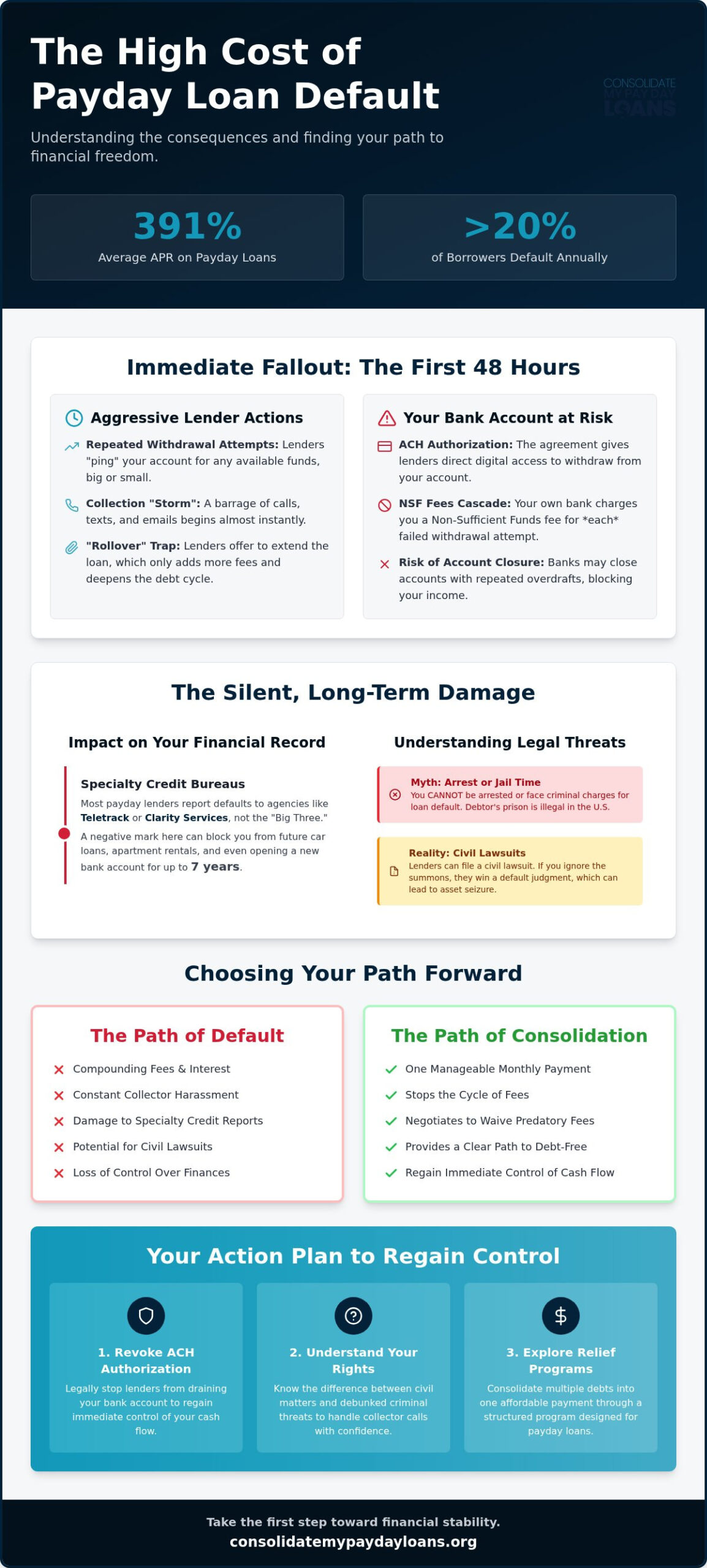
What if the constant dread of your phone ringing could be replaced by a clear, actionable plan to settle your debt? When you’re staring at a bank account emptied by automatic withdrawals or receiving threats of legal action, it’s easy to feel like you’ve lost control. You aren’t alone in this struggle. Over 20% of borrowers across the country face payday loan default consequences every year, dealing with interest rates that often average 391%.
It’s exhausting to live under the weight of ballooning fees and aggressive collection tactics. We understand the stress you’re under, and we’re here to tell you that there is a way out. This article promises to clarify exactly what happens when you default in 2026 and provides the strategic steps needed to regain your financial agency. We will preview the latest federal protections, explain how to legally stop unauthorized ACH transfers, and show you how to move toward a debt-free future with confidence and peace of mind. By the end of this guide, you’ll have the tools to stop the harassment and protect your hard-earned income.
Key Takeaways
- Learn how to legally revoke ACH authorization to stop lenders from draining your bank account and regain immediate control of your cash flow.
- Understand the full scope of payday loan default consequences, including the difference between FICO score impact and specialty reporting through bureaus like Teletrack.
- Discover your rights regarding debt collection and why civil court is the only legal avenue for lenders, effectively debunking common fears of arrest or criminal charges.
- Explore why proactive payday loan consolidation is a more cost-effective alternative to default, stopping the cycle of compounding fees and 400% APR interest.
- Find out how a structured payday loan relief program can consolidate multiple debts into one manageable monthly payment while negotiating to waive predatory fees.
What Happens Immediately When You Default on a Payday Loan?
The moment the clock strikes midnight on your due date and the funds aren’t there, the landscape of your finances changes instantly. Default is the moment a borrower fails to meet the contractual repayment terms. This isn’t just a missed payment; it’s the trigger for a series of automated events designed to extract funds at any cost. You’ll likely see “pings” on your account almost immediately. These are multiple, smaller withdrawal attempts where the lender tries to see if even $50 or $100 is available when the full amount isn’t. It’s a digital fishing expedition that can happen several times in a single day.
These attempts often lead to a cascade of Non-Sufficient Funds (NSF) fees from your bank. While the lender is busy trying to collect, your own financial institution is charging you for every failed attempt. This hidden cost of defaulting can quickly add hundreds of dollars to your total debt before you’ve even spoken to a collector. Understanding the immediate payday loan default consequences is vital because the damage starts at the bank level before the lender even picks up the phone.
The 48-Hour Fallout: Aggressive Collection Tactics
Within the first two days, the “collection storm” usually hits with full force. Payday lenders are notoriously more aggressive than traditional credit card companies because their business model relies on high-velocity repayment. You’ll likely receive a barrage of calls, texts, and emails starting early in the morning. During these calls, lenders often offer a “rollover” as a helpful solution. Don’t be fooled by this tactic. A rollover is a trap that adds more fees to your balance while extending the due date by only a few weeks. It doesn’t solve the debt; it simply ensures the lender makes more money while you stay stuck.
Bank Account Vulnerability and ACH Withdrawals
When you signed your initial agreement, you likely provided an Automatic Clearing House (ACH) authorization. This gives the lender direct digital access to your checking account. A payday loan contract is specifically designed to make the lender the first person paid when your paycheck hits. Hiding from the lender or ignoring their calls doesn’t stop these digital withdrawals. They will continue to attempt transfers, which puts you at a high risk of permanent account closure. Banks will eventually shut down accounts that suffer from repeated overdrafts, leaving you without a way to receive your income or pay essential bills like rent. This digital vulnerability is why many people feel trapped in the cycle of debt.
The Long-Term Consequences of Payday Loan Default
While the immediate chaos of collection calls is loud and distressing, the silent, long-term damage to your financial footprint is often more restrictive. Moving past the first few weeks of a missed payment, the payday loan default consequences begin to settle into your permanent record. This isn’t just about a lower number on a screen; it’s about a systematic lockout from the financial tools you need to build a stable life. When you default, you aren’t just failing to pay a single debt. You’re often being flagged across a network of specialty databases that most consumers don’t even know exist.
Specialty Credit Reporting and Future Borrowing
Many borrowers believe that if a payday lender doesn’t report to the “Big Three” bureaus—Experian, TransUnion, and Equifax—their credit is safe. This is a dangerous misconception. Most high-interest lenders use specialty credit bureaus like Teletrack or Clarity Services to vet applicants. These reports track your history with small-dollar loans, check-cashing services, and rent-to-own agreements. A default on these reports can stay visible for up to seven years. Even if your FICO score remains untouched, a negative mark on Teletrack can prevent you from getting a car loan, securing an apartment, or even opening a basic checking account. You become part of an industry-wide “blacklist” that marks you as a high-risk individual.
Civil Judgments and the Threat of Lawsuits
Fear is a primary tool for collectors, and many use the threat of jail time to pressure payments. It’s vital to remember that debtor’s prison is illegal in the United States. You cannot be arrested or face criminal charges for defaulting on a payday loan. It’s strictly a civil matter. However, “civil” doesn’t mean “without teeth.” If a lender or a debt buyer decides to sue, you will receive a civil summons. Ignoring this document is a mistake. If you don’t show up to court, the lender wins a “default judgment” automatically.
While criminal charges are impossible, civil judgments can lead to asset seizure or the freezing of your remaining bank funds. In many states, this judgment allows the lender to begin wage garnishment. This is a court-ordered process where a portion of your paycheck is sent directly to the creditor before you ever see it. In California, for example, a lender must obtain this court judgment before they can touch your earnings. If you’re feeling overwhelmed by these possibilities, using a payday loan consolidation calculator can help you visualize a path toward settlement before the legal process escalates. Taking proactive steps now is the best way to protect your future income from court-ordered seizures.
Default vs. Proactive Payday Loan Consolidation
Defaulting on a payday loan might feel like an escape when you’re out of cash, but it’s actually the most expensive path you can take. While you might stop paying the principal, the “fee-compounding” engine only accelerates. Between bank NSF fees and lender penalties, the total balance can double in a matter of weeks. Choosing proactive relief over default is about more than just money; it’s about reclaiming your agency. Instead of being a victim of aggressive collections, you become the architect of your own recovery.
Comparing the monthly costs makes the choice even clearer. In a default scenario, you’re hit with unpredictable charges that drain your account without ever lowering the principal. With a single consolidated payment, you gain a predictable, fixed cost that actually moves you toward a zero balance. This shift from reactive survival to proactive management is the key to ending the cycle. Understanding the full scope of payday loan default consequences means recognizing that every day spent in default is a day you aren’t moving toward a debt-free life.
Breaking the Debt Cycle Before the Crash
For those facing the 2026 lending landscape, payday loan consolidation offers a structured path out that avoids the wreckage of a court judgment. It works by negotiating with your current lenders to reduce interest rates and waive those ballooning fees that make repayment feel impossible. Many people consider bankruptcy when they can’t meet their payments, but consolidation is often a much more strategic alternative. It allows you to resolve the debt without the ten-year shadow of a bankruptcy filing on your record. By making payments manageable, you stop the rollover trap and start building a real financial foundation.
Visualizing the Savings with a Consolidation Calculator
The biggest hurdle to recovery is often the unknown. Using a payday loan consolidation calculator allows you to see the real numbers and compare your options side-by-side. You can see exactly how long it will take to reach freedom through consolidation versus the endless cycle of rollovers and defaults. A calculator helps transform abstract fear into a concrete repayment plan. When you see the total repayment time drop from “indefinite” to a specific number of months, the psychological weight of your debt begins to lift. This clarity is the first step toward regaining your financial peace.
How to Stop the Bleeding: Tactical Steps After Default
Once the initial shock of a missed payment fades, you must move from a state of panic to a state of protection. Managing the payday loan default consequences requires a methodical approach to secure your remaining assets and stop the cycle of predatory fees. You don’t have to wait for the lender to dictate the terms of your financial life. By taking the following steps, you can build a defensive wall around your income and begin the process of recovery.
- Revoke ACH authorization immediately to prevent lenders from “pinging” your account and triggering NSF fees.
- Move all communication to writing to ensure you have a verifiable record of every interaction and promise made.
- Organize your debt by creating a master list of every lender, including current balances, interest rates, and the date of your last payment.
- Seek professional payday loan relief to handle negotiations and stop the compounding interest.
The Legal Power of ACH Revocation
Many borrowers mistakenly try to “stop payment” on a single transaction at their bank. This is often an ineffective and expensive temporary fix. Under the Electronic Fund Transfer Act (EFTA), you have the legal right to revoke the lender’s entire authorization to access your account. To do this, you must notify the lender in writing that you’re revoking their access and then provide a copy of that notice to your bank. This stops digital withdrawals permanently. Furthermore, as of the federal rules effective in 2025, lenders are prohibited from attempting to withdraw funds more than twice after two consecutive failed attempts, giving you additional leverage to protect your balance.
Dealing with Debt Collectors Professionally
Collectors often rely on your stress and lack of industry knowledge to exert pressure. The Fair Debt Collection Practices Act (FDCPA) protects you from harassment, including calls before 8 a.m. or after 9 p.m. and any threats of criminal charges. Your first move should be requesting a “validation of debt” in writing. This legal request forces the collector to prove they have the right to collect the specific amount they’re claiming. It also pauses collection activity until they provide the proof. Once you have organized your records, you can stop engaging with aggressive agents and let a relief program handle the complex negotiations. If you’re ready to shield your income from further attempts, you can start your recovery journey today by exploring your relief options.
Regaining Control with a Payday Loan Relief Program
Defaulting doesn’t have to be the end of your financial story. While the payday loan default consequences we’ve explored create significant stress, a structured relief program provides a definitive exit. These programs shift the focus from reactive survival to organized management. By centralizing multiple high-interest obligations into a single monthly payment, you stop the chaotic drain on your bank account and begin a predictable path toward zero. This shift isn’t just financial; it’s a psychological turning point that replaces constant dread with a clear, achievable goal.
Professional relief works because it addresses the systemic problem: the 391% average APR and the compounding fees. Negotiators work directly with your lenders to waive penalties and lower interest rates to a level you can actually afford. This isn’t just about making things easier. It’s about making repayment possible. Consolidate My Payday Loans acts as your dedicated advocate, using industry expertise to push back against predatory tactics that traditional credit counseling often isn’t equipped to handle. You gain a partner who understands the mechanics of the “rollover trap” and knows how to break it.
The Consolidation Process: What to Expect
The journey starts with a simple, non-judgmental consultation to review your current lenders and balances. Whether you’re dealing with local storefront lenders or complex online contracts, the process is designed to be seamless. Once your program is established, your first lower payment is scheduled, providing immediate relief from the collection storm. Solid Ground Financial plays a crucial role here, offering the stability and professional oversight needed to ensure your recovery stays on track. You’ll finally have a clear date for when you’ll be debt-free, which provides the peace of mind necessary to focus on your future.
Choosing the Right Path for Your Future
For many, payday loans are only one part of a larger financial struggle involving high-interest credit lines. This is why consolidation is often the best way to consolidate credit card debt and payday loans simultaneously. Instead of juggling multiple due dates and punishing interest rates, you create a unified defense against high-cost debt. The first step is getting a free debt assessment to see exactly where you stand. You don’t have to guess about your future or live in fear of the next unauthorized withdrawal. Estimate your savings and start your relief journey today to see how much you could save by breaking the cycle of payday loan default consequences for good.
Reclaiming Your Financial Future in 2026
You don’t have to navigate the heavy weight of high-interest debt alone. Understanding the full scope of payday loan default consequences is the first essential step toward stopping the cycle of predatory fees and aggressive collection calls. By exercising your legal rights to revoke ACH authorization and choosing a structured consolidation path over the chaos of default, you can protect your income and your long-term peace of mind.
Recovery is possible when you have the right advocate by your side. With over 20 years of debt management expertise through Solid Ground Financial, we provide customized relief plans specifically designed to stop the cycle of rollovers. Our empathetic, US-based support team understands your stress and is dedicated to offering a non-judgmental environment for your recovery. It’s time to move past the fear and toward a stable financial foundation.
Take Control of Your Debt: Get a Payday Loan Consolidation Quote
You’ve already taken the hardest step by seeking information; now it’s time to turn that knowledge into action and start your journey toward financial freedom today.
Frequently Asked Questions
Can I go to jail for defaulting on a payday loan?
No, you cannot be sent to jail for failing to repay a payday loan. Defaulting on a civil debt is not a criminal offense in the United States, and debtor’s prisons have been illegal for nearly two centuries. While aggressive collectors might use intimidating language or threats of arrest to pressure you into paying, these tactics are often legal violations. If a collector threatens you with criminal charges, they are likely breaching the Fair Debt Collection Practices Act.
How much does a payday loan default hurt my credit score?
The impact depends on which credit bureau is being used. Many payday lenders don’t report to major bureaus like Experian, but they almost always report to specialty bureaus like Teletrack or Clarity Services. These negative marks stay on your specialty record for seven years. If the debt is eventually sold to a third-party collection agency, it will then likely appear on your standard FICO report, causing a significant and lasting score drop.
Can a payday lender sue me if I default?
Yes, a payday lender has the legal right to sue you in civil court to recover the balance. If they win the case, the court will issue a judgment against you. This judgment gives the lender more powerful tools to collect, such as freezing your bank account or seizing personal assets. It’s vital to respond to any civil summons you receive to prevent an automatic default judgment, which is much more difficult to resolve later.
What happens if I close my bank account to stop a payday loan?
Closing your account is a temporary fix that often results in long-term damage. While it stops immediate withdrawals, the lender will continue to view the debt as active and will likely escalate to aggressive collections. Furthermore, your bank might report the closure to ChexSystems as “account abuse” due to unpaid overdrafts. This can prevent you from opening a new checking or savings account at any other financial institution for several years.
How do I stop a payday lender from taking money out of my account?
You must formally revoke your ACH authorization in writing to both the lender and your bank. Under the Electronic Fund Transfer Act, you have the legal right to stop automatic withdrawals at any time. Simply calling the lender isn’t enough; you need a verifiable paper trail. Once you provide the bank with a copy of your revocation notice, they are required to block future attempts. This is a critical step in managing payday loan default consequences.
Will a payday loan default affect my job or employment?
A default typically won’t affect your current job unless the lender wins a lawsuit and obtains a court-ordered wage garnishment. In that case, your employer’s payroll department will be notified to withhold a portion of your pay. For future employment, some industries that require financial background checks, such as banking or government security clearances, might view a history of defaults as a concern. However, most general employers don’t check specialty credit reports during hiring.
Is it better to consolidate or default on a payday loan?
Consolidation is almost always the superior choice because it stops the cycle of compounding fees and interest. Defaulting triggers a barrage of NSF fees and late penalties that can double your balance in weeks. Proactive consolidation replaces multiple high-interest payments with one manageable monthly amount. This approach protects your bank account and specialty credit report while providing a clear, legal path to becoming debt-free without the trauma of aggressive collection tactics or lawsuits.
Can payday lenders garnish my wages if I don’t pay?
Payday lenders cannot garnish your wages without first winning a lawsuit against you. Wage garnishment is a legal process that requires a specific court order. If a lender wins a civil judgment, the court may allow them to withhold a portion of your disposable earnings, typically up to 25% depending on state limits. Understanding these payday loan default consequences helps you realize that you have time to seek relief before the situation reaches the litigation stage.