
Reviewed by Nela Diaz — Negotiations Manager, Solid Ground Financial. [Last reviewed: July 9, 2026]
You wake up on payday only to find your bank account already drained to zero by an automatic withdrawal you didn’t authorize for today. With interest rates frequently exceeding 400% APR, it’s easy to feel like you’re drowning in a system specifically designed to keep you underwater. If you’re searching for how to get out of high interest payday loans, you’ve likely realized that simply working more hours won’t beat a debt cycle where fees grow faster than you can pay them down.
We understand the suffocating weight of harassing collection calls at your workplace and the constant fear of being unable to afford food or rent. It’s a heavy burden, but you don’t have to carry it alone. This guide provides a clear path forward by showing you the structural strategies and professional relief options available to regain your financial agency. We will outline a methodical plan to stop the rollover fees, consolidate multiple high-cost payments into one manageable amount, and help you achieve a zero balance within 12 to 24 months. You can break this cycle and find the psychological peace you deserve.
Key Takeaways
- Learn the specific legal steps required to revoke ACH authorization and stop lenders from draining your bank account on payday.
- Understand the mechanics of the “payday trap” and why paying interest-only fees prevents you from ever reducing your principal balance.
- Discover how to get out of high interest payday loans by exploring professional consolidation options that simplify your debt into a single, lower payment.
- Use specialized tools like a payday loan consolidation calculator to see exactly how much you can save and when you’ll be debt-free.
- Find out how expert advocates use federal consumer protection laws to stop harassing collection calls and negotiate directly with your lenders.
Understanding the Structural Trap of High-Interest Payday Loans
The “Payday Trap” isn’t an accidental hurdle; it’s a feature of the lending model. Most borrowers enter these agreements expecting a short-term fix, but the structure of the loan often creates a permanent debt floor. When you can’t repay the full balance plus fees within two weeks, lenders offer a “rollover.” You pay a new fee to extend the due date, yet the original principal remains untouched. You’re essentially paying a premium just to stay in debt for another fourteen days.
The math behind a 400% APR is staggering. If you borrow $100 with a $15 fee for two weeks, it might seem manageable. However, if you’re forced to roll that loan over for a full year, you’ll end up paying over $390 in interest alone for that original $100. This is why paying only the minimum interest never reduces the principal. The interest accumulates so rapidly that your hard-earned money is swallowed by fees before a single cent can be applied to what you actually borrowed. Understanding Payday Loans and their history reveals how these products are specifically engineered to bypass traditional consumer protections and usury caps.
From the lender’s perspective, a borrower who pays back immediately is far less profitable than one who rolls over a loan ten times. While “high interest” describes the cost, “predatory” describes the intent. Predatory lending targets individuals with limited financial options, using aggressive bank withdrawals and complex terms to ensure the debt stays active. Learning how to get out of high interest payday loans requires recognizing that you aren’t just fighting a balance; you’re fighting a system designed to keep you from ever reaching zero.
The Mechanics of the Rollover Cycle
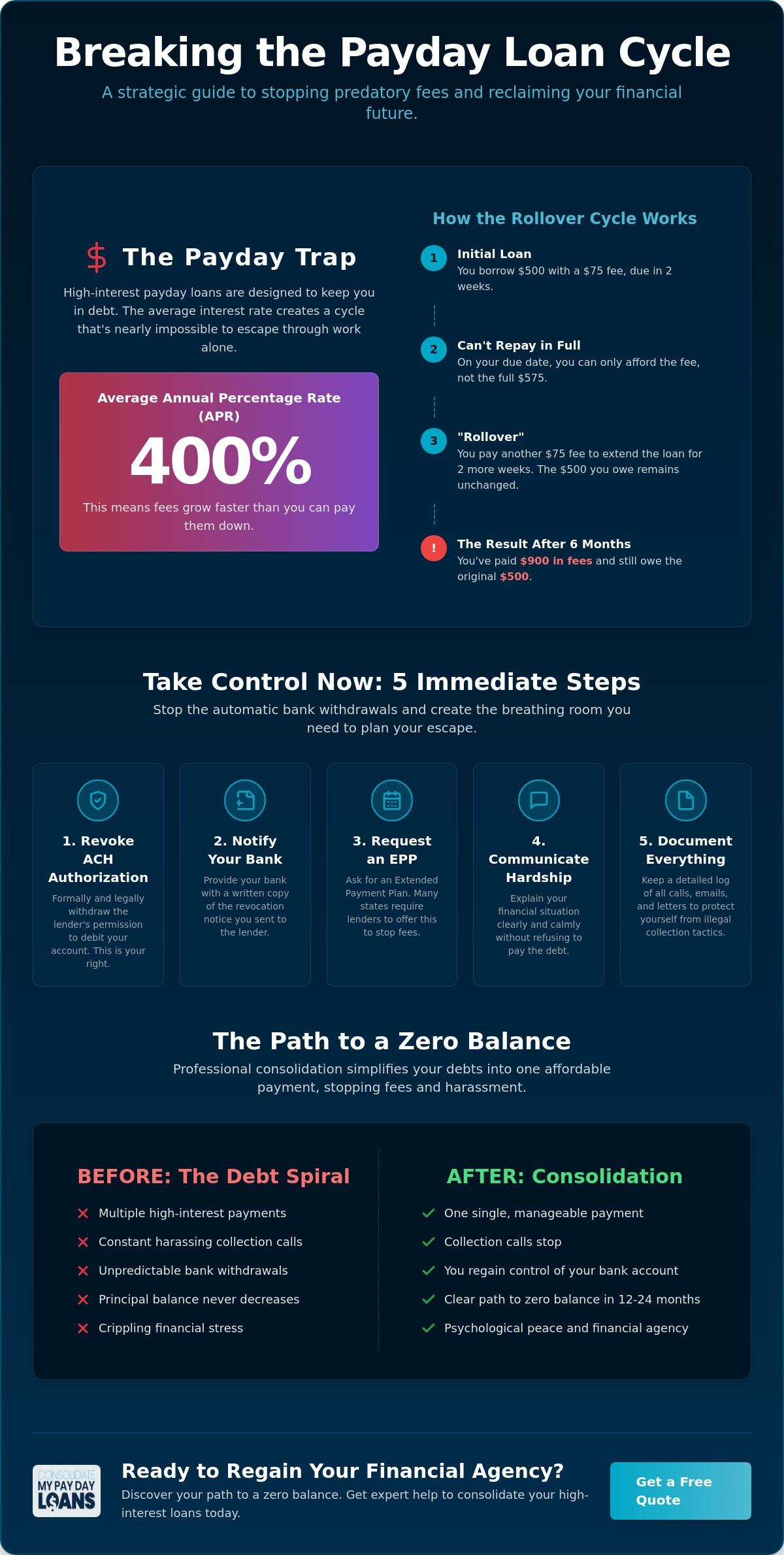
Consider a $500 loan with a $75 fee due every two weeks. If you roll that loan over for six months, you’ll have paid $900 in fees while still owing the original $500. Lenders often use “loan flipping” tactics to reset the clock on these fees, making it appear as a new transaction while your total obligation grows. The cycle of debt is a structural design, not a personal failure. Breaking this cycle is the first step in learning how to get out of high interest payday loans for good.
Why Traditional Refinancing Often Fails
Traditional banks usually reject payday loan borrowers because the debt cycle itself damages credit scores. This creates a significant barrier to recovery. Many people make the catastrophic error of taking a second payday loan to pay off the first, which only accelerates the financial collapse. Unlike a car loan or mortgage, payday loans are unsecured debt. Because there’s no asset to seize, lenders use aggressive collection tactics and constant bank drafts to secure their profit. Understanding these differences helps you see why specialized relief is often the only way forward.
Immediate Strategies to Stop the Financial Hemorrhage
The first priority in any recovery plan is stopping the bleeding. You cannot effectively strategize how to get out of high interest payday loans while a lender has unrestricted access to your checking account. This automatic bank drain is what causes the most immediate stress, often leaving families without enough money for basic survival needs like food or rent. Reclaiming your bank account is a tactical necessity that provides the breathing room required to build a long-term solution.
- Step 1: Revoke ACH Authorization. Formally withdraw your permission for the lender to stop automatic bank withdrawals.
- Step 2: Notify Your Bank. Provide your financial institution and the lender with written notification of the revocation.
- Step 3: Request an EPP. Ask for an Extended Payment Plan before your next due date to stop fees.
- Step 4: Communicate Hardship. Explain your financial situation without using language that implies a refusal to pay.
- Step 5: Document Everything. Keep a detailed log of all correspondence to prevent illegal collection tactics.
How to Legally Stop Automatic Bank Withdrawals
Under the Electronic Fund Transfer Act, you have the legal right to stop automatic payments at any time. It’s vital to understand the distinction between a “Stop Payment” and an “ACH Revocation.” A stop payment is a request to your bank to block a specific upcoming transfer, which usually involves a fee and may only work for one transaction. An ACH Revocation is a permanent legal withdrawal of your permission for the lender to access your account entirely. To do this, you must notify the lender in writing that their authorization is revoked, then provide a copy of that notice to your bank at least three business days before the scheduled transfer. If a lender continues to attempt withdrawals after receiving this notice, they are likely in violation of federal consumer rights.
Utilizing the Extended Payment Plan (EPP)
Before your next due date, you should specifically ask your lender for an Extended Payment Plan. Lenders rarely volunteer this information because it stops the accumulation of new interest and fees, allowing you to pay down the principal balance over a longer period. In many states, lenders are legally required to offer an EPP if you request it before the loan is in default. This is one of the most effective Strategies to Escape Payday Loans because it converts a high-velocity debt into a structured installment plan. If you’re feeling overwhelmed by the process, seeking professional payday loan relief can help you navigate these negotiations more effectively.
When communicating with lenders, always focus on your financial hardship. State clearly that you intend to pay but the current terms have become impossible to meet. Avoid using phrases that sound like a “refusal to pay,” as this can trigger more aggressive collection tactics. Instead, document every email, log the time of every phone call, and save copies of every letter sent. This paper trail is your best defense against illegal collection practices and ensures you have the evidence needed if you ever have to dispute a charge with your bank.
Comparing Relief Options: Consolidation vs. Settlement vs. DMPs
Once you’ve stopped the immediate drain on your bank account, the next step is choosing a long-term exit strategy. There isn’t a one-size-fits-all answer for how to get out of high interest payday loans, as the best path depends on your specific debt-to-income ratio and your long-term credit goals. You need a solution that aggressively targets the principal balance rather than just treading water with interest payments. According to Payday Loan Information from the CFPB, the high costs and short repayment windows of these loans often require a structured intervention to prevent a permanent cycle of debt.
There are three primary professional pathways to consider for your recovery:
- Payday Loan Consolidation: This involves rolling multiple high-interest debts into a single, structured monthly payment with a significantly reduced interest rate.
- Debt Settlement: A process where professional negotiators work with lenders to accept a lump-sum payment that is less than the total amount you currently owe.
- Debt Management Plans (DMPs): Usually offered by credit counselors, these plans involve negotiating with creditors to lower rates and waive fees while you pay the full principal over several years.
The Benefits of Single-Payment Consolidation
Managing five or six different payday lenders is administrative chaos. Each lender has its own due date, portal, and collection team. Consolidation simplifies your life by replacing that noise with one predictable payment. Most importantly, professional consolidation programs act as a protective shield. Once you’re enrolled, the program handles the communication, which effectively stops lender harassment and gives you the mental space to focus on your financial future. For a deeper look at how this works, read Payday Loan Consolidation: Your Path to Financial Peace.
When Debt Settlement is the Better Choice
If your debt-to-income ratio is so high that you can’t afford even a consolidated payment, settlement might be the necessary path. While settlement can impact your credit score more heavily than consolidation, it often provides the fastest exit from the debt itself. You must be cautious, though. Legitimate settlement programs don’t charge upfront fees before settling a debt. Your goal should always be to negotiate for a “Paid in Full” or “Settled in Full” status on your credit report to ensure the account is closed permanently and accurately.
Your debt-to-income (DTI) ratio is the most important metric when deciding which path to take. If your total monthly debt payments exceed 40% of your gross income, you’re in a “danger zone” where traditional DMPs might not provide enough relief. In these cases, consolidation or settlement becomes the more realistic option. Understanding how to get out of high interest payday loans is about matching the solution to the severity of your situation. Choosing the right path today prevents the need for more drastic financial measures tomorrow.
The Math of Recovery: Visualizing Your Path to Zero
Financial anxiety often thrives in the dark. When you’re unsure of exactly how much you owe or how long it will take to pay it off, the debt feels infinite. Visualizing the numbers is the first step toward reclaiming your peace of mind. By moving from abstract fear to concrete data, you can see that learning how to get out of high interest payday loans is a solvable mathematical problem rather than a lifelong sentence. Lenders rely on your confusion to keep you paying, but once you map out a recovery timeline, their leverage disappears.
A critical part of this process is identifying the hidden costs that lenders bury in the fine print. Beyond the headline APR, many predatory agreements include “verification fees,” “origination charges,” or steep penalties for missed payments that aren’t clearly disclosed. These fees act as a secondary interest rate, quietly inflating your balance even if you’re making payments. When you use a professional payday loan consolidation calculator, you can factor in these hidden costs to see your true “Debt Free” date.
Calculating Interest Savings
Consider a hypothetical scenario where a borrower has $3,000 in total debt across four different payday loans. At a typical 400% APR, the interest alone costs roughly $1,000 every month just to keep the loans from growing. In contrast, a consolidated plan might lower that rate to 30% or less. Reducing APR from 400% to 30% impacts the monthly cash flow by shifting hundreds of dollars from pure interest charges back into your pocket every single month. This allows you to use strategies like the “snowball method,” where you pay off the smallest balances first to gain momentum, or the “avalanche method,” which targets the highest interest rates to save the most money over time.
Building an Emergency Buffer During Repayment
To make the math of recovery work, you must commit to a hard rule: stop taking out new loans immediately. Every new loan resets the cycle and destroys the progress made through consolidation. Most people return to payday lenders because of a sudden, small emergency like a flat tire or a medical bill. A structured repayment plan provides the breathing room to build a “mini-emergency” fund of $500 to $1,000. Because your consolidated payment is lower than the combined original fees, you can divert the savings into a protected account. This buffer ensures that when life happens, you have the cash on hand to handle it without ever needing to step foot in a payday loan store again.
Choosing between a 12-month and a 24-month payoff timeline depends on your current income. A 12-month plan gets you to zero faster and saves more on total interest, but a 24-month plan offers a lower, more sustainable monthly payment that protects your ability to pay for essentials. You can test these different scenarios yourself using our Payday Loan Consolidation Calculator to find the exact balance that fits your budget.
Professional Payday Loan Relief: Why Expert Advocacy Matters
Trying to handle aggressive lenders on your own is exhausting. Many people spend months researching how to get out of high interest payday loans only to find themselves stuck in the same cycle of harassment and debt. This is where professional advocacy changes the dynamic. Lenders often ignore individual requests for leniency, but they respond differently to established organizations that understand the industry’s legal boundaries. By partnering with a dedicated relief service, you shift the burden of communication and negotiation to experts who know exactly how to secure better terms.
The Role of an Advocate in Debt Recovery
When you work with a professional, you move from being a “victim” of predatory lending to a “client” with professional representation. This shift is essential for your psychological well-being. Instead of dreading every phone call or notification, you can rest knowing that a protective expert is handling the heavy lifting of lender calls. At Consolidate My Payday Loans, we provide a non-judgmental environment where your financial recovery is the only priority. We act as a stable anchor, ensuring that lenders respect your rights and adhere to the guidelines set by the Fair Debt Collection Practices Act (FDCPA).
Specialized programs are designed to navigate the complexities of these laws, protecting you from threats, middle-of-the-night calls, and workplace harassment. This professional layer of protection restores your personal agency and allows you to focus on your daily life rather than your debt. It’s about more than just numbers; it’s about reclaiming the mental space that high-interest debt has occupied for far too long.
Taking the First Step Toward Financial Agency
Regaining control of your finances begins with a clear, honest assessment of your situation. During your initial consultation for payday loan relief, you’ll work with a guide who understands the pitfalls of the industry and can outline a customized methodology for your improvement. This structured approach ensures you feel informed rather than overwhelmed by the technicalities of the process. To make this transition as smooth as possible, you should gather your documents beforehand.
- Digital Contracts: Copies of your current loan agreements or screenshots of your lender portal balances.
- Bank Records: Recent statements showing the frequency and amount of automatic withdrawals.
- Collection Log: A record of any recent collection calls, including times and names of representatives.
- Budget Summary: A basic list of your monthly income and essential expenses like rent and utilities.
Having these items ready allows for a more accurate calculation of your potential savings and a faster path to a zero balance. You don’t have to navigate this turbulence alone. Expert advocacy provides the stability you need to move from a state of financial crisis to one of long-term security. Ready to stop the cycle? See how much you can save with a professional consolidation plan.
Take the Final Step Toward Financial Freedom
Breaking free from the payday loan cycle requires a shift from reactive stress to proactive management. You now have the tactical tools to stop the immediate bank drain through ACH revocation and understand that the high-interest trap is a structural hurdle, not a personal failing. By choosing a clear path, whether through an Extended Payment Plan or professional consolidation, you can finally target the principal balance rather than just the fees. This shift is the foundation of regaining your financial agency.
Learning how to get out of high interest payday loans is significantly easier when you have a dedicated advocate in your corner. Our team maintains a specialized focus on high-interest payday debt. We provide the expert negotiation needed to stop the endless rollovers and fees that keep you underwater. You don’t have to face these lenders alone or endure the pressure of constant collection calls.
Calculate your potential savings and start your relief plan today to see how quickly you can achieve a zero balance and restore your psychological peace. You’ve already taken the most difficult step by getting informed. Now it’s time to put this knowledge into action and move toward the debt-free life you deserve.
Frequently Asked Questions
Is it possible to consolidate payday loans with bad credit?
Yes, you can absolutely consolidate these debts even if your credit score is low. Professional payday loan consolidation programs don’t typically function like a traditional bank loan that requires a high credit score for approval. Instead, these programs focus on your current income and your ability to commit to a single, lower monthly payment. This allows you to manage multiple high-interest obligations without the barrier of a credit check.
What happens if I stop paying my payday loans without a plan?
Stopping payments without a structured exit strategy often leads to aggressive collection efforts and financial instability. Lenders will likely attempt frequent bank withdrawals, which can trigger multiple overdraft fees and drain your account. You’ll also face persistent, harassing calls at home and work. Eventually, the lender may sell your debt to a third-party collection agency, which can significantly damage your credit report for several years. To fully understand the legal and financial consequences you may face, review this detailed breakdown of what happens if you don’t pay back a payday loan before making any decisions.
Can a payday lender sue me or take me to court?
Yes, a payday lender has the legal right to sue you in civil court to recover the unpaid balance. If the lender wins the lawsuit and obtains a judgment, they may be able to garnish your wages or place a lien on your property, depending on your state’s laws. It’s vital to remember that they cannot have you arrested or sent to jail, as failing to pay a civil debt is not a criminal offense.
How do I legally stop a payday lender from taking money from my bank account?
You can legally stop these withdrawals by providing the lender with a written “ACH Revocation” notice and notifying your bank at least three business days before the next scheduled payment. This is a federal right guaranteed under the Electronic Fund Transfer Act. Once you’ve revoked this authorization, the lender no longer has permission to draft your account, which effectively stops the “bank drain” and gives you control over your paycheck.
Will payday loan consolidation hurt my credit score?
Consolidation can actually help your credit standing over time by replacing multiple delinquent accounts with a single, consistent payment history. While you might see a small initial dip if several accounts are closed simultaneously, the long-term reduction in your debt-to-income ratio is highly beneficial. It’s a strategic move for anyone researching how to get out of high interest payday loans while aiming to rebuild their financial reputation through professional management.
How long does it typically take to get out of payday loan debt?
Most professional relief programs are designed to help you achieve a zero balance within 12 to 24 months. The exact timeline depends on the total amount of debt you’ve accumulated and the monthly payment you can realistically afford. A 12-month plan is faster and saves more on interest, while a 24-month plan offers a more manageable monthly cost for individuals who need to protect their cash flow for essential living expenses.
Are there government programs for payday loan relief?
There are no federal grants that pay off individual debt, but there are significant government regulations that protect your rights. The Consumer Financial Protection Bureau (CFPB) enforces rules regarding bank withdrawals and interest rate transparency. Additionally, many federal credit unions offer Payday Alternative Loans (PALs) with interest rates capped at 28%. These are safer, regulated options for those who qualify and need to move away from predatory, triple-digit interest rates.
What is the difference between a payday loan and a personal loan?
The primary differences are the total cost and the length of the repayment term. Payday loans are ultra-short-term products with APRs often exceeding 400%, while personal loans from traditional banks usually have APRs between 6% and 36% with several years to repay. Understanding these differences is essential when learning how to get out of high interest payday loans, as it helps you recognize why transitioning to a structured, lower-interest installment plan is safer.