
Reviewed by Nela Diaz — Negotiations Manager, Solid Ground Financial. [Last reviewed: July 8, 2026]
Did you know that over 80% of payday loans are rolled over into new loans, trapping millions of Americans in a cycle that feels impossible to break? It’s exhausting to watch your bank account dwindle every payday as predatory interest rates, sometimes exceeding 400% APR, consume your hard-earned income. You’re likely tired of the constant fear of wage garnishment or the relentless pressure from creditors. When you’re ready to stop the bleeding, the most important decision you’ll make is choosing between debt settlement vs consolidation for payday loans.
We understand the stress of facing financial turbulence and want to help you find a stable anchor. This guide will help you discover the critical differences between payday loan settlement and consolidation to choose the most effective path toward permanent financial relief. We’ll break down the mechanics of each strategy, explaining how to replace multiple high-interest traps with a single, manageable monthly payment. By the end, you’ll have the insider knowledge needed to silence the harassment and finally reclaim your personal agency. It’s time to stop the cycle of fees and start your journey toward true psychological peace.
Key Takeaways
- Learn the fundamental differences between grouping your debts into one structured plan and negotiating with lenders to accept a reduced balance.
- Understand the long-term trade-offs of debt settlement vs consolidation for payday loans, specifically how each path affects your credit score and future borrowing power.
- Identify the specific cash flow indicators that determine whether your financial reality requires a proactive consolidation or a reactive settlement rescue mission.
- Discover the immediate steps to protect your assets, including how to exercise your legal rights under the Electronic Fund Transfer Act to stop automatic bank withdrawals.
- Explore why specialized relief organizations serve as a stable anchor, often securing better cooperation from payday lenders than individuals can achieve alone.
Understanding the Mechanics: Payday Loan Debt Settlement vs. Consolidation
Choosing the right exit strategy requires a clear view of how these two paths operate. When evaluating debt settlement vs consolidation for payday loans, you’re essentially choosing between a proactive restructuring of your debt and a reactive negotiation to reduce the total amount you owe. Payday loans are fundamentally different from standard unsecured debt. Their short-term nature and extreme interest rates, often exceeding 400% APR, create a velocity of debt that standard relief methods often fail to catch. Both paths aim to stop the bleeding of predatory fees, but they take very different routes to get there.
Understanding Debt Consolidation is the first step in regaining control over your finances. While many people think of consolidation as just another loan, it’s actually a strategic grouping of multiple high-interest obligations into one manageable plan. Payday lenders use automatic ACH withdrawals to deplete your account the moment your paycheck hits, creating a survival crisis that requires a specialized approach. You aren’t just managing debt; you’re fighting for your daily liquidity and peace of mind.
How Payday Loan Consolidation Works
Consolidation is about moving from chaos to order. Instead of juggling four or five different lenders with weekly or bi-weekly due dates, you transition to a single monthly installment. This strategy focuses heavily on interest rate reduction and principal repayment. For many, a specialized payday loan relief program acts as the vehicle for this transition. Unlike a traditional personal loan, which often requires a high credit score, these programs focus on managing existing lenders through a coordinated repayment schedule. You gain a predictable path forward, allowing you to breathe again while your principal balance actually begins to drop.
The Mechanics of Payday Loan Debt Settlement
The core of debt settlement is negotiating with lenders to accept a lump sum or a structured payment plan for less than the full balance. It’s a rescue mission for those at the breaking point. To gain negotiation leverage, borrowers often stop payments, which can trigger aggressive collection efforts. This is where the debt settlement vs consolidation for payday loans debate becomes critical. A third-party negotiator steps in to reach an agreement, aiming for significant principal reduction rather than just interest management. While this path can be more stressful, it’s a powerful tool for those who need a fresh start and cannot afford to pay back the full original amount plus accrued fees.
Comparing the Impact: Credit Score, Total Cost, and Creditor Relations
The choice you make today echoes through your credit report for years. While both strategies aim to stop the 400% APR nightmare, their impact on your financial reputation varies significantly. Consolidation acts as a protective shield, preserving your standing while you systematically dismantle the debt. Settlement, by contrast, is a heavy-duty tool often used when the walls are closing in. Understanding the nuances of debt settlement vs. consolidation ensures you don’t trade one crisis for another. You’re fighting for your future agency, not just a lower balance.
Credit Score Consequences: Preservation vs. Recovery
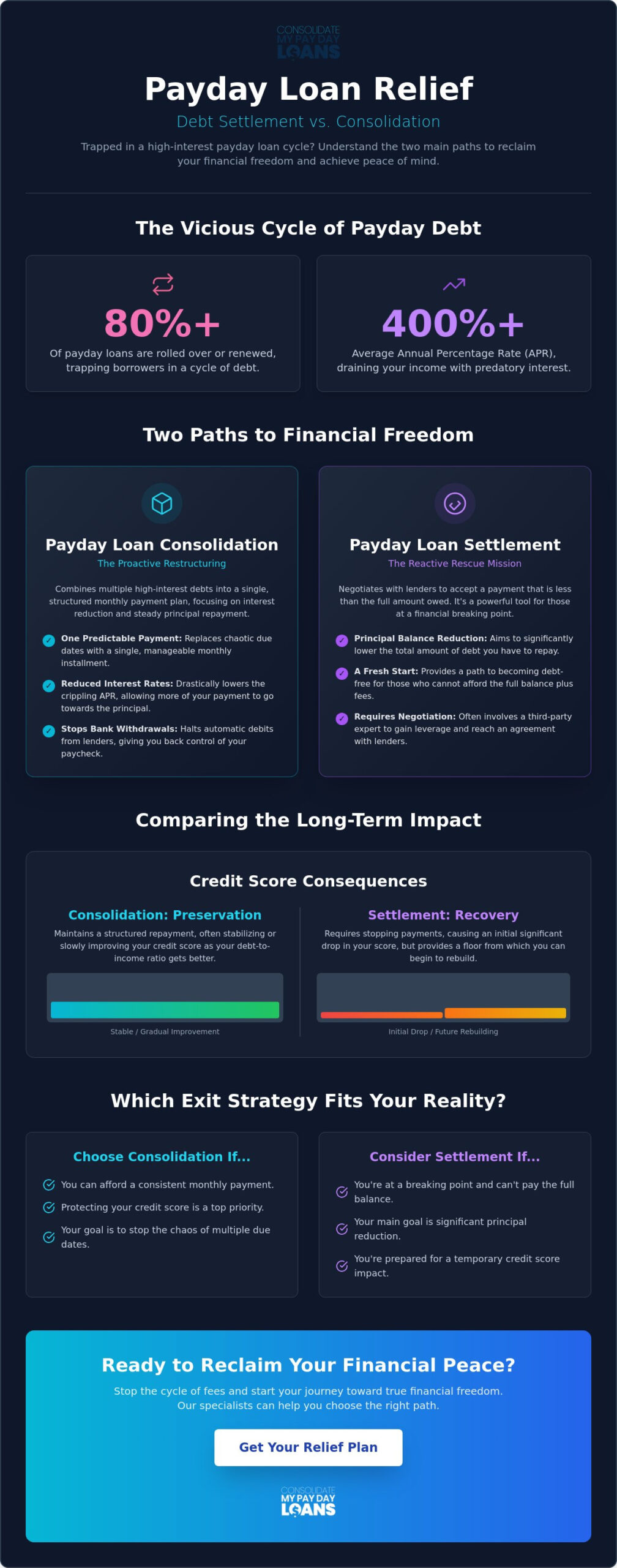
Consolidation is generally the “quieter” path for your credit score. Because you’re maintaining a structured repayment schedule, your score often remains stable or even begins a slow climb as your debt-to-income ratio improves. Settlement requires a different, more aggressive stance. To get lenders to agree to take less than what is owed, you typically have to stop payments. This triggers late marks and increases the “charge-off” risk, where a lender writes off the debt as uncollectible. While settlement causes an immediate, significant drop in your score, it provides a floor for those who would otherwise face years of default.
Total Cost of Borrowing: Interest Savings vs. Principal Reduction
The math of debt settlement vs consolidation for payday loans reveals two different types of savings. A 12-month consolidation plan focuses on eliminating those soul-crushing interest rates, ensuring every dollar you pay actually hits the principal. You can see how this math changes your outlook by using a payday loan consolidation calculator to visualize your path to zero. Settlement seeks a deeper cut by reducing the principal itself. However, settlement comes with hidden variables. The IRS may view forgiven debt as taxable income, potentially resulting in a 1099-C form at year-end. You must weigh the immediate reduction against these long-term obligations.
Credit recovery is the systematic process of replacing high-risk default patterns with consistent, documented repayment history to rebuild your financial reputation. You aren’t just paying back money; you’re buying back your future. If the stress of multiple withdrawals is reaching a breaking point, exploring professional relief options can provide the clarity you need to move forward. Breaking the cycle requires a plan that respects both your current cash flow and your long-term goals.
Choosing Your Exit Strategy: Which Path Fits Your Financial Reality?
Your bank account balance on Friday morning usually dictates your next move. Deciding on debt settlement vs consolidation for payday loans isn’t just a math problem; it’s a reflection of your current survival capacity. If you’re managing three or more lenders, the administrative burden alone can lead to missed payments and spiraling fees. You need to ask yourself whether you need a “clean-up” to protect your credit or a “fresh start” because your present situation is unsustainable. We see this choice as a pivot point toward regaining your personal agency.
The CFPB explanation of debt relief options highlights that these paths serve different financial realities. Consolidation works best when you still have some breathing room. Settlement is the emergency brake. Your decision should be based on a cold, hard look at your remaining cash flow after your essential bills are paid.
When Consolidation is the Superior Choice
Consolidation is the ideal path if you’ve maintained a steady income but simply can’t keep up with the “rollover” fees. It’s built for individuals who can afford a single, lower monthly payment but need the interest rates slashed to make real progress. If you plan on buying a home or financing a car in the next few years, consolidation is your best bet. It avoids the damaging “settled for less than full balance” mark on your credit report. You’re essentially choosing to honor the principal while stripping away the predatory interest that keeps you stuck.
When Debt Settlement Becomes the Necessary Last Resort
Sometimes the math just doesn’t work. If your total payday debt far exceeds your annual income, or if you’ve already defaulted and are dodging calls from collection agencies, settlement becomes the necessary rescue mission. It’s for the borrower whose cash flow is so restricted that full repayment is a mathematical impossibility. While it carries more emotional weight and a temporary credit hit, it provides a definitive end date for those who are drowning. It’s a tough choice, but often the only way to stop the depletion of your bank account.
To help you decide which path fits your reality, consider this simple framework:
- Choose Consolidation if: You have a stable income, want to protect your credit score, and can manage one monthly payment.
- Choose Settlement if: You’re already in default, your debt is overwhelming compared to your earnings, and you need a significant reduction in the total amount owed to survive.
Executing Your Relief Plan: From ACH Revocation to Single Payments
Taking the first step toward financial recovery requires more than just a decision; it requires immediate defensive action. Before you commit to debt settlement vs consolidation for payday loans, you must secure your remaining assets. Payday lenders often rely on their ability to reach directly into your bank account, a practice that keeps you in a state of constant emergency. Reclaiming control of your cash flow is the only way to ensure you have the funds necessary to fuel your relief plan. ACH revocation is a legal right granted to every consumer under federal law, specifically the Electronic Fund Transfer Act.
Stopping the Bleeding: Revoking ACH Authorizations
You don’t have to wait for a lender’s permission to stop the withdrawals. Stopping payday loan automatic withdrawals is the critical first step to stability. First, notify the lender in writing that you are revoking their authorization to debit your account. Second, contact your bank or credit union to inform them that you have revoked this authorization. Under federal law, your bank must honor this request if provided with proper notice. If a lender ignores your revocation and attempts to pull funds anyway, your bank can place a stop payment on those specific entries. This process creates a necessary barrier between your income and the predatory interest rates that threaten your survival. If you’re looking for proven strategies to lower payday loan payments while protecting your bank account, understanding ACH revocation is an essential first move.
Navigating the Negotiation Process with Lenders
Once you’ve secured your account, the focus shifts to communication. Document every interaction, including dates, times, and the names of representatives. This paper trail is vital for preventing harassment and holding lenders accountable. Be cautious when initiating contact. In some jurisdictions, making a partial payment or acknowledging a debt in writing can reset the statute of limitations, potentially extending the time a lender has to sue you. This risk is why many borrowers find that professional management yields better results than “DIY” negotiation. While lenders may offer internal hardship programs, these are often just temporary Band-Aids that keep you in the debt cycle. A professional relief organization acts as a stable anchor, using established relationships to secure terms that actually lead to a zero balance. If you’re ready to move from defense to offense, speaking with a professional about payday loan relief can help you execute a plan that sticks.
Professional Relief: Why Specialized Payday Loan Management Matters
Deciding on the best path between debt settlement vs consolidation for payday loans becomes much simpler when you have a dedicated advocate in your corner. Lenders often show more willingness to cooperate with established relief organizations than with individual borrowers. This cooperation stems from years of industry experience and a deep understanding of the regulatory environment. When a professional organization steps in, it signals to the lender that the cycle of endless renewals has reached its end. We act as your stable anchor, providing the firm ground you need to stand on while the financial turbulence subsides. You aren’t alone in this fight.
Professional consolidators bring a level of insider knowledge that is difficult to replicate on your own. They understand the specific tactics payday lenders use to keep borrowers trapped in a cycle of high-interest debt. By leveraging this expertise, a structured relief plan restores your personal agency. You move from a defensive position of dodging calls to a proactive stance of following a verified methodology for improvement. This structured approach ensures that you feel guided rather than overwhelmed by the technicalities of the process.
The Advantage of a Structured Consolidation Program
Managing multiple payday loans is an exhausting mental burden. The constant tracking of different due dates and withdrawal amounts creates a state of perpetual stress. A payday loan consolidation service simplifies this entire process by replacing the chaos with one predictable payment. Professional programs are specifically designed to handle pushback from predatory lenders who may try to ignore your legal rights. These experts act as a protective barrier, ensuring that your repayment plan is respected and that your bank account remains secure from unauthorized access.
Beyond the Payment: Long-Term Financial Stability
Financial relief is about more than just balancing a ledger. It’s about the tangible benefit of regaining control over your daily life. Once the harassment stops and the fees are frozen, you can finally move from a state of survival to a state of growth. The psychological peace that comes with knowing exactly when your debt will be gone is life-changing. You can start looking toward wealth building and long-term security instead of wondering how you’ll cover next week’s bills. Don’t let another payday pass under the shadow of predatory lending. Take the first step toward your fresh start and explore your payday loan relief options today.
Take the First Step Toward Permanent Financial Peace
Breaking free from high-interest debt requires a clear strategy and a dedicated ally. Whether you’ve decided that a proactive clean-up or a reactive fresh start fits your reality, understanding the nuances of debt settlement vs consolidation for payday loans is your most powerful tool for recovery. By securing your bank account through ACH revocation and choosing a structured path forward, you can finally silence the harassment and stop the depletion of your income. You don’t have to navigate these complex financial traps alone.
With 20+ years of debt management expertise, we provide specialized payday loan relief programs designed to act as a stable anchor during your recovery. Our advocate-led support is entirely non-judgmental; we focus on your tangible progress and psychological relief. It’s time to reclaim your personal agency and move beyond the burden of predatory fees. Calculate your potential savings and start your path to relief today. You have the power to end the cycle and build a secure financial future starting now.
Frequently Asked Questions
Is debt settlement better than consolidation for payday loans?
The better choice depends entirely on your current financial health and credit goals. When comparing debt settlement vs consolidation for payday loans, consolidation is usually the superior choice if you can afford a single, lower monthly payment and want to protect your credit score. Settlement is a reactive rescue mission designed for those who have already defaulted or simply cannot pay back the full principal due to extreme hardship.
Will consolidating my payday loans hurt my credit score?
Consolidation typically helps or stabilizes your credit score over time. Because the process focuses on systematic repayment rather than defaulting, you avoid the late marks and charge-offs that destroy your rating. As you reduce your total debt-to-income ratio through a structured plan, you’ll likely see your score begin to recover from the damage caused by the initial high-interest borrowing cycle.
Can I settle a payday loan without using a debt relief company?
You can negotiate directly with lenders, but it’s often difficult for individuals to achieve significant reductions alone. Lenders are accustomed to aggressive collection tactics and may ignore your requests for a hardship plan. Professional relief organizations use established relationships and industry knowledge to secure terms that individuals rarely get. They act as a protective barrier, handling the predatory pushback so you don’t have to.
How much can I save by consolidating my payday loans?
Your primary savings come from eliminating the predatory interest rates that often exceed 400% APR. By stopping the cycle of renewals and rollover fees, every dollar you pay actually begins to reduce your principal balance. While we don’t quote specific dollar amounts, most borrowers find that moving to a single monthly payment significantly increases their daily cash flow and ends the constant depletion of their bank accounts.
What happens if I stop paying my payday loans to settle them?
Stopping payments provides negotiation leverage but triggers aggressive collection efforts and a significant drop in your credit score. You’ll likely face frequent calls and letters from lenders or third-party collectors. It’s vital to revoke your ACH authorizations before taking this path to prevent lenders from draining your account. This strategy is a “fresh start” move that trades temporary credit damage for a lower total payout.
Can payday lenders garnish my wages if I choose consolidation?
Lenders won’t pursue wage garnishment if you’re actively participating in a consolidation program. Garnishment is a legal process that requires a court order, which is a last resort for lenders when a borrower stops communicating entirely. By choosing a structured repayment plan, you demonstrate a commitment to resolving the debt. This proactive stance effectively removes the threat of legal action or the fear of your employer being contacted.
How long does the payday loan consolidation process take?
The initial setup for a relief program usually happens within a few business days. Once your plan is active, the total journey to a zero balance typically lasts between 6 and 18 months. This timeline depends on the total number of lenders involved and your available monthly cash flow. It’s a methodical process designed to provide immediate relief while building a predictable path toward permanent financial freedom.
Are there legitimate payday loan debt settlement companies?
Legitimate companies exist, but they must follow strict federal and various state regulations. These regulations often include requirements for licensing, registration, and prohibitions against illegal upfront fees. Always ensure your provider offers a written agreement and has a documented history of successfully navigating the predatory lending industry.